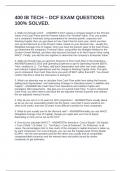
400 IB TECH – DCF EXAM QUESTIONS
100% SOLVED.
1. Walk me through a DCF. - ANSWER"A DCF values a company based on the Present
Value of its Cash Flows and the Present Value of its Terminal Value. First, you project
out a company's financials using assumptions for revenue growth, expenses and
Working Capital; then you get down to Free Cash Flow for each year, which you then
sum up and discount to a Net Present Value, based on your discount rate - usually the
Weighted Average Cost of Capital. Once you have the present value of the Cash Flows,
you determine the company's Terminal Value, using either the Multiples Method or the
Gordon Growth Method, and then also discount that back to its Net Present Value using
WACC. Finally, you add the two together to determine the company's Enterprise Value."
2. Walk me through how you get from Revenue to Free Cash Flow in the projections. -
ANSWERSubtract COGS and Operating Expenses to get to Operating Income (EBIT).
Then, multiply by (1 - Tax Rate), add back Depreciation and other non-cash charges,
and subtract Capital Expenditures and the change in Working Capital. Note: This gets
you to Unlevered Free Cash Flow since you went off EBIT rather than EBT. You should
confirm that this is what the interviewer is asking for.
3. What's an alternate way to calculate Free Cash Flow aside from taking Net Income,
adding back Depreciation, and subtracting Changes in Operating Assets / Liabilities and
CapEx? - ANSWERTake Cash Flow From Operations and subtract CapEx and
mandatory debt repayments - that gets you to Levered Cash Flow. To get to Unlevered
Cash Flow, you then need to add back the tax-adjusted Interest Expense and subtract
the tax-adjusted Interest Income.
4. Why do you use 5 or 10 years for DCF projections? - ANSWERThat's usually about
as far as you can reasonably predict into the future. Less than 5 years would be too
short to be useful, and over 10 years is too difficult to predict for most companies.
5. What do you usually use for the discount rate? - ANSWERNormally you use WACC
(Weighted Average Cost of Capital), though you might also use Cost of Equity
depending on how you've set up the DCF.
6. How do you calculate WACC? - ANSWERThe formula is: Cost of Equity * (% Equity)
+ Cost of Debt * (% Debt) * (1 - Tax Rate) + Cost of Preferred * (% Preferred). In all
cases, the percentages refer to how much of the company's capital structure is taken up
by each component. For Cost of Equity, you can use the Capital Asset Pricing Model
(CAPM - see the next question) and for the others you usually look at comparable
companies/debt issuances and the interest rates and yields issued by similar
companies to get estimates.
, 7. How do you calculate the Cost of Equity? - ANSWERCost of Equity = Risk-Free Rate
+ Beta * Equity Risk Premium The risk-free rate represents how much a 10-year or 20-
year US Treasury should yield; Beta is calculated based on the "riskiness" of
Comparable Companies and the Equity Risk Premium is the % by which stocks are
expected to out-perform "risk-less" assets. Normally you pull the Equity Risk Premium
from a publication called Ibbotson's. Note: This formula does not tell the whole story.
Depending on the bank and how precise you want to be, you could also add in a "size
premium" and "industry premium" to account for how much a company is expected to
out-perform its peers is according to its market cap or industry. Small company stocks
are expected to out-perform large company stocks and certain industries are expected
to out-perform others, and these premiums reflect these expectations.
8. How do you get to Beta in the Cost of Equity calculation? - ANSWERYou look up the
Beta for each Comparable Company (usually on Bloomberg), un-lever each one, take
the median of the set and then lever it based on your company's capital structure. Then
you use this Levered Beta in the Cost of Equity calculation. For your reference, the
formulas for un-levering and re-levering Beta are below: Un-Levered Beta = Levered
Beta / (1 + ((1 - Tax Rate) x (Total Debt/Equity))) Levered Beta = Un-Levered Beta x (1
+ ((1 - Tax Rate) x (Total Debt/Equity)))
9. Why do you have to un-lever and re-lever Beta? - ANSWERAgain, keep in mind our
"apples-to-apples" theme. When you look up the Betas on Bloomberg (or from whatever
source you're using) they will be levered to reflect the debt already assumed by each
company. But each company's capital structure is different and we want to look at how
"risky" a company is regardless of what % debt or equity it has. To get that, we need to
un-lever Beta each time. But at the end of the calculation, we need to re-lever it
because we want the Beta used in the Cost of Equity calculation to reflect the true risk
of our company, taking into account its capital structure this time.
10. Would you expect a manufacturing company or a technology company to have a
higher Beta? - ANSWERA technology company, because technology is viewed as a
"riskier" industry than manufacturing.
11. Let's say that you use Levered Free Cash Flow rather than Unlevered Free Cash
Flow in your DCF - what is the effect? - ANSWERLevered Free Cash Flow gives you
Equity Value rather than Enterprise Value, since the cash flow is only available to equity
investors (debt investors have already been "paid" with the interest payments).
12. If you use Levered Free Cash Flow, what should you use as the Discount Rate? -
ANSWERYou would use the Cost of Equity rather than WACC since we're not
concerned with Debt or Preferred Stock in this case - we're calculating Equity Value, not
Enterprise Value.
13. How do you calculate the Terminal Value? - ANSWERYou can either apply an exit
multiple to the company's Year 5 EBITDA, EBIT or Free Cash Flow (Multiples Method)
or you can use the Gordon Growth method to estimate its value based on its growth
100% SOLVED.
1. Walk me through a DCF. - ANSWER"A DCF values a company based on the Present
Value of its Cash Flows and the Present Value of its Terminal Value. First, you project
out a company's financials using assumptions for revenue growth, expenses and
Working Capital; then you get down to Free Cash Flow for each year, which you then
sum up and discount to a Net Present Value, based on your discount rate - usually the
Weighted Average Cost of Capital. Once you have the present value of the Cash Flows,
you determine the company's Terminal Value, using either the Multiples Method or the
Gordon Growth Method, and then also discount that back to its Net Present Value using
WACC. Finally, you add the two together to determine the company's Enterprise Value."
2. Walk me through how you get from Revenue to Free Cash Flow in the projections. -
ANSWERSubtract COGS and Operating Expenses to get to Operating Income (EBIT).
Then, multiply by (1 - Tax Rate), add back Depreciation and other non-cash charges,
and subtract Capital Expenditures and the change in Working Capital. Note: This gets
you to Unlevered Free Cash Flow since you went off EBIT rather than EBT. You should
confirm that this is what the interviewer is asking for.
3. What's an alternate way to calculate Free Cash Flow aside from taking Net Income,
adding back Depreciation, and subtracting Changes in Operating Assets / Liabilities and
CapEx? - ANSWERTake Cash Flow From Operations and subtract CapEx and
mandatory debt repayments - that gets you to Levered Cash Flow. To get to Unlevered
Cash Flow, you then need to add back the tax-adjusted Interest Expense and subtract
the tax-adjusted Interest Income.
4. Why do you use 5 or 10 years for DCF projections? - ANSWERThat's usually about
as far as you can reasonably predict into the future. Less than 5 years would be too
short to be useful, and over 10 years is too difficult to predict for most companies.
5. What do you usually use for the discount rate? - ANSWERNormally you use WACC
(Weighted Average Cost of Capital), though you might also use Cost of Equity
depending on how you've set up the DCF.
6. How do you calculate WACC? - ANSWERThe formula is: Cost of Equity * (% Equity)
+ Cost of Debt * (% Debt) * (1 - Tax Rate) + Cost of Preferred * (% Preferred). In all
cases, the percentages refer to how much of the company's capital structure is taken up
by each component. For Cost of Equity, you can use the Capital Asset Pricing Model
(CAPM - see the next question) and for the others you usually look at comparable
companies/debt issuances and the interest rates and yields issued by similar
companies to get estimates.
, 7. How do you calculate the Cost of Equity? - ANSWERCost of Equity = Risk-Free Rate
+ Beta * Equity Risk Premium The risk-free rate represents how much a 10-year or 20-
year US Treasury should yield; Beta is calculated based on the "riskiness" of
Comparable Companies and the Equity Risk Premium is the % by which stocks are
expected to out-perform "risk-less" assets. Normally you pull the Equity Risk Premium
from a publication called Ibbotson's. Note: This formula does not tell the whole story.
Depending on the bank and how precise you want to be, you could also add in a "size
premium" and "industry premium" to account for how much a company is expected to
out-perform its peers is according to its market cap or industry. Small company stocks
are expected to out-perform large company stocks and certain industries are expected
to out-perform others, and these premiums reflect these expectations.
8. How do you get to Beta in the Cost of Equity calculation? - ANSWERYou look up the
Beta for each Comparable Company (usually on Bloomberg), un-lever each one, take
the median of the set and then lever it based on your company's capital structure. Then
you use this Levered Beta in the Cost of Equity calculation. For your reference, the
formulas for un-levering and re-levering Beta are below: Un-Levered Beta = Levered
Beta / (1 + ((1 - Tax Rate) x (Total Debt/Equity))) Levered Beta = Un-Levered Beta x (1
+ ((1 - Tax Rate) x (Total Debt/Equity)))
9. Why do you have to un-lever and re-lever Beta? - ANSWERAgain, keep in mind our
"apples-to-apples" theme. When you look up the Betas on Bloomberg (or from whatever
source you're using) they will be levered to reflect the debt already assumed by each
company. But each company's capital structure is different and we want to look at how
"risky" a company is regardless of what % debt or equity it has. To get that, we need to
un-lever Beta each time. But at the end of the calculation, we need to re-lever it
because we want the Beta used in the Cost of Equity calculation to reflect the true risk
of our company, taking into account its capital structure this time.
10. Would you expect a manufacturing company or a technology company to have a
higher Beta? - ANSWERA technology company, because technology is viewed as a
"riskier" industry than manufacturing.
11. Let's say that you use Levered Free Cash Flow rather than Unlevered Free Cash
Flow in your DCF - what is the effect? - ANSWERLevered Free Cash Flow gives you
Equity Value rather than Enterprise Value, since the cash flow is only available to equity
investors (debt investors have already been "paid" with the interest payments).
12. If you use Levered Free Cash Flow, what should you use as the Discount Rate? -
ANSWERYou would use the Cost of Equity rather than WACC since we're not
concerned with Debt or Preferred Stock in this case - we're calculating Equity Value, not
Enterprise Value.
13. How do you calculate the Terminal Value? - ANSWERYou can either apply an exit
multiple to the company's Year 5 EBITDA, EBIT or Free Cash Flow (Multiples Method)
or you can use the Gordon Growth method to estimate its value based on its growth