CAPA Certification Study Guide
Questions with Complete Solutions
(Latest 2025)
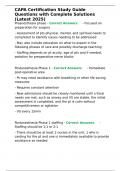
Preanesthesia phase - Correct Answers ✅- Focused on
preparation for surgery
- Assessment of pts physical, mental, and spiritual needs to
completed to identify issues needing to be addressed
- May also include education on what to expect in the
following phases of care and possibly discharge teaching
- Staffing depends on pt acuity, age of pts and if needed,
sedation for preoperative nerve blocks
Postanesthesia Phase 1 - Correct Answers ✅- Immediate
post-operative area
- Pt may need assistance with breathing or other life saving
measures
- Requires constant attention
- New admissions should be closely monitored until critical
needs are met, such as airway and VS are stable, the initial
assessment is completed, and the pt is calm without
competitiveness or agitation
- VS every 15min
Postanesthesia Phase 1 staffing - Correct Answers ✅-
Staffing should be 1:1 or 2:1
- There should be at least 2 nurses in the unit, 1 who is
carding for the pt and one is immediately available to provide
assistance as needed
,CAPA Certification Study Guide
Questions with Complete Solutions
(Latest 2025)
- 1 nurse in the unit must be competent in phase 1
- The nurse may have 2 pts if both are hemodynamically
stable, conscious, over age 8, or under 8 with
family/caregiver at bedside
- The nurse may have 1 pt if under 8 years old and
unconscious
- The nurse may have 1 pt who is not conscious but
hemodynamically stable, with a stable airway over the age of
8 and 1 pt who is conscious and stable
- Occasionally 1 pt who is critical and unstable may require 2
nurses
Postanesthesia phase 2 - Correct Answers ✅- The pts in
this area are preparing to go home
- Here pt receives discharge instructions
- Still requires monitoring for complications related to surgery
or medications
- VS every 30-60min (at arrival and discharge)
Postanesthesia phase 2 staffing - Correct Answers ✅- 1:3 if
over the age of 8 or under 8 with family present
- if the pt is under 8 w/out family, ration should be 1:2
- 2 staff members are required to be in the unit at all times (1
RN competent in phase 2)
,CAPA Certification Study Guide
Questions with Complete Solutions
(Latest 2025)
- Staffing will be 1 nurse to 1 pt if pt becomes unstable and
requires transfer to higher level of care
Extended care - Correct Answers ✅- Area where pts
require extended observation after discharge from phase 2
- Staffing should be 1:3-5
- These pts are typically waiting for transport home/inpt bed
- 2 staff members should be in the unit at all times (1 RN who
is competent in caring for pt population)
Blended care - Correct Answers ✅- Care of pts who belong
in multiple phases of care
- Clinical judgement is required to determine safe staffing
- Pts in different levels may share same physical space
- An effort must be made to ensure privacy and
confidentiality
Recommendations to combat alarm fatigue - Correct
Answers ✅- Identify important alarms
- Develop policies that identify when alarms can be disabled
- Use alarms that change back to default settings when the pt
is discharged from device
- Adjust the alarms to the pt needs
, CAPA Certification Study Guide
Questions with Complete Solutions
(Latest 2025)
Capnography - Correct Answers ✅- Can detect early
hypoxia to allow correction of hypoventilation, apnea, or
airway obstruction
- Can be used in areas other than operating rooms for
procedures or peripheral nerve blocks
- Can increase safety for pts when included with use of pulse
ox
- O2 supplementation may correct for pulse ox readings but
may mask hypoventilation
Minimal sedation, anxiolysis - Correct Answers ✅- Pt
responds normally
- Coordination may be impaired
- Pt is able to maintain airway
Moderate sedation, analgesia - Correct Answers ✅-
"Conscious sedation"
- Pt has depressed level of consciousness but can respond to
verbal commands or light touch
- Can maintain their own airway
Deep sedation, analgesia - Correct Answers ✅- Pt responds
purposefully to painful stimulation
- Pt may not be able to maintain their own airway
Questions with Complete Solutions
(Latest 2025)
Preanesthesia phase - Correct Answers ✅- Focused on
preparation for surgery
- Assessment of pts physical, mental, and spiritual needs to
completed to identify issues needing to be addressed
- May also include education on what to expect in the
following phases of care and possibly discharge teaching
- Staffing depends on pt acuity, age of pts and if needed,
sedation for preoperative nerve blocks
Postanesthesia Phase 1 - Correct Answers ✅- Immediate
post-operative area
- Pt may need assistance with breathing or other life saving
measures
- Requires constant attention
- New admissions should be closely monitored until critical
needs are met, such as airway and VS are stable, the initial
assessment is completed, and the pt is calm without
competitiveness or agitation
- VS every 15min
Postanesthesia Phase 1 staffing - Correct Answers ✅-
Staffing should be 1:1 or 2:1
- There should be at least 2 nurses in the unit, 1 who is
carding for the pt and one is immediately available to provide
assistance as needed
,CAPA Certification Study Guide
Questions with Complete Solutions
(Latest 2025)
- 1 nurse in the unit must be competent in phase 1
- The nurse may have 2 pts if both are hemodynamically
stable, conscious, over age 8, or under 8 with
family/caregiver at bedside
- The nurse may have 1 pt if under 8 years old and
unconscious
- The nurse may have 1 pt who is not conscious but
hemodynamically stable, with a stable airway over the age of
8 and 1 pt who is conscious and stable
- Occasionally 1 pt who is critical and unstable may require 2
nurses
Postanesthesia phase 2 - Correct Answers ✅- The pts in
this area are preparing to go home
- Here pt receives discharge instructions
- Still requires monitoring for complications related to surgery
or medications
- VS every 30-60min (at arrival and discharge)
Postanesthesia phase 2 staffing - Correct Answers ✅- 1:3 if
over the age of 8 or under 8 with family present
- if the pt is under 8 w/out family, ration should be 1:2
- 2 staff members are required to be in the unit at all times (1
RN competent in phase 2)
,CAPA Certification Study Guide
Questions with Complete Solutions
(Latest 2025)
- Staffing will be 1 nurse to 1 pt if pt becomes unstable and
requires transfer to higher level of care
Extended care - Correct Answers ✅- Area where pts
require extended observation after discharge from phase 2
- Staffing should be 1:3-5
- These pts are typically waiting for transport home/inpt bed
- 2 staff members should be in the unit at all times (1 RN who
is competent in caring for pt population)
Blended care - Correct Answers ✅- Care of pts who belong
in multiple phases of care
- Clinical judgement is required to determine safe staffing
- Pts in different levels may share same physical space
- An effort must be made to ensure privacy and
confidentiality
Recommendations to combat alarm fatigue - Correct
Answers ✅- Identify important alarms
- Develop policies that identify when alarms can be disabled
- Use alarms that change back to default settings when the pt
is discharged from device
- Adjust the alarms to the pt needs
, CAPA Certification Study Guide
Questions with Complete Solutions
(Latest 2025)
Capnography - Correct Answers ✅- Can detect early
hypoxia to allow correction of hypoventilation, apnea, or
airway obstruction
- Can be used in areas other than operating rooms for
procedures or peripheral nerve blocks
- Can increase safety for pts when included with use of pulse
ox
- O2 supplementation may correct for pulse ox readings but
may mask hypoventilation
Minimal sedation, anxiolysis - Correct Answers ✅- Pt
responds normally
- Coordination may be impaired
- Pt is able to maintain airway
Moderate sedation, analgesia - Correct Answers ✅-
"Conscious sedation"
- Pt has depressed level of consciousness but can respond to
verbal commands or light touch
- Can maintain their own airway
Deep sedation, analgesia - Correct Answers ✅- Pt responds
purposefully to painful stimulation
- Pt may not be able to maintain their own airway