

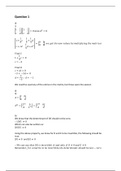
Question 1
a)
i)
! !
1 " 1 "
! %! % = 0 since 𝐴# = 0
𝑐 𝑑 𝑐 𝑑
1 1 1
1+ 𝑐 + 𝑑
) 3 3 3 , = -0 0. 𝑤𝑒 𝑔𝑒𝑡 𝑡ℎ𝑒 𝑛𝑒𝑤 𝑣𝑎𝑙𝑢𝑒𝑠 𝑏𝑦 𝑚𝑢𝑙𝑡𝑖𝑝𝑙𝑦𝑖𝑛𝑔 𝑡ℎ𝑒 𝑚𝑎𝑡𝑟𝑖𝑐𝑒𝑠
1 0 0
𝑐 + 𝑐𝑑 𝑑 + 𝑑#
3
𝐹𝑖𝑛𝑑 𝐶
1
1+ 𝑐 =0
3
𝑐 = −3
𝐹𝑖𝑛𝑑 𝐷
𝑐 + 𝑐𝑑 = 0
−3 + −3𝑑 = 0
3
𝑑= ∴ 𝑑 = −1
−3
We could’ve used any of the entries in the matrix, but those were the easiest.
a)
ii)
2 0
𝐴=- .
0 1
"#
𝐴"# = -2 0 . = -2"# 0.
0 1"# 0 1
b)
We know that the determinant of DE should not be zero.
∴ |𝐷𝐸| ≠ 0
Which can also be written as:
|𝐷||𝐸| ≠ 0
Using the above property, we know for D and E to be invertible, the following should be
true:
|𝐷| ≠ 0 and |𝐸| ≠ 0
∴ 𝑊𝑒 𝑐𝑎𝑛 𝑠𝑎𝑦 𝑡ℎ𝑎𝑡 𝐷𝐸 𝑖𝑠 𝑖𝑛𝑣𝑒𝑟𝑡𝑖𝑏𝑙𝑒 𝑖𝑓 𝑎𝑛𝑑 𝑜𝑛𝑙𝑦 𝑖𝑓 𝐷 ≠ 0 𝑎𝑛𝑑 𝐸 ≠ 0
𝑅𝑒𝑚𝑒𝑚𝑏𝑒𝑟, 𝑓𝑜𝑟 𝑎 𝑚𝑎𝑡𝑟𝑖𝑥 𝑡𝑜 𝑏𝑒 𝑖𝑛𝑣𝑒𝑟𝑡𝑖𝑏𝑙𝑒, 𝑡ℎ𝑒 𝑑𝑒𝑡𝑒𝑟𝑚𝑖𝑛𝑎𝑛𝑡 𝑠ℎ𝑜𝑢𝑙𝑑 𝑏𝑒 𝑛𝑜𝑛 − 𝑧𝑒𝑟𝑜
a)
i)
! !
1 " 1 "
! %! % = 0 since 𝐴# = 0
𝑐 𝑑 𝑐 𝑑
1 1 1
1+ 𝑐 + 𝑑
) 3 3 3 , = -0 0. 𝑤𝑒 𝑔𝑒𝑡 𝑡ℎ𝑒 𝑛𝑒𝑤 𝑣𝑎𝑙𝑢𝑒𝑠 𝑏𝑦 𝑚𝑢𝑙𝑡𝑖𝑝𝑙𝑦𝑖𝑛𝑔 𝑡ℎ𝑒 𝑚𝑎𝑡𝑟𝑖𝑐𝑒𝑠
1 0 0
𝑐 + 𝑐𝑑 𝑑 + 𝑑#
3
𝐹𝑖𝑛𝑑 𝐶
1
1+ 𝑐 =0
3
𝑐 = −3
𝐹𝑖𝑛𝑑 𝐷
𝑐 + 𝑐𝑑 = 0
−3 + −3𝑑 = 0
3
𝑑= ∴ 𝑑 = −1
−3
We could’ve used any of the entries in the matrix, but those were the easiest.
a)
ii)
2 0
𝐴=- .
0 1
"#
𝐴"# = -2 0 . = -2"# 0.
0 1"# 0 1
b)
We know that the determinant of DE should not be zero.
∴ |𝐷𝐸| ≠ 0
Which can also be written as:
|𝐷||𝐸| ≠ 0
Using the above property, we know for D and E to be invertible, the following should be
true:
|𝐷| ≠ 0 and |𝐸| ≠ 0
∴ 𝑊𝑒 𝑐𝑎𝑛 𝑠𝑎𝑦 𝑡ℎ𝑎𝑡 𝐷𝐸 𝑖𝑠 𝑖𝑛𝑣𝑒𝑟𝑡𝑖𝑏𝑙𝑒 𝑖𝑓 𝑎𝑛𝑑 𝑜𝑛𝑙𝑦 𝑖𝑓 𝐷 ≠ 0 𝑎𝑛𝑑 𝐸 ≠ 0
𝑅𝑒𝑚𝑒𝑚𝑏𝑒𝑟, 𝑓𝑜𝑟 𝑎 𝑚𝑎𝑡𝑟𝑖𝑥 𝑡𝑜 𝑏𝑒 𝑖𝑛𝑣𝑒𝑟𝑡𝑖𝑏𝑙𝑒, 𝑡ℎ𝑒 𝑑𝑒𝑡𝑒𝑟𝑚𝑖𝑛𝑎𝑛𝑡 𝑠ℎ𝑜𝑢𝑙𝑑 𝑏𝑒 𝑛𝑜𝑛 − 𝑧𝑒𝑟𝑜


