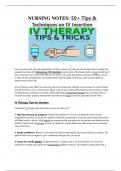
NURSING NOTES: 50+ Tips &
Techniques on IV Insertion
Here are your best tips and techniques on how to start an IV. Nurses who would want to master this
essential nursing skill. Intravenous (IV) insertion may be one of the basics skills a nurse would learn,
but it could be one of the most difficult to master if you lack the practice and the confidence to do
it. Most of the sharpshooters have gained their skill through continuous practice and plenty of
experiences in this field.
A lot of factors may affect the way you insert an intravenous catheter, but you have to control them
and bend them to your convenience. Never rush on any nursing skills that you still not have, or take
a shortcut just to achieve your goals. Along with these intravenous therapy tips, nursing practices
must be accurate, precise, and learned not only by the brain but most especially by the heart.
IV Therapy Tips for Starters
Preliminary IV therapy tips and tricks on how to start an IV:
1. Stay focused and be prepared. Hitting the bullseye on one try will depend on the nurse’s
preparation and skill. You and your patient should be composed as a nervous and rushed procedure
will likely result in failure. Allay anxiety by explaining the procedure to the patient and determine the
patient’s history with IV therapy. Ensure the patient is comfortable and sufficiently warm to prevent
vasoconstriction.
2. Exude confidence. Believe in yourself and reassure the patient you know what you’re doing. The
patient will be encouraged by your confidence and you too, of course.
3. Assess for needle phobia. Needle phobia is a response as a result of previous IV insertions.
Symptoms include tachycardia and hypertension before insertion. On insertion bradycardia and a
, drop in blood pressure occurs with signs and symptoms of pallor, diaphoresis, and syncope.
Reassure the patient with a soothing tone, educating the patient, keeping needles out of sight until
the last minute before use, and use of topical anesthetics can help manage needle phobia.
4. Observe Infection control measures. Use gloves in inserting a cannula into the
patient. Intravenous insertion is an invasive procedure and requires aseptic technique and
proper infection control measures. Wipe a cotton swab or alcohol pad on the insertion site to
minimize microorganisms in the area and also to visualize the chosen vein more clearly.
5. Assess the vein. Before inserting a needle into a patient’s vein, you have to assess its condition
first. A well-hydrated person has firm, supple, and easy-to-reach veins. Well-hydrated veins are
bouncy, making them the right fit for insertion. Some patients need intravenous therapy but are
dehydrated, so it is a challenge to hit the vein in one go. To avoid injuring the vein, always assess first
that you are aiming for a vein that is not frail enough to blow up during the insertion. Take your
time. The following tips can help you with that.
6. Feel rather than look. If you can’t see a suitable vein, trust your fingers even more than your
eyes. It’s also an excellent opportunity to familiarize yourself with a suitable vein. A tendon may feel
like a vein but palpating it through a range of motion may prove that it is not.
7. Ask your patient. The patient may know more which veins are suitable based on his previous IV
history.
8. Use an appropriate cannula size. Match the needle and the gauge of the cannula to the size of
the patient. The gauge refers to the diameter of the lumen of the needle or cannula — the smaller
the gauge number, the larger the diameter of the lumen, the larger the gauge number, the smaller
the diameter of the lumen. You can hit a vein that is smaller than your needle, but it would be injured
and would blow up because the needle is bigger than it is.
Techniques on IV Insertion
Here are your best tips and techniques on how to start an IV. Nurses who would want to master this
essential nursing skill. Intravenous (IV) insertion may be one of the basics skills a nurse would learn,
but it could be one of the most difficult to master if you lack the practice and the confidence to do
it. Most of the sharpshooters have gained their skill through continuous practice and plenty of
experiences in this field.
A lot of factors may affect the way you insert an intravenous catheter, but you have to control them
and bend them to your convenience. Never rush on any nursing skills that you still not have, or take
a shortcut just to achieve your goals. Along with these intravenous therapy tips, nursing practices
must be accurate, precise, and learned not only by the brain but most especially by the heart.
IV Therapy Tips for Starters
Preliminary IV therapy tips and tricks on how to start an IV:
1. Stay focused and be prepared. Hitting the bullseye on one try will depend on the nurse’s
preparation and skill. You and your patient should be composed as a nervous and rushed procedure
will likely result in failure. Allay anxiety by explaining the procedure to the patient and determine the
patient’s history with IV therapy. Ensure the patient is comfortable and sufficiently warm to prevent
vasoconstriction.
2. Exude confidence. Believe in yourself and reassure the patient you know what you’re doing. The
patient will be encouraged by your confidence and you too, of course.
3. Assess for needle phobia. Needle phobia is a response as a result of previous IV insertions.
Symptoms include tachycardia and hypertension before insertion. On insertion bradycardia and a
, drop in blood pressure occurs with signs and symptoms of pallor, diaphoresis, and syncope.
Reassure the patient with a soothing tone, educating the patient, keeping needles out of sight until
the last minute before use, and use of topical anesthetics can help manage needle phobia.
4. Observe Infection control measures. Use gloves in inserting a cannula into the
patient. Intravenous insertion is an invasive procedure and requires aseptic technique and
proper infection control measures. Wipe a cotton swab or alcohol pad on the insertion site to
minimize microorganisms in the area and also to visualize the chosen vein more clearly.
5. Assess the vein. Before inserting a needle into a patient’s vein, you have to assess its condition
first. A well-hydrated person has firm, supple, and easy-to-reach veins. Well-hydrated veins are
bouncy, making them the right fit for insertion. Some patients need intravenous therapy but are
dehydrated, so it is a challenge to hit the vein in one go. To avoid injuring the vein, always assess first
that you are aiming for a vein that is not frail enough to blow up during the insertion. Take your
time. The following tips can help you with that.
6. Feel rather than look. If you can’t see a suitable vein, trust your fingers even more than your
eyes. It’s also an excellent opportunity to familiarize yourself with a suitable vein. A tendon may feel
like a vein but palpating it through a range of motion may prove that it is not.
7. Ask your patient. The patient may know more which veins are suitable based on his previous IV
history.
8. Use an appropriate cannula size. Match the needle and the gauge of the cannula to the size of
the patient. The gauge refers to the diameter of the lumen of the needle or cannula — the smaller
the gauge number, the larger the diameter of the lumen, the larger the gauge number, the smaller
the diameter of the lumen. You can hit a vein that is smaller than your needle, but it would be injured
and would blow up because the needle is bigger than it is.