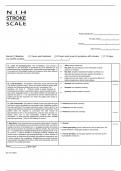
Patient Identification. - -
Pt. Date of Birth / /
Hospital ( - )
Date of Exam / /
Interval: [ ] Baseline [ ] 2 hours post treatment [ ] 24 hours post onset of symptoms ±20 minutes [ ] 7-10 days
[ ] 3 months [ ] Other ( )
1a. Level of Consciousness: The investigator must choose a 0= Alert; keenly responsive.
response if a full evaluation is prevented by such obstacles as an 1= Not alert; but arousable by minor stimulation to obey,
endotracheal tube, language barrier, orotracheal trauma/bandages. A answer, or respond.
3 is scored only if the patient makes no movement (other than reflexive 2= Not alert; requires repeated stimulation to attend, or is
posturing) in response to noxious stimulation.
obtunded and requires strong or painful stimulation to
make movements (not stereotyped).
3= Responds only with reflex motor or autonomic effects or
totally unresponsive, flaccid, and areflexic.
1b. LOC Questions: The patient is asked the month and his/her age. 1= Answers both questions correctly.
The answer must be correct - there is no partial credit for being close.
Aphasic and stuporous patients who do not comprehend the 2= Answers one question correctly.
questions will score 2. Patients unable to speak because of
endotracheal intubation, orotracheal trauma, severe dysarthria from Answers neither question correctly.
any cause, language barrier, or any other problem not secondary to 3=
aphasia are given a 1. It is important that only the initial answer be
graded and that the examiner not "help" the patient with verbal or
non-verbal cues.
1c. LOC Commands: The patient is asked to open and close the eyes 1 = Performs both tasks correctly.
and then to grip and release the non-paretic hand. Substitute another
one step command if the hands cannot be used. Credit is given if an 2 = Performs one task correctly.
unequivocal attempt is made but not completed due to weakness. If the
patient does not respond to command, the task should be 3 = Performs neither task correctly.
demonstrated to him or her (pantomime), and the result scored (i.e.,
follows none, one or two commands). Patients with trauma,
amputation, or other physical impediments should be given suitable
one-step commands. Only the first attempt is scored.
2. Best Gaze: Only horizontal eye movements will be tested. Voluntary 1 = Normal.
or reflexive (oculocephalic) eye movements will be scored, but caloric
testing is not done. If the patient has a conjugate deviation of the eyes 2 = Partial gaze palsy; gaze is abnormal in one or both eyes, but
that can be overcome by voluntary or reflexive activity, the score will forced deviation or total gaze paresis is not present.
be 1. If a patient has an isolated peripheral nerve paresis (CN III, IV or
VI), score a 1. Gaze is testable in all aphasic patients. Patients with
ocular trauma, bandages, pre-existing blindness, or other disorder of 3 = Forced deviation, or total gaze paresis not overcome by the
visual acuity or fields should be tested with reflexive movements, and oculocephalic maneuver.
a choice made by the investigator. Establishing eye contact and then
moving about the patient from side to side will occasionally clarify the
presence of a partial gaze palsy.
Time: : [ ]am [ ]pm
Rev 10/1/2003
, Patient Identification. - -
Pt. Date of Birth / /
Hospital ( - )
Date of Exam / /
Person Administering Scale
Administer stroke scale items in the order listed. Record performance in each category after each subscale exam. Do not go
back and change scores. Follow directions provided for each exam technique. Scores should reflect what the patient does, not
what the clinician thinks the patient can do. The clinician should record answers while administering the exam and work quickly.
Except where indicated, the patient should not be coached (i.e., repeated requests to patient to make a special effort).
Instructions Scale Definition Score
Rev 10/1/2003
Pt. Date of Birth / /
Hospital ( - )
Date of Exam / /
Interval: [ ] Baseline [ ] 2 hours post treatment [ ] 24 hours post onset of symptoms ±20 minutes [ ] 7-10 days
[ ] 3 months [ ] Other ( )
1a. Level of Consciousness: The investigator must choose a 0= Alert; keenly responsive.
response if a full evaluation is prevented by such obstacles as an 1= Not alert; but arousable by minor stimulation to obey,
endotracheal tube, language barrier, orotracheal trauma/bandages. A answer, or respond.
3 is scored only if the patient makes no movement (other than reflexive 2= Not alert; requires repeated stimulation to attend, or is
posturing) in response to noxious stimulation.
obtunded and requires strong or painful stimulation to
make movements (not stereotyped).
3= Responds only with reflex motor or autonomic effects or
totally unresponsive, flaccid, and areflexic.
1b. LOC Questions: The patient is asked the month and his/her age. 1= Answers both questions correctly.
The answer must be correct - there is no partial credit for being close.
Aphasic and stuporous patients who do not comprehend the 2= Answers one question correctly.
questions will score 2. Patients unable to speak because of
endotracheal intubation, orotracheal trauma, severe dysarthria from Answers neither question correctly.
any cause, language barrier, or any other problem not secondary to 3=
aphasia are given a 1. It is important that only the initial answer be
graded and that the examiner not "help" the patient with verbal or
non-verbal cues.
1c. LOC Commands: The patient is asked to open and close the eyes 1 = Performs both tasks correctly.
and then to grip and release the non-paretic hand. Substitute another
one step command if the hands cannot be used. Credit is given if an 2 = Performs one task correctly.
unequivocal attempt is made but not completed due to weakness. If the
patient does not respond to command, the task should be 3 = Performs neither task correctly.
demonstrated to him or her (pantomime), and the result scored (i.e.,
follows none, one or two commands). Patients with trauma,
amputation, or other physical impediments should be given suitable
one-step commands. Only the first attempt is scored.
2. Best Gaze: Only horizontal eye movements will be tested. Voluntary 1 = Normal.
or reflexive (oculocephalic) eye movements will be scored, but caloric
testing is not done. If the patient has a conjugate deviation of the eyes 2 = Partial gaze palsy; gaze is abnormal in one or both eyes, but
that can be overcome by voluntary or reflexive activity, the score will forced deviation or total gaze paresis is not present.
be 1. If a patient has an isolated peripheral nerve paresis (CN III, IV or
VI), score a 1. Gaze is testable in all aphasic patients. Patients with
ocular trauma, bandages, pre-existing blindness, or other disorder of 3 = Forced deviation, or total gaze paresis not overcome by the
visual acuity or fields should be tested with reflexive movements, and oculocephalic maneuver.
a choice made by the investigator. Establishing eye contact and then
moving about the patient from side to side will occasionally clarify the
presence of a partial gaze palsy.
Time: : [ ]am [ ]pm
Rev 10/1/2003
, Patient Identification. - -
Pt. Date of Birth / /
Hospital ( - )
Date of Exam / /
Person Administering Scale
Administer stroke scale items in the order listed. Record performance in each category after each subscale exam. Do not go
back and change scores. Follow directions provided for each exam technique. Scores should reflect what the patient does, not
what the clinician thinks the patient can do. The clinician should record answers while administering the exam and work quickly.
Except where indicated, the patient should not be coached (i.e., repeated requests to patient to make a special effort).
Instructions Scale Definition Score
Rev 10/1/2003