Virusziekten samenvatting HC.3
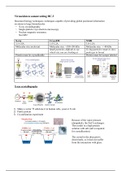
Structural biology techniques: techniques capable of providing global positional information
on atoms in large biomolecules.
X-ray crystallography
Single-particle cryo-electron microscopy
Nuclear magnetic resonance
Not MS!
X-ray Cryo-EM NMR
3.5-1.8A 1.8-3.2A 3.0-1.5A
Molecular size irrelevant Molecular size >100-150 kDa Molecular size < 40 kDa
- Small particles, difficult to see To big particles rotate to slow,
which site you are looking at peaks get to broad
Protein must be crystallizable - Protein must be isotope labeled
X-ray crystallography
1) Make a vector subclone it in human cells, yeast or E.coli
2) Purify protein
3) Crystallization experiment
Because of the vapor pressure
(dampdruk), the NaCl exchanges.
This results in a high protein
solution with salt (salt is required
for crystallization).
The crystal in the drop grows
downwards, so it does not suffer
from the interaction with glass.
, Typical crystallization conditions:
Protein sample
protein (~10 mg/ml)
buffer (low concentration ~10 mM)
additives or ligands for protein stabilization
Precipitant solutions
precipitants: [NaCl], [(NH4)2SO4], [PEG4000], [MPD], etc
buffers: high concentration (100 mM), (determines) range of pH
additives: salts, organic compounds
Different temperatures
Poorly ordered crystals can look beautifull, but
there are not always good. A good crystal should
be well ordered inside!!
4) X-ray data are measured on frozen crystals (100K) to prevent damage by X-ray. X-ray
can break disulfide bonds and carboxylate groups can disappear. A radical reaction causes
the damage and by freezing the sample, the radicals do not travel and there is only
particular damage.
In X-ray diffraction, the lens is replaces by a
Fourier transform. Each diffraction spot
(reflection) contains information on the
position of every atom.
There is only a phase problem. Light is a wave and the intensity can be measured (blackness
of the dots) but the phases of the waves cannot be measured. So you lack information. There
are different solution for this problem (only needs to be solved once for a particular protein):
Isomorphous replacement (MIR) by collecting X-ray data on crystals soaked with
heavy atoms (like Pt, U, Hg). When the atoms bind, you can see a visible difference in
diffraction data and then you can estimate the phase. (need synchrotron)
Multiple anomalous dispersion (MAD) By replacing methionine by seleno-methionine
and collecting X-ray data at multiple wavelengths. This also causes a different pattern and
then you can also estimate the phase
Molecular replacement (MR) (non-experimental) by using the structure of a
homologous protein (>30% homology required)
In drug discovery the phase problem does not play a role The phases of the protein alone
are sufficiently close to the phases of protein + bound compound to allow structure
determination
When you search up a crystal structure in the protein data bank, you get different information:
Structural biology techniques: techniques capable of providing global positional information
on atoms in large biomolecules.
X-ray crystallography
Single-particle cryo-electron microscopy
Nuclear magnetic resonance
Not MS!
X-ray Cryo-EM NMR
3.5-1.8A 1.8-3.2A 3.0-1.5A
Molecular size irrelevant Molecular size >100-150 kDa Molecular size < 40 kDa
- Small particles, difficult to see To big particles rotate to slow,
which site you are looking at peaks get to broad
Protein must be crystallizable - Protein must be isotope labeled
X-ray crystallography
1) Make a vector subclone it in human cells, yeast or E.coli
2) Purify protein
3) Crystallization experiment
Because of the vapor pressure
(dampdruk), the NaCl exchanges.
This results in a high protein
solution with salt (salt is required
for crystallization).
The crystal in the drop grows
downwards, so it does not suffer
from the interaction with glass.
, Typical crystallization conditions:
Protein sample
protein (~10 mg/ml)
buffer (low concentration ~10 mM)
additives or ligands for protein stabilization
Precipitant solutions
precipitants: [NaCl], [(NH4)2SO4], [PEG4000], [MPD], etc
buffers: high concentration (100 mM), (determines) range of pH
additives: salts, organic compounds
Different temperatures
Poorly ordered crystals can look beautifull, but
there are not always good. A good crystal should
be well ordered inside!!
4) X-ray data are measured on frozen crystals (100K) to prevent damage by X-ray. X-ray
can break disulfide bonds and carboxylate groups can disappear. A radical reaction causes
the damage and by freezing the sample, the radicals do not travel and there is only
particular damage.
In X-ray diffraction, the lens is replaces by a
Fourier transform. Each diffraction spot
(reflection) contains information on the
position of every atom.
There is only a phase problem. Light is a wave and the intensity can be measured (blackness
of the dots) but the phases of the waves cannot be measured. So you lack information. There
are different solution for this problem (only needs to be solved once for a particular protein):
Isomorphous replacement (MIR) by collecting X-ray data on crystals soaked with
heavy atoms (like Pt, U, Hg). When the atoms bind, you can see a visible difference in
diffraction data and then you can estimate the phase. (need synchrotron)
Multiple anomalous dispersion (MAD) By replacing methionine by seleno-methionine
and collecting X-ray data at multiple wavelengths. This also causes a different pattern and
then you can also estimate the phase
Molecular replacement (MR) (non-experimental) by using the structure of a
homologous protein (>30% homology required)
In drug discovery the phase problem does not play a role The phases of the protein alone
are sufficiently close to the phases of protein + bound compound to allow structure
determination
When you search up a crystal structure in the protein data bank, you get different information: