100% satisfaction guarantee Immediately available after payment Both online and in PDF No strings attached 4.6 TrustPilot
logo-home
Exam (elaborations)

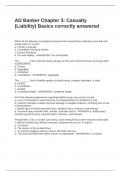
AD Banker Chapter 3: Casualty (Liability) Basics correctly answered

Rating
-
Sold
-
Pages
6
Grade
A+
Uploaded on
05-03-2025
Written in
2024/2025

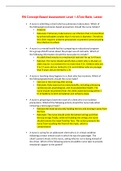
Which of the following is designed to prevent the insured from collecting more than the actual extent of a loss? a. Primary coverage b. Contribution by equal shares c. Excess insurance d. Pro rata liability - ANSWERSd. Pro rata liability The _______ is the most the policy will pay for the sum of all the losses occurring within a policy period. a. Excess b. Aggregate c. Combined d. Contribution - ANSWERSb. Aggregate The _______ Limit of liability applies to bodily injury, property damages, or both. a. Excess b. Contribution c. Limited d. Combined Single - ANSWERSd. Combined Single All of the following statements regarding liability losses are correct, except: a. Loss of consortium means the loss of companionship of a husband or wife b. Property damage includes physical damage to tangible property, including loss of use of that property c. Bodily injury includes personal injury, physical injury, sickness, and disease d. Personal injury includes libel, slander, and false arrest - ANSWERSc. Bodily injury includes personal injury, physical injury, sickness, and disease Policyholder J has a no-fault auto policy. Upon being hit by a driver that ran a stop light, J suffers a broken leg. Whose insurance company will pay for J's injury? a. J's insurer b. The insurer of the at-fault driver c. J's and the negligent driver's insurer will share the loss d. The court will determine which insurer is responsible - ANSWERSa. J's insurer Which of the following statements best describes the Other Insurance condition on a standard property insurance policy, when two separate property policies provide coverage for the same loss? a. One policy pays up to its limits and the other policy pays the balance b. Each policy pays an equal share c. Neither policy will make payment for the loss d. Each policy pays its pro rata share of the loss - ANSWERSd. Each policy pays its pro rata share of the loss When a claimant can prove that a product caused an injury, the fact that the manufacturer will be held liable regardless of whether the product was defective or not, is considered which of the following? a. Contingent Liability b. Strict Liability c. Vicarious Liability d. Direct Liability - ANSWERSb. Strict Liability Property damage covered by a liability policy includes which of the following? a. Damage to the insured's products arising out of the products b. Damage to property owned by, or leased to, the insured c. Damage to property of others in the insured's care, custody, or control d. Damage to tangible property, including loss of use of that property caused by the insured's negligence - ANSWERSd. Damage to tangible property, including loss of use of that property caused by the insured's negligence Which of the following reduces an award in proportion to the amount of negligence? a. Comparative negligence b. Comparative risk c. Contributory negligence d. Contributory risk - ANSWERSa. Comparative negligence The equal sharing of a loss by two or more insurers until the loss is paid, or until each insurer has exhausted its limits of insurance, whichever comes first, is the description of which of the following? a. Pro rata liability b. Excess insurance c. Contribution by equal shares d. Assumed liability - ANSWERSc. Contribution by equal shares Which of the following defines a tort? a. A wrongful act b. An award to an injured party c. An unforeseen event from which damage results d. Liability assigned to one party for the conduct of another - ANSWERSa. A wrongful act Which of the following prevents recovery for injuries caused by a negligent party if the claimant was also negligent? a. Gross negligence b. Absolute liability c. Contributory negligence d. Comparative negligence - ANSWERSc. Contributory negligence Which of the following is a legal liability imposed without demonstrated negligence? a. Contingent Liability b. Absolute Liability c. Direct Liability d. Vicarious Liability - ANSWERSb. Absolute Liability Bodily injury liability coverage includes all of the following, except: a. Breach of contract b. Mental Anguish c. Medical Bills d. Lost Wages - ANSWERSa. Breach of contract Personal injury includes all of the following, except: a. False arrest b. Bodily injury c. Libel d. Slander - ANSWERSb. Bodily injury Bodily Injury may include which of the following? a. Slander b. Loss of earnings c. Invasion of privacy d. False arrest - ANSWERSb. Loss of earnings Which of the following is an example of general damages? a. Pain b. Repair costs c. Loss of income d. Medical expenses - ANSWERSa. Pain All of the following are true of negligence, except: a. It does not include breach of contract b. It does not require a duty to be owed c. It is the failure to use ordinary care d. It is a type of tort - ANSWERSb. It does not require a duty to be owed The person specifically designated in the policy as the person with whom the contract of insurance has been made is considered to be the: a. Named Insured b. Additional Insured c. Contract Insured d. Contingent Insured - ANSWERSa. Named Insured The maximum amount a policy will pay in the event of a loss, regardless of the number of insureds, claims made, lawsuits filed, or parties making claims is the: a. Limit of Liability b. Split Limit c. Premium d. Deductible - ANSWERSa. Limit of Liability Which of the following is true regarding a negligence claim? a. Every accident resulting in bodily injury or property damage is due to a negligent act b. The claimant must demonstrate that the wrongful actions of the insured were the direct or proximate cause of the claimed injury or damages c. In every accident there is one or more negligent parties d. An uninjured party to an accident is presumed to be negligent - ANSWERSb. The claimant must demonstrate that the wrongful actions of the insured were the direct or proximate cause of the claimed injury or damages A liability policy contains a per person bodily injury limit of $25,000 and a per occurrence limit of $50,000. If an accident were to occur and three persons have claims of $20,000 each, the total amount paid is: a. $50,000 b. $60,000 c. $75,000 d. $25,000 - ANSWERSa. $50,000 Which of the following statements about medical payments is false? a. General damages compensate the injured party for pain and suffering b. Specific damages compensate the injured party for actual damages c. Medical payments cover personal injury d. Medical payments coverage is provided to discourage lawsuits - ANSWERSc. Medical payments cover personal injury H's liability policy has the following limits: $25,000 per person, $100,000 per occurrence, and $2,000,000 aggregate. This year, five separate claimants file in the amount $25,000 for injuries suffered in a single accident. How much will the policy pay? a. $50,000 b. $125,000 c. $25,000 d. $100,000 - ANSWERSd. $100,000 Q runs a stop sign causing an oncoming vehicle to swerve and hit a tree. Q is guilty of: a. No wrongdoing b. A criminal violation c. Trespassing d. Negligence - ANSWERSd. Negligence Which coverage is written with a per occurrence limit? a. Bodily injury and property damage b. Personal injury c. Advertising injury d. Strict liability - ANSWERSa. Bodily injury and property damage The maximum amount payable for all losses within a policy period is known as the: a. Per person limit b. Per occurrence limit c. Aggregate limit d. Combined single limit - ANSWERSc. Aggregate limit Medical payments coverage includes which of the following? a. Payment of medical expenses incurred by persons who occupy the insured premises b. Payment of medical expenses incurred by an insured while at work on the premises c. Payment of necessary medical expenses incurred by an injury on the insured's premises d. Payment of medical expenses caused by illness manifesting itself on the insured's premises - ANSWERSc. Payment of necessary medical expenses incurred by an injury on the insured's premises Which of the following indicates a disrupted chain of events that frees the defendant from liability? a. Concurrent causation b. Proximate cause c. Intervening cause d. Lost cause - ANSWERSc. Intervening cause Driver D slid into another car causing an accident in which three people in the other car were injured. Two injured parties claimed $15,000 in medical expenses, and the third person claimed $25,000. How much will D's insurance company pay if D's policy has 25/50 limits for bodily injury? a. $45,000 b. $50,000 c. $60,000 d. $75,000 - ANSWERSb. $50,000 What is the name for a type of policy that doesn't pay benefits until the limits of the primary policy has been exhausted? a. Liberalization policy b. Surplus lines policy c. Common law policy d. Excess policy - ANSWERSd. Excess policy Which of the following is an example of special damages? a. The damages of pain, suffering, and disfigurement b. Compensation to an injured party for actual medical expenses and loss of earnings c. Compensation to a husband or wife for the loss of companionship of a spouse d. The damages assessed by the court as a penalty for gross negligence - ANSWERSb. Compensation to an injured party for actual medical expenses and loss of earnings Policy A provides liability coverage to Fred's Grocery up to $500,000. Policy B provides coverage for the same risks up to $1.5 million. Both policies pay on a pro rata basis. If Fred's Grocery is determined to have a legal liability of $400,000 to a claimant who was injured on the property, how much will Policy A pay? a. $400,000 b. $100,000 c. $50,000 d. $500,000 - ANSWERSb. $100,000 Which of the following prevents recovery for injuries caused by a negligent party if the claimant was also negligent? a. Absolute liability b. Comparative negligence c. Contributory negligence d. Gross negligence - ANSWERSc. Contributory negligence Insurer G decides to increase the first aid benefits for one of its insureds for no extra premium. What is the name of the provision which automatically applies this broader coverage without additional premium to all policies currently in effect by the same insurer? a. Assumption of risk b. Assumption of risk c. Liberalization d. Subrogation - ANSWERSc. Liberalization When a claimant can prove that a product caused an injury, the fact that the manufacturer will be held liable regardless of whether the product was defective or not, is considered which of the following? a. Direct Liability b. Vicarious Liability c. Contingent Liability

Show more Read less
Institution
AD Banker
Course
AD Banker


Whoops! We can’t load your doc right now. Try again or contact support.

Written for

Institution
AD Banker
Course
AD Banker

Document information

Uploaded on
March 5, 2025
Number of pages
6
Written in
2024/2025
Type
Exam (elaborations)
Contains
Questions & answers

Subjects

Content preview

AD Banker Chapter 3: Casualty
(Liability) Basics correctly answered

Which of the following is designed to prevent the insured from collecting more than the
actual extent of a loss?
a. Primary coverage
b. Contribution by equal shares
c. Excess insurance
d. Pro rata liability - ANSWERSd. Pro rata liability

The _______ is the most the policy will pay for the sum of all the losses occurring within
a policy period.
a. Excess
b. Aggregate
c. Combined
d. Contribution - ANSWERSb. Aggregate

The _______ Limit of liability applies to bodily injury, property damages, or both.
a. Excess
b. Contribution
c. Limited
d. Combined Single - ANSWERSd. Combined Single

All of the following statements regarding liability losses are correct, except:
a. Loss of consortium means the loss of companionship of a husband or wife
b. Property damage includes physical damage to tangible property, including loss of use
of that property
c. Bodily injury includes personal injury, physical injury, sickness, and disease
d. Personal injury includes libel, slander, and false arrest - ANSWERSc. Bodily injury
includes personal injury, physical injury, sickness, and disease

Policyholder J has a no-fault auto policy. Upon being hit by a driver that ran a stop light,
J suffers a broken leg. Whose insurance company will pay for J's injury?
a. J's insurer
b. The insurer of the at-fault driver
c. J's and the negligent driver's insurer will share the loss
d. The court will determine which insurer is responsible - ANSWERSa. J's insurer

, Which of the following statements best describes the Other Insurance condition on a
standard property insurance policy, when two separate property policies provide
coverage for the same loss?
a. One policy pays up to its limits and the other policy pays the balance
b. Each policy pays an equal share
c. Neither policy will make payment for the loss
d. Each policy pays its pro rata share of the loss - ANSWERSd. Each policy pays its pro
rata share of the loss

When a claimant can prove that a product caused an injury, the fact that the
manufacturer will be held liable regardless of whether the product was defective or not,
is considered which of the following?
a. Contingent Liability
b. Strict Liability
c. Vicarious Liability
d. Direct Liability - ANSWERSb. Strict Liability

Property damage covered by a liability policy includes which of the following?
a. Damage to the insured's products arising out of the products
b. Damage to property owned by, or leased to, the insured
c. Damage to property of others in the insured's care, custody, or control
d. Damage to tangible property, including loss of use of that property caused by the
insured's negligence - ANSWERSd. Damage to tangible property, including loss of use
of that property caused by the insured's negligence

Which of the following reduces an award in proportion to the amount of negligence?
a. Comparative negligence
b. Comparative risk
c. Contributory negligence
d. Contributory risk - ANSWERSa. Comparative negligence

The equal sharing of a loss by two or more insurers until the loss is paid, or until each
insurer has exhausted its limits of insurance, whichever comes first, is the description of
which of the following?
a. Pro rata liability
b. Excess insurance
c. Contribution by equal shares
d. Assumed liability - ANSWERSc. Contribution by equal shares

Which of the following defines a tort?
a. A wrongful act
b. An award to an injured party
c. An unforeseen event from which damage results
d. Liability assigned to one party for the conduct of another - ANSWERSa. A wrongful
act

$13.49
Get access to the full document:

100% satisfaction guarantee
Immediately available after payment
Both online and in PDF
No strings attached

Get to know the seller
Seller avatar
paugrades1479
2.0
(1)

Also available in package deal

Thumbnail
Package deal
A PACKAGE DEAL OF AD BANKER DISTINCTION GAURANTEED
-
13 2025
$ 178.87 More info

Get to know the seller

Seller avatar
paugrades1479 Nursing
View profile
Follow You need to be logged in order to follow users or courses
Sold
1
Member since
2 year
Number of followers
1
Documents
470
Last sold
2 year ago

2.0

1 reviews

5
0
4
0
3
0
2
1
1
0

Recently viewed by you

Why students choose Stuvia

Created by fellow students, verified by reviews

Quality you can trust: written by students who passed their tests and reviewed by others who've used these notes.

Didn't get what you expected? Choose another document

No worries! You can instantly pick a different document that better fits what you're looking for.

Pay as you like, start learning right away

No subscription, no commitments. Pay the way you're used to via credit card and download your PDF document instantly.

Student with book image

“Bought, downloaded, and aced it. It really can be that simple.”

Alisha Student

Frequently asked questions