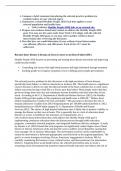
1. Compose a brief statement introducing the selected practice problem (to
remind readers of your selected topic).
2. Summarize a related Healthy People 2030 Goal that applies to your
selected population and health issue.
o Link (website): Healthy People 2030Links to an external site.
3. Propose one evidence-based intervention to address the Healthy People 2030
goal. You may use the same study from Week 3 if it aligns with the selected
Healthy People 2030 goal, or you may select another evidence-based
intervention after reviewing the literature.
4. Describe how you would determine if your evidence-based intervention
was efficient, effective, and efficacious. Each of the 3 E’s must be
addressed.
Because heart disease is broad, my focus is more so on Heart Failure (HF).
Healthy People 2030 focuses on preventing and treating heart disease and stroke and improving
cardiovascular health.
• Controlling risk factors like high blood pressure and high cholesterol through treatment
• teaching people to recognize symptoms is key to helping more people get treatment.
The selected practice problem for this discussion is the high prevalence of heart disease,
specifically heart failure, in African Americans in Jackson, MS. This health issue is a significant
concern because it affects not only the physical health of the heart condition but, in some cases,
failure may mean having to lead life at a slower pace than before. Most people notice that they
get fewer things done each day and sometimes become breathless and tired when they do too
much. According to the U.S. Department of Health and Human Services (2022), the Healthy
People 2030 goal that applies to this population and health issue is HDS-09: " Reduce heart
failure hospitalization in adults (18 years and older).” This goal aims to decrease the rate of
hospital admission of adults from 366.9 hospitalizations per 100,000 adults (baseline) to 330.2
hospitalizations per 100,00 adults (target) (U.S. Department of Health and Human
Services,2022). The chance of high hospital admission rates is likely due to patients' inability to
manage the disease on their own at home. This is generally due to a lack of education about
diseases or access to healthcare (no insurance, no transportation, etc.).
One evidence-based intervention that could address this Healthy People 2030 goal is
implementing continuous education about the disease process through health education
programs, community outreach programs, and integrated healthcare delivery strategies. A study
by Haynes et al. (2022) found that such programs can significantly reduce higher rates of heart
disease in African Americans (AA) and provide ways to address social disparities causing this
issue amongst AA in Jackson, Mississippi. The intervention involves various stakeholders to
ensure the intervention is delivered appropriately and effectively to the targeted population. The
goal is to create strategies involving African Americans' engagement in Jackson, MS, by
carefully considering the barriers to care, cultural factors, and their preference for intervention
delivery. Targeting these social health factors, the selected intervention aims to create a
reassuring social environment that promotes improved health outcomes and reduces the risk of
remind readers of your selected topic).
2. Summarize a related Healthy People 2030 Goal that applies to your
selected population and health issue.
o Link (website): Healthy People 2030Links to an external site.
3. Propose one evidence-based intervention to address the Healthy People 2030
goal. You may use the same study from Week 3 if it aligns with the selected
Healthy People 2030 goal, or you may select another evidence-based
intervention after reviewing the literature.
4. Describe how you would determine if your evidence-based intervention
was efficient, effective, and efficacious. Each of the 3 E’s must be
addressed.
Because heart disease is broad, my focus is more so on Heart Failure (HF).
Healthy People 2030 focuses on preventing and treating heart disease and stroke and improving
cardiovascular health.
• Controlling risk factors like high blood pressure and high cholesterol through treatment
• teaching people to recognize symptoms is key to helping more people get treatment.
The selected practice problem for this discussion is the high prevalence of heart disease,
specifically heart failure, in African Americans in Jackson, MS. This health issue is a significant
concern because it affects not only the physical health of the heart condition but, in some cases,
failure may mean having to lead life at a slower pace than before. Most people notice that they
get fewer things done each day and sometimes become breathless and tired when they do too
much. According to the U.S. Department of Health and Human Services (2022), the Healthy
People 2030 goal that applies to this population and health issue is HDS-09: " Reduce heart
failure hospitalization in adults (18 years and older).” This goal aims to decrease the rate of
hospital admission of adults from 366.9 hospitalizations per 100,000 adults (baseline) to 330.2
hospitalizations per 100,00 adults (target) (U.S. Department of Health and Human
Services,2022). The chance of high hospital admission rates is likely due to patients' inability to
manage the disease on their own at home. This is generally due to a lack of education about
diseases or access to healthcare (no insurance, no transportation, etc.).
One evidence-based intervention that could address this Healthy People 2030 goal is
implementing continuous education about the disease process through health education
programs, community outreach programs, and integrated healthcare delivery strategies. A study
by Haynes et al. (2022) found that such programs can significantly reduce higher rates of heart
disease in African Americans (AA) and provide ways to address social disparities causing this
issue amongst AA in Jackson, Mississippi. The intervention involves various stakeholders to
ensure the intervention is delivered appropriately and effectively to the targeted population. The
goal is to create strategies involving African Americans' engagement in Jackson, MS, by
carefully considering the barriers to care, cultural factors, and their preference for intervention
delivery. Targeting these social health factors, the selected intervention aims to create a
reassuring social environment that promotes improved health outcomes and reduces the risk of