

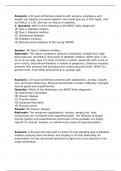
Scenario: A 42-year-old female presents with polyuria, polydipsia, and
weight loss despite increased appetite. Her blood glucose is 350 mg/dL, and
her HbA1c is 12%. She has no history of diabetes.
1. Question: Which of the following is the MOST likely diagnosis?
(A) Type 1 diabetes mellitus
(B) Type 2 diabetes mellitus
(C) Gestational diabetes
(D) Diabetes insipidus
(E) Maturity-onset diabetes of the young (MODY)
Answer: (B) Type 2 diabetes mellitus
Rationale: The classic symptoms (polyuria, polydipsia, weight loss), high
blood glucose, and HbA1c level point to diabetes mellitus. While type 1 can
occur at any age, type 2 is more common in adults, especially with a lack of
prior history. Gestational diabetes is related to pregnancy. Diabetes insipidus
presents with polyuria and polydipsia but normal glucose levels. MODY is a
genetic form, more likely presenting at a younger age.
Scenario: A 35-year-old female presents with palpitations, anxiety, weight
loss, and heat intolerance. Physical examination reveals a diffusely enlarged
thyroid gland and exophthalmos.
Question: Which of the following is the MOST likely diagnosis?
(A) Hashimoto's thyroiditis
(B) Graves' disease
(C) Thyroid nodule
(D) Subacute thyroiditis
(E) Thyroid cancer
Answer: (B) Graves' disease
Rationale: The symptoms (palpitations, anxiety, weight loss, heat
intolerance) are consistent with hyperthyroidism. The diffusely enlarged
thyroid (goiter) and exophthalmos (protrusion of the eyeballs) are highly
specific for Graves' disease, an autoimmune cause of hyperthyroidism.
Scenario: A 55-year-old male with a history of long-standing type 2 diabetes
mellitus presents with numbness and tingling in his feet bilaterally. On
examination, he has decreased sensation to light touch and vibration in his
lower extremities.
weight loss despite increased appetite. Her blood glucose is 350 mg/dL, and
her HbA1c is 12%. She has no history of diabetes.
1. Question: Which of the following is the MOST likely diagnosis?
(A) Type 1 diabetes mellitus
(B) Type 2 diabetes mellitus
(C) Gestational diabetes
(D) Diabetes insipidus
(E) Maturity-onset diabetes of the young (MODY)
Answer: (B) Type 2 diabetes mellitus
Rationale: The classic symptoms (polyuria, polydipsia, weight loss), high
blood glucose, and HbA1c level point to diabetes mellitus. While type 1 can
occur at any age, type 2 is more common in adults, especially with a lack of
prior history. Gestational diabetes is related to pregnancy. Diabetes insipidus
presents with polyuria and polydipsia but normal glucose levels. MODY is a
genetic form, more likely presenting at a younger age.
Scenario: A 35-year-old female presents with palpitations, anxiety, weight
loss, and heat intolerance. Physical examination reveals a diffusely enlarged
thyroid gland and exophthalmos.
Question: Which of the following is the MOST likely diagnosis?
(A) Hashimoto's thyroiditis
(B) Graves' disease
(C) Thyroid nodule
(D) Subacute thyroiditis
(E) Thyroid cancer
Answer: (B) Graves' disease
Rationale: The symptoms (palpitations, anxiety, weight loss, heat
intolerance) are consistent with hyperthyroidism. The diffusely enlarged
thyroid (goiter) and exophthalmos (protrusion of the eyeballs) are highly
specific for Graves' disease, an autoimmune cause of hyperthyroidism.
Scenario: A 55-year-old male with a history of long-standing type 2 diabetes
mellitus presents with numbness and tingling in his feet bilaterally. On
examination, he has decreased sensation to light touch and vibration in his
lower extremities.


