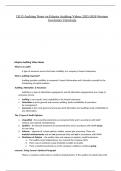
D215 Auditing Notes on Edspira Auditing Videos 2025-2026 Western
Governors University
Edspira Auditing Video Notes
What is an audit?
A type of assurance service that lends credibility to a company's financial statements.
Why is auditing important?
Auditing provides credibility to companies' financial information and is therefore essential to the
functioning of capital markets.
Auditing, Attestation, & Assurance
Auditing is a type of attestation engagement, and all attestation engagements are a type of
assurance service.
• Auditing is most specific, lends creditability to the financial statements.
• Attestation is more general and encases auditing, lends creditability to assertions
by management.
• Assurance is the most general and encases both attestation and auditing, lends creditability to
any information.
The 4 Types of Audit Opinions
1. Unqualified - the accounting statements are presented fairly and in accordance with GAAP
without any material misstatements.
2. Qualified – the financial statements are presented fairly and in accordance with GAAP except
for one thing.
3. Adverse – opposite of a clean opinion, auditor cannot give assurance. There are
material misstatements and are not presented fairly and not in accordance with GAAP.
4. Disclaimer of Opinion – the auditor does not express an opinion, could be because:
a. The auditor lacks independence (ex: married the company CEO).
b. There was an extensive scope limitation (unable to do job).
c. There is doubt/uncertainty as to the company’s ability to continue (going
concern). Going Concern Opinion/Paragraph
Means a company could cease to continue doing business. If the auditor has doubt about the
, company’s ability to continue, then they give their opinion, for example a unqualified opinion, with an
extra Going Concern Paragraph explaining the concern of cease of business. AKA, an opinion
could be clean and presented fairly in accordance with GAAP and still need the extra paragraph to
explain to investors that the clean opinion is based on the going concern assumption (the
assumption that the business will continue) and the information reviewed by the auditor raises
doubt about the company’s ability to continue.
Internal Audit vs External Auditor
Internal Auditor:
• Works for the company being audited by identifying areas of risk and improvement.
• Looks to improve internal controls through:
Governors University
Edspira Auditing Video Notes
What is an audit?
A type of assurance service that lends credibility to a company's financial statements.
Why is auditing important?
Auditing provides credibility to companies' financial information and is therefore essential to the
functioning of capital markets.
Auditing, Attestation, & Assurance
Auditing is a type of attestation engagement, and all attestation engagements are a type of
assurance service.
• Auditing is most specific, lends creditability to the financial statements.
• Attestation is more general and encases auditing, lends creditability to assertions
by management.
• Assurance is the most general and encases both attestation and auditing, lends creditability to
any information.
The 4 Types of Audit Opinions
1. Unqualified - the accounting statements are presented fairly and in accordance with GAAP
without any material misstatements.
2. Qualified – the financial statements are presented fairly and in accordance with GAAP except
for one thing.
3. Adverse – opposite of a clean opinion, auditor cannot give assurance. There are
material misstatements and are not presented fairly and not in accordance with GAAP.
4. Disclaimer of Opinion – the auditor does not express an opinion, could be because:
a. The auditor lacks independence (ex: married the company CEO).
b. There was an extensive scope limitation (unable to do job).
c. There is doubt/uncertainty as to the company’s ability to continue (going
concern). Going Concern Opinion/Paragraph
Means a company could cease to continue doing business. If the auditor has doubt about the
, company’s ability to continue, then they give their opinion, for example a unqualified opinion, with an
extra Going Concern Paragraph explaining the concern of cease of business. AKA, an opinion
could be clean and presented fairly in accordance with GAAP and still need the extra paragraph to
explain to investors that the clean opinion is based on the going concern assumption (the
assumption that the business will continue) and the information reviewed by the auditor raises
doubt about the company’s ability to continue.
Internal Audit vs External Auditor
Internal Auditor:
• Works for the company being audited by identifying areas of risk and improvement.
• Looks to improve internal controls through: