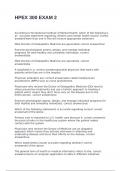
HPEX 300 Final Exam
3 Components of Healthcare (Iron Triangle) correct answers-Access
-Quality
-Cost Containment
U.S. Healthcare GDP (2014) correct answers17.5% (2.6 trillion)
Estimated 2024 U.S. Healthcare GDP correct answers20%
(4.64 trillion)
Factors of Increased Healthcare Spending in U.S. correct answers-
When prices increase in an economy overall, the cost of medical care
will increase
-Life expectancy increasing in the U.S.
-Technology & research
Payment of Healthcare Services in U.S. Derived from correct answers-
OOP payments
-Cost-sharing
-Health insurance plans
-Public/government funding
-Health savings accounts (HSAs)
Coinsurance correct answersSet proportion of medical costs
Deductibles correct answersPayments that are required prior to the
insurance paying for services rendered in a fee-for-service plan
Comprehensive Health Insurance Plans correct answersProvide benefits such
as:
-Inpatient/outpatient services
-Surgery
-Lab testing
-Medical equipment purchases
-Therapies
-Other services such as mental health
Major Medical Policies correct answersReimburse hospital services such as
surgeries and any expenses related to hospitalization
Types of Managed Care Plans correct answers-HMOs: health maintenance
orgs
-PPOs: preferred provider orgs
-POS: point of service
Stop-Loss Measure correct answersLimits the amount a company will pay
for claims
, Medicare Part A correct answersPrimarily finances from payroll taxes and is
considered hospital insurance
Medicare Part B correct answersSupplemental health plan to cover physician
services
Medicare Part C correct answersAlso referred to as Medicare advantage-
considered a managed care model
Medicare Part D correct answersAuthorized by the Medicare
prescription drug improvement and modernization act (MMA)-
produced the largest additions and changes to Medicare
"Donut Hole" correct answersCoverage gap in Medicare part D
No-Fault Liability correct answersDeveloped to avoid costly legal fees
because there is no process to assess blame
Retrospective Reimbursement correct answersA method in which a provider
submitted a bill to a health insurance company that automatically
reimbursed the provider, which gave no incentive to control costs in
healthcare
Prospective Reimbursement correct answersA method in which Medicare
payment is made based on a predetermined, fixed amount based on care
criteria for certain conditions, regardless of a providers costs
Capitated Rate correct answersThe set rate received by the healthcare
provider for serving enrolled patients regardless of how much care the
provider gives
Per Diem Rates correct answersAlso known as patient per day rates, it is
a defined dollar amount per day for care provided, which is the most
common form of reimbursement to hospitals
Certificate of Need (CON) correct answersAn act to ensure that the state
approved any capita expenditures associated with hospital and medical
facility construction and expansion
Home Health Resource Groups (HHRGs) correct answersA prospective
payment used by Medicare- pays a fixed predetermined rate for each 60-
day episode of care, regardless of the services
Resource Based Relative Scales (RBRVS) correct answersThe physician
payment system used by the CMS- based on the principle that payments
for physician services should vary with the resource costs for providing
those services and is intended to improve and stabilize the payment
system while providing physicians an avenue to continuously improve it
3 Components of Healthcare (Iron Triangle) correct answers-Access
-Quality
-Cost Containment
U.S. Healthcare GDP (2014) correct answers17.5% (2.6 trillion)
Estimated 2024 U.S. Healthcare GDP correct answers20%
(4.64 trillion)
Factors of Increased Healthcare Spending in U.S. correct answers-
When prices increase in an economy overall, the cost of medical care
will increase
-Life expectancy increasing in the U.S.
-Technology & research
Payment of Healthcare Services in U.S. Derived from correct answers-
OOP payments
-Cost-sharing
-Health insurance plans
-Public/government funding
-Health savings accounts (HSAs)
Coinsurance correct answersSet proportion of medical costs
Deductibles correct answersPayments that are required prior to the
insurance paying for services rendered in a fee-for-service plan
Comprehensive Health Insurance Plans correct answersProvide benefits such
as:
-Inpatient/outpatient services
-Surgery
-Lab testing
-Medical equipment purchases
-Therapies
-Other services such as mental health
Major Medical Policies correct answersReimburse hospital services such as
surgeries and any expenses related to hospitalization
Types of Managed Care Plans correct answers-HMOs: health maintenance
orgs
-PPOs: preferred provider orgs
-POS: point of service
Stop-Loss Measure correct answersLimits the amount a company will pay
for claims
, Medicare Part A correct answersPrimarily finances from payroll taxes and is
considered hospital insurance
Medicare Part B correct answersSupplemental health plan to cover physician
services
Medicare Part C correct answersAlso referred to as Medicare advantage-
considered a managed care model
Medicare Part D correct answersAuthorized by the Medicare
prescription drug improvement and modernization act (MMA)-
produced the largest additions and changes to Medicare
"Donut Hole" correct answersCoverage gap in Medicare part D
No-Fault Liability correct answersDeveloped to avoid costly legal fees
because there is no process to assess blame
Retrospective Reimbursement correct answersA method in which a provider
submitted a bill to a health insurance company that automatically
reimbursed the provider, which gave no incentive to control costs in
healthcare
Prospective Reimbursement correct answersA method in which Medicare
payment is made based on a predetermined, fixed amount based on care
criteria for certain conditions, regardless of a providers costs
Capitated Rate correct answersThe set rate received by the healthcare
provider for serving enrolled patients regardless of how much care the
provider gives
Per Diem Rates correct answersAlso known as patient per day rates, it is
a defined dollar amount per day for care provided, which is the most
common form of reimbursement to hospitals
Certificate of Need (CON) correct answersAn act to ensure that the state
approved any capita expenditures associated with hospital and medical
facility construction and expansion
Home Health Resource Groups (HHRGs) correct answersA prospective
payment used by Medicare- pays a fixed predetermined rate for each 60-
day episode of care, regardless of the services
Resource Based Relative Scales (RBRVS) correct answersThe physician
payment system used by the CMS- based on the principle that payments
for physician services should vary with the resource costs for providing
those services and is intended to improve and stabilize the payment
system while providing physicians an avenue to continuously improve it