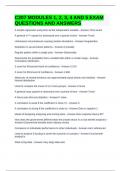
C207 MODULES 1, 2, 3, 4 AND 5 EXAM
QUESTIONS AND ANSWERS
A simple regression using time as the independent variable - Answer-Time series
A general s**** upward or downward over a period of time - Answer-Trend
Unforeseen circumstances causing random deviations - Answer-Irregularities
Repetition in up-and-down patterns - Answer-Cyclicality
Regular pattern within a single year - Answer-Seasonality
Represents the probability that a variable falls within a certain range - Answer-
Cumulative distribution
Z score for 99 percent level of confidence - Answer-2.576
Z score for 95% level of confidence - Answer-1.960
Measures of central tendency are approximately equal (mean and median) - Answer-
Normal distribution
Used to compare the mean of 3 or more groups - Answer-A Nova
A general soup upward or downward over a period of time - Answer-Trend
A Nova uses this test statistics - Answer-F value
A correlation is weak if the coefficient is close To - Answer-0
A correlation is strong if the coefficient is close to - Answer-One or negative 1
Model of designing analyzing and scoring tests - Answer-Item response theory IRT
How does the government different than the private sector in a cost benefit analysis's -
Answer-Government benefits aren't always money
Compares on individuals performance to other individuals - Answer-norm referenced
Used to analyze if funding is worth the outcome of a project - Answer-Cost benefit
analysis's
What is big data - Answer-Very large data sets
, Used to count all of the existing cases in a disease - Answer-Prevalence
Use account only the new cases of a disease - Answer-Incidents or incident rate
Compare individuals performance to a standard score - Answer-Criterion referenced
Used to analyze if funding is worth the outcome of a project - Answer-Cost benefit
analysis's
Management strategy that uses results of the central measurement of performance -
Answer-Results based management RBM
is the discovery, analysis and communication of meaningful patterns in data - Answer-
Analytics
is a prejudice in data that results when either the respondent or the interviewer have
and agenda that affects responses - Answer-Information Bias
places data into categories that are ordered by a predetermined criteria - Answer-
Ordinal Data
occurs when something (for example data or survey response) is missing - Answer-
Omission Error
is numerical data that is ordered, is equal distance apart and does not have a natural
zero - Answer-Interval Data
is consistent and repeatable - Answer-Reliable Data
represents errors in data caused by unpredictable statistical fluctuations - Answer-
Random Error
places data into "either or" categories or identifies by name or characteristic - Answer-
Nominal Data
includes cleaning and storage of collected data - Answer-Data management
is a massive amount of data that is difficult to process using traditional database and
software techniques - Answer-Big Data
is numerical data that has a natural zero allowing this data to be added, subtracted,
multiplied and divided - Answer-Ratio Data
is a prejudice in data that results when the sample is not representative of the
population be tested - Answer-Measurement Bias
QUESTIONS AND ANSWERS
A simple regression using time as the independent variable - Answer-Time series
A general s**** upward or downward over a period of time - Answer-Trend
Unforeseen circumstances causing random deviations - Answer-Irregularities
Repetition in up-and-down patterns - Answer-Cyclicality
Regular pattern within a single year - Answer-Seasonality
Represents the probability that a variable falls within a certain range - Answer-
Cumulative distribution
Z score for 99 percent level of confidence - Answer-2.576
Z score for 95% level of confidence - Answer-1.960
Measures of central tendency are approximately equal (mean and median) - Answer-
Normal distribution
Used to compare the mean of 3 or more groups - Answer-A Nova
A general soup upward or downward over a period of time - Answer-Trend
A Nova uses this test statistics - Answer-F value
A correlation is weak if the coefficient is close To - Answer-0
A correlation is strong if the coefficient is close to - Answer-One or negative 1
Model of designing analyzing and scoring tests - Answer-Item response theory IRT
How does the government different than the private sector in a cost benefit analysis's -
Answer-Government benefits aren't always money
Compares on individuals performance to other individuals - Answer-norm referenced
Used to analyze if funding is worth the outcome of a project - Answer-Cost benefit
analysis's
What is big data - Answer-Very large data sets
, Used to count all of the existing cases in a disease - Answer-Prevalence
Use account only the new cases of a disease - Answer-Incidents or incident rate
Compare individuals performance to a standard score - Answer-Criterion referenced
Used to analyze if funding is worth the outcome of a project - Answer-Cost benefit
analysis's
Management strategy that uses results of the central measurement of performance -
Answer-Results based management RBM
is the discovery, analysis and communication of meaningful patterns in data - Answer-
Analytics
is a prejudice in data that results when either the respondent or the interviewer have
and agenda that affects responses - Answer-Information Bias
places data into categories that are ordered by a predetermined criteria - Answer-
Ordinal Data
occurs when something (for example data or survey response) is missing - Answer-
Omission Error
is numerical data that is ordered, is equal distance apart and does not have a natural
zero - Answer-Interval Data
is consistent and repeatable - Answer-Reliable Data
represents errors in data caused by unpredictable statistical fluctuations - Answer-
Random Error
places data into "either or" categories or identifies by name or characteristic - Answer-
Nominal Data
includes cleaning and storage of collected data - Answer-Data management
is a massive amount of data that is difficult to process using traditional database and
software techniques - Answer-Big Data
is numerical data that has a natural zero allowing this data to be added, subtracted,
multiplied and divided - Answer-Ratio Data
is a prejudice in data that results when the sample is not representative of the
population be tested - Answer-Measurement Bias