©THEBRIGHT 2024/2025 ALL RIGHTS RESERVED 10:15AM A+
CSCC Psych Final Exam McGraw Hill Study
Guide 100% Verified.
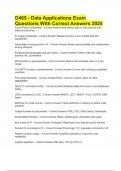
Psychology - Answer✔the scientific study of behavior and mental processes
Critical Thinking - Answer✔thinking that does not blindly accept arguments and conclusions.
Rather, it examines assumptions, discerns hidden values, evaluates evidence, and assesses
conclusions.
Wilhelm Wundt - Answer✔father of psychology
Contemporary Approaches - Answer✔biological, behavioral, psychodynamic, humanistic,
cognitive, evolutionary, sociocultural
Biological Approach - Answer✔an approach to psychology focusing on the body, especially the
brain and nervous system
Neuroscience Approach - Answer✔psychological perspective concerned with physiological and
biochemical factors that determine behavior and mental processes
Behavioral Approach - Answer✔An approach to psychology emphasizing the scientific study of
observable behavioral responses and their environmental determinants.
Psychodynamic Approach (Freud) - Answer✔an approach that regards personality as formed by
needs, strivings, and desires largely operating outside of awareness-motives that can also
produce emotional disorders
Humanistic Approach - Answer✔An approach to psychology emphasizing a person's positive
qualities, the capacity for positive growth, and the freedom to choose any destiny.
Cognitive Approach - Answer✔An approach to psychology emphasizing the mental processes
involved in knowing: how we direct our attention, perceive, remember, think, and solve
problems.
Evolutionary Approach - Answer✔An approach to psychology centered on evolutionary ideas
such as adaptation, reproduction, and natural selection as the basis for explaining specific
human behaviors.
1
, ©THEBRIGHT 2024/2025 ALL RIGHTS RESERVED 10:15AM A+
Sociocultural Approach - Answer✔An approach to psychology that examines the ways in which
social and cultural environments influence behavior.
Culture - Answer✔Beliefs, customs, and traditions of a specific group of people.
biopsysocial - Answer✔"to understand a person's medical condition it is not simply the
biological factors to consider, but also the psychological and social factors"
Psychology's Scientific Method - Answer✔1. Observing some phenomenon
2. Formulating hypotheses and predictions
3. Testing through empirical research
4. Drawing conclusions
5. Evaluating the theory
Theory - Answer✔A hypothesis that has been tested with a significant amount of data
Hypothesis - Answer✔A testable prediction, often implied by a theory
Three types of psychological research - Answer✔descriptive, correlational, experimental
Descriptive research - Answer✔research methods that involve observing behavior to describe
that behavior objectively and systematically
case study - Answer✔an observation technique in which one person is studied in depth in the
hope of revealing universal principles
correlational research - Answer✔the study of the naturally occurring relationships among
variables
correlation coefficient - Answer✔a statistical index of the relationship between two things
(from -1 to +1)
Correlation does not equal - Answer✔causation
experimental research - Answer✔gathering primary data by selecting matched groups of
subjects, giving them different treatments, controlling related factors, and checking for
differences in group responses
experiment - Answer✔A research method in which an investigator manipulates one or more
factors to observe the effect on some behavior or mental process
random assignment - Answer✔assigning participants to experimental and control conditions by
chance, thus minimizing preexisting differences between those assigned to the different groups
independent variable vs. dependent variable - Answer✔independent: manipulated or
controlled
2
CSCC Psych Final Exam McGraw Hill Study
Guide 100% Verified.
Psychology - Answer✔the scientific study of behavior and mental processes
Critical Thinking - Answer✔thinking that does not blindly accept arguments and conclusions.
Rather, it examines assumptions, discerns hidden values, evaluates evidence, and assesses
conclusions.
Wilhelm Wundt - Answer✔father of psychology
Contemporary Approaches - Answer✔biological, behavioral, psychodynamic, humanistic,
cognitive, evolutionary, sociocultural
Biological Approach - Answer✔an approach to psychology focusing on the body, especially the
brain and nervous system
Neuroscience Approach - Answer✔psychological perspective concerned with physiological and
biochemical factors that determine behavior and mental processes
Behavioral Approach - Answer✔An approach to psychology emphasizing the scientific study of
observable behavioral responses and their environmental determinants.
Psychodynamic Approach (Freud) - Answer✔an approach that regards personality as formed by
needs, strivings, and desires largely operating outside of awareness-motives that can also
produce emotional disorders
Humanistic Approach - Answer✔An approach to psychology emphasizing a person's positive
qualities, the capacity for positive growth, and the freedom to choose any destiny.
Cognitive Approach - Answer✔An approach to psychology emphasizing the mental processes
involved in knowing: how we direct our attention, perceive, remember, think, and solve
problems.
Evolutionary Approach - Answer✔An approach to psychology centered on evolutionary ideas
such as adaptation, reproduction, and natural selection as the basis for explaining specific
human behaviors.
1
, ©THEBRIGHT 2024/2025 ALL RIGHTS RESERVED 10:15AM A+
Sociocultural Approach - Answer✔An approach to psychology that examines the ways in which
social and cultural environments influence behavior.
Culture - Answer✔Beliefs, customs, and traditions of a specific group of people.
biopsysocial - Answer✔"to understand a person's medical condition it is not simply the
biological factors to consider, but also the psychological and social factors"
Psychology's Scientific Method - Answer✔1. Observing some phenomenon
2. Formulating hypotheses and predictions
3. Testing through empirical research
4. Drawing conclusions
5. Evaluating the theory
Theory - Answer✔A hypothesis that has been tested with a significant amount of data
Hypothesis - Answer✔A testable prediction, often implied by a theory
Three types of psychological research - Answer✔descriptive, correlational, experimental
Descriptive research - Answer✔research methods that involve observing behavior to describe
that behavior objectively and systematically
case study - Answer✔an observation technique in which one person is studied in depth in the
hope of revealing universal principles
correlational research - Answer✔the study of the naturally occurring relationships among
variables
correlation coefficient - Answer✔a statistical index of the relationship between two things
(from -1 to +1)
Correlation does not equal - Answer✔causation
experimental research - Answer✔gathering primary data by selecting matched groups of
subjects, giving them different treatments, controlling related factors, and checking for
differences in group responses
experiment - Answer✔A research method in which an investigator manipulates one or more
factors to observe the effect on some behavior or mental process
random assignment - Answer✔assigning participants to experimental and control conditions by
chance, thus minimizing preexisting differences between those assigned to the different groups
independent variable vs. dependent variable - Answer✔independent: manipulated or
controlled
2