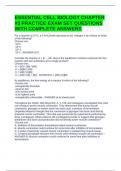
ESSENTIAL CELL BIOLOGY CHAPTER
#3 PRACTICE EXAM SET QUESTIONS
WITH COMPLETE ANSWERS
For a reaction at 37°C, a 5.94 kJ/mole decrease in ΔG changes K by a factor of which
of the following?
Choose one:
10^2
10^3
10^-1
10^1 - ANSWER-10^1
Consider the reaction A + B → AB. How is the equilibrium constant expressed for this
reaction with two substrates and a single product?
Choose one:
K = ([A] + [B]) / [AB]
K = [A][B] / [AB]
K = [AB] / [A][B]
K = [AB] / ([A] + [B]) - ANSWER-K = [AB] / [A][B]
At equilibrium, the free energy of a reaction is which of the following?
Choose one:
energetically favorable
equal to ΔG°
at its lowest point
at its highest point
energetically unfavorable - ANSWER-at its lowest point
Throughout the 1920s, Otto Meyerhof, A. V. Hill, and colleagues investigated how cells
use energy to power muscle contraction. They determined that during muscle
contraction, glycogen is broken down into lactic acid, a product of fermentation.
Originally Meyerhof thought that the conversion of glycogen into lactic acid directly
powered muscle contraction. This idea was overturned by experiments performed by
Einar Lundsgaard. What evidence did Lundsgaard provide to suggest that glycogen
breakdown and lactic acid production did not directly power muscle contraction?
Choose one:
A. Inhibition of fermentation immediately halted muscle contraction.
B. Muscle contraction could continue for some time after inhibition of fermentation.
C. A pulse of electricity caused muscle contraction in isolated frog muscle tissue.
D. Creatine phosphate infusions into muscle cells inhibited muscle cell contraction. -
ANSWER-B. Muscle contraction could continue for some time after inhibition of
fermentation.
#3 PRACTICE EXAM SET QUESTIONS
WITH COMPLETE ANSWERS
For a reaction at 37°C, a 5.94 kJ/mole decrease in ΔG changes K by a factor of which
of the following?
Choose one:
10^2
10^3
10^-1
10^1 - ANSWER-10^1
Consider the reaction A + B → AB. How is the equilibrium constant expressed for this
reaction with two substrates and a single product?
Choose one:
K = ([A] + [B]) / [AB]
K = [A][B] / [AB]
K = [AB] / [A][B]
K = [AB] / ([A] + [B]) - ANSWER-K = [AB] / [A][B]
At equilibrium, the free energy of a reaction is which of the following?
Choose one:
energetically favorable
equal to ΔG°
at its lowest point
at its highest point
energetically unfavorable - ANSWER-at its lowest point
Throughout the 1920s, Otto Meyerhof, A. V. Hill, and colleagues investigated how cells
use energy to power muscle contraction. They determined that during muscle
contraction, glycogen is broken down into lactic acid, a product of fermentation.
Originally Meyerhof thought that the conversion of glycogen into lactic acid directly
powered muscle contraction. This idea was overturned by experiments performed by
Einar Lundsgaard. What evidence did Lundsgaard provide to suggest that glycogen
breakdown and lactic acid production did not directly power muscle contraction?
Choose one:
A. Inhibition of fermentation immediately halted muscle contraction.
B. Muscle contraction could continue for some time after inhibition of fermentation.
C. A pulse of electricity caused muscle contraction in isolated frog muscle tissue.
D. Creatine phosphate infusions into muscle cells inhibited muscle cell contraction. -
ANSWER-B. Muscle contraction could continue for some time after inhibition of
fermentation.