
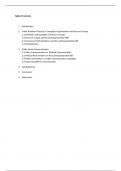
Table of Contents
1. Introduction
2. Public Relations Practice in Campaign Organisations and Pressure Groups
2.1 Definition and Examples of Pressure Groups
2.2 Pressure Groups and the Land Expropriation Bill
2.3 Consensus Public Relations and the Land Expropriation Bill
2.4 Self-Reflection
3. Public Sector Communication
3.1 Policy Communication vs. Political Communication
3.2 Political Party Position on the Land Expropriation Bill
3.3 Public Information vs. Public Communication Campaigns
3.4 Improving NSFAS Communication
4. Self-Reflection
5. Conclusion
6. References
, Introduction
Public relations play a critical role in shaping public opinion, influencing policy decisions, and
managing communication between organizations, governments, and the public. This assignment
explores the role of pressure groups in influencing policy changes, particularly in the context of the
Land Expropriation Bill in South Africa. It also examines how consensus public relations can help the
government communicate a unified message on the bill. Furthermore, the assignment discusses the
distinction between policy communication and political communication, the effectiveness of public
sector campaigns, and how NSFAS can improve its communication with students. The final section
provides a self-reflection on the key lessons learned and challenges encountered.
UNIT 1: PUBLIC RELATIONS PRACTICE IN CAMPAIGN ORGANISATIONS AND PRESSURE GROUPS
1.1 Pressure Groups and Examples
Pressure groups are organized groups of people who seek to influence public policy without
seeking to hold political office. They work to promote or resist changes in laws and policies by
lobbying, protesting, or campaigning.
Examples:
1. AfriForum – Advocates for property rights and opposes land expropriation.
2. Black First Land First (BLF) – Supports land expropriation without compensation.
3. Treatment Action Campaign (TAC) – Pressured the government for better HIV/AIDS
treatment.
4. Greenpeace Africa – Fights for environmental protection policies.
5. OUTA (Organisation Undoing Tax Abuse) – Challenges government policies on tax and
corruption.
1.2 Pressure Group and the Land Expropriation Bill
One pressure group involved in the land issue is AfriForum, which opposes the Land Expropriation
Bill.
Interest in the Issue:
AfriForum believes the bill threatens private property rights and investor confidence.
Steps Taken to Oppose the Bill:
1. Introduction
2. Public Relations Practice in Campaign Organisations and Pressure Groups
2.1 Definition and Examples of Pressure Groups
2.2 Pressure Groups and the Land Expropriation Bill
2.3 Consensus Public Relations and the Land Expropriation Bill
2.4 Self-Reflection
3. Public Sector Communication
3.1 Policy Communication vs. Political Communication
3.2 Political Party Position on the Land Expropriation Bill
3.3 Public Information vs. Public Communication Campaigns
3.4 Improving NSFAS Communication
4. Self-Reflection
5. Conclusion
6. References
, Introduction
Public relations play a critical role in shaping public opinion, influencing policy decisions, and
managing communication between organizations, governments, and the public. This assignment
explores the role of pressure groups in influencing policy changes, particularly in the context of the
Land Expropriation Bill in South Africa. It also examines how consensus public relations can help the
government communicate a unified message on the bill. Furthermore, the assignment discusses the
distinction between policy communication and political communication, the effectiveness of public
sector campaigns, and how NSFAS can improve its communication with students. The final section
provides a self-reflection on the key lessons learned and challenges encountered.
UNIT 1: PUBLIC RELATIONS PRACTICE IN CAMPAIGN ORGANISATIONS AND PRESSURE GROUPS
1.1 Pressure Groups and Examples
Pressure groups are organized groups of people who seek to influence public policy without
seeking to hold political office. They work to promote or resist changes in laws and policies by
lobbying, protesting, or campaigning.
Examples:
1. AfriForum – Advocates for property rights and opposes land expropriation.
2. Black First Land First (BLF) – Supports land expropriation without compensation.
3. Treatment Action Campaign (TAC) – Pressured the government for better HIV/AIDS
treatment.
4. Greenpeace Africa – Fights for environmental protection policies.
5. OUTA (Organisation Undoing Tax Abuse) – Challenges government policies on tax and
corruption.
1.2 Pressure Group and the Land Expropriation Bill
One pressure group involved in the land issue is AfriForum, which opposes the Land Expropriation
Bill.
Interest in the Issue:
AfriForum believes the bill threatens private property rights and investor confidence.
Steps Taken to Oppose the Bill:


