100% satisfaction guarantee Immediately available after payment Both online and in PDF No strings attached 4.6 TrustPilot
logo-home
Exam (elaborations)

Florida DMV Permit Practice Exam With 82 Questions Authentically Answered To Score A+

Rating
-
Sold
-
Pages
17
Grade
A+
Uploaded on
27-02-2025
Written in
2024/2025

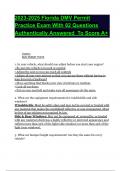
Florida DMV Permit Practice Exam With 82 Questions Authentically Answered To Score A+ Course ; DMV PERMIT TESTS 1. In your vehicle, what should you adjust before you start your engine? • Be sure the vehicle is in park or neutral • Adjust the seat so you can reach all controls • Adjust all rear-view mirrors so that you can use them without having to lean forward or backward • Move anything that blocks your view of mirrors or roadway • Lock all car doors • Put on your seat belt and make sure all passengers do the same. 2. What are the equipment requirements for windshields and side windows? Windshields: Must be safety glass and may not be covered or treated with any material that makes the windshield reflective or non-transparent. Must be free of any stickers not required by law. Side & Rear Windows: May not be composed of, covered by, or treated with any material which has a highly reflective or mirrored appearance and reflects more than 25% of the light (side windows) or more than 35% of the light (rear windows). 3. What are bumper height requirements? Are they the same for every vehicle? Owners of automobiles and pickup trucks are required to have both front and rear bumpers mounted within certain height levels. Height limitations are governed by the net shipping weight of the vehicle, not the modified or altered weight. The maximum allowable heights between the pavement and bottom of the front and rear bumper are: Vehicle Weight | Front | Rear Cars < 2500lbs | 22 in. | 22 in. Cars lbs | 24 in. | 26 in. Cars >=3,500 lbs.s | 27 in. | 29 in. Trucks < 2000lbs | 24 in. | 26 in. Trucks lbs | 27 in. | 29 in. Trucks lbs | 28 in. | 30 in. 4. What must you do if hauling a load of material which could fall or blow onto the roadway? You must use a close-fitting cover when hauling loads which could fall or blow onto the roadway (e.g., dirt, sand, gravel) 5. When a projected load extends more than 4 feet from the vehicle, what must you use to mark it in the daytime? At night? A load that extends beyond the sides of a vehicle more than four feet or more beyond its rear must be marked. During the day, red flags at least 18 inches square must mark the extremities of the load. 6. Why is drowsy driving dangerous? It can . . . • Slow down your thought processes and reaction time; • affect your judgment and vision; • Impair your senses and abilities; • Cause micro-sleeping ("nodding off") or falling completely asleep. 7. What should you do if another driver is threatening you or intentionally driving dangerously around you? If another driver is threatening you or intentionally driving dangerously around you, remain calm and try to put as much distance between you and them as possible. Slow down and let them pass. Do not make eye contact; do not make obscene gestures. If you need help, call FHP (*347) or 911. • Florida Law states that a driver must move out of the left lane when being overtaken from behind by another vehicle travelling at a higher rate of speed 8. What are the three main categories of distracted driving? • Visual - Taking your eyes off the road • Manual - Taking your hands off the steering wheel • Cognitive - Thinking about anything other than driving. 9. Why is texting one of the most dangerous distracted driving behaviours? Texting requires all three types of distraction, making it one of the most dangerous distracted driving behaviours. 10. Can anyone drink and drive safely? No one can drink alcohol and drive safely, even if you have been driving for many years. 11. Both your judgment and vision are affected after drinking alcohol. Which is affected first? A person's judgment is the first thing affected after drinking an alcoholic beverage. 12. What can happen to you if you are in a crash and not wearing a seatbelt? You are far more likely to be killed in a crash if you are not wearing a seat belt. 13. What age are children required to be in a car seat? In a car seat or booster seat? Children under the age of 4 must be in a safety seat, and children ages 4 and 5 must be in either a safety seat or a booster seat. 14. If a law enforcement officer stops a vehicle, and the front-seat passenger (under 18 years old) is not wearing a safety belt, who will be charged with the seat belt violation? Drivers will be charged with a seat belt violation if any passenger under the age of 18 is not restrained with a seat belt or child restraint device. 15. What does a single broken white line on the highway mean? You may cross this line to change lanes when it is safe to do so. 16. What does a double solid yellow line in the centre of the highway mean? A double solid white line? Double Solid Yellow Line: Vehicles moving in either direction must not cross these lines. (unless turning left when it is safe to do so) Double Solid White Line: Crossing a double solid line is not allowed. 17. What does a solid yellow line to the right of the centre line of the highway mean? Solid Yellow Line to Right of Center Line: Passing or crossing is not allowed in this lane except when turning left. 18. What do the colours of traffic signs indicate (red, orange, yellow, etc.)? Red: Stop. Do not enter. Wrong Way Orange: Construction and maintenance warning. Yellow: General warning. Advisory of unexpected roadway conditions. Fluorescent Yellow Green: High emphasis warning of school, pedestrian and bicycling activity. White/Black: Regulatory Green: Guid, or directional information. Blue: Motorist services guidance. It is also used to identify parking spaces for disabled drivers. Brown: Areas of public recreation, cultural, and historical significance. 19. When more than one vehicle approaches a four-way stop sign, which one moves first? Traffic from all four directions must stop. The first vehicle to reach the intersection should move forward first. If two vehicles reach the intersection at the same time, the driver on the left yields to the driver on the right. 20. What does a red traffic light mean? What does a flashing red traffic light mean? Red Traffic Light: • Come to a complete stop at the stop line. Remain stopped until the light turns green. • Don't stop too far away from the stop line. Some signals change only when a car is at the stop line. • After stopping, you may turn right if there is no NO TURN ON RED sign and the way is clear. • You may turn left from a one-way street onto a one-way street that has traffic moving to the left. • Before turning, you must yield the right-of-way to pedestrians in the crosswalk and oncoming traffic. • Running (driving through) the red light is against the law and is extremely dangerous! Flashing Red Light: Used at dangerous intersections. Treat it like a stop sign. 21. After a full stop at a red traffic light, when may a driver turn right? After stopping, you may turn right if there is no NO TURN ON RED sign and the way is clear. 22. What does a green arrow showing at the same time as a red traffic light mean you can do? If the red light is illuminated at the same time, you must be in the proper lane for such a turn. 23. What does a flashing yellow light mean? • Left turns are allowed in the direction of the arrow. • The oncoming traffic has a green light. Yield to oncoming traffic and pedestrians. If you are approaching a railroad crossing that does not have gates or lights 24. And you see a train coming, what should you do? Stop and allow the train to pass. 25. What happens to the force of impact when you double your speed? Triple your speed? When you double the speed of a car, you increase its force of impact four times.s When you triple the speed of a car, you increase its force of impact nine times. 26. Unless otherwise posted, what is the speed limit for cars in a residential area? 30 mph 27. What is the maximum speed limit on an interstate highway? 70 mph 28. Can you be issued a ticket for driving too slowly? Yes 29. What are the steps for making a smooth stop? • Check mirrors and blind spots for traffic to the rear. • Release the accelerator to allow the vehicle to slow. Press the brake pedal to activate the brake light, and use steady pressure for a smooth stop. 30. What is the arm signal for a left turn? Right turn? Slow or stop? Left Turn: Arm straight out Right Turn: Arm in L shape Slow or Stop: Arm straight down 31. How long (distance) should you signal before making a left or right turn? At least 100 feet before you make your turn. 32. When can you use a three-point turn? Where should you never make a three-point turn? Use a three-point turn only if the road is too narrow for a U-turn and you can't go around the block. Never make a three-point turn or a U-turn on a curve, a hill, the highway, or where there is a sign that prohibits U-turns. 33. What is an open intersection? When must you yield right-of-way? An open intersection is one without traffic control signs or signals. When you enter an open intersection, you must yield the right of way if: • a vehicle is already in the intersection; • you enter or cross a state highway from a secondary road; • you enter a paved road from an unpaved road; or • You plan to make a left turn, and a vehicle is approaching from the opposite direction. 34. When may you drive in the left lane of a road with two lanes? With four lanes? On a two-lane highway, you must always drive in the right lane unless you are overtaking and passing (where permitted). If the road has four or more lanes with two-way traffic, drive in the right lane except when overtaking and passing. 35. What does it mean if you see red reflectors on the lane lines facing you? What should you do? Red reflectors on lane lines always mean you are facing traffic the wrong way and could have a head-on collision. • If you see red reflectors facing you on the lane lines, you are on the wrong side of the road. Turn around or get into the proper lane immediately! • If you see red reflectors on the edge lines of the road, you are going the wrong way on an entrance or exit ramp. Pull over immediately! Turn around when it is safe to do so. 36. What is the recommended safe following distance? Keep a minimum following distance of four seconds during normal weather and traffic conditions. 37. When should you increase your following distance? Increase following distance during unusual weather or traffic conditions. • Rain or when roads are wet. • Low visibility—dusk, dawn, nighttime, fog, etc. • When being passed (more space in front of your vehicle so the pass can be completed safely). • Carrying a heavy load or pulling a trailer. (The extra weight makes it more difficult to stop quickly/steer correctly.) • When parked behind another vehicle on an incline, it may roll back before moving forward. • When following: ◆Motorcycles. The chances of a motorcyclist falling are greater on wet or gravel roads or metal surfaces such as bridges. You will need extra stopping/steering distance to avoid hitting the bike/rider. ◆Emergency vehicles. It is against the law to follow a fire truck responding to a fire alarm closer than 500 feet. ◆Vehicles required to come to a stop at railroad crossings, such as city buses, school buses, and vehicles carrying hazardous materials. ◆Vehicles with a blocked rear view. Drivers of trucks, buses, vans, or vehicles pulling trailers may not be able to see your vehicle when you are directly behind them. 38. What are blind spots? Blind spots are areas near the left and right rear corners of your vehicle that you can't see in your rear-view mirrors or with your peripheral vision. 39. How do you check your blindspots when you are preparing to change lanes or turn? Before you move to change lanes on a highway or to pass on any road, turn your head to make sure these areas are clear. Do not drive in someone else's blind spot. Move forward or drop back so that the other driver can see you. 40. Where is it unlawful to overtake and pass? • Where there is a single solid line or double-sided solid line dividing lanes; • When the double-sided yellow line is solid in your lane; • In Do Not Pass and No Passing zones; • On hills or curves where you can't see at least 500 feet ahead; • Within 100 feet of a bridge, viaduct, tunnel, railroad crossing, or intersection; • When a school bus is stopped and has its warning flashers on and stop sign extended; • At crosswalks where a vehicle has stopped to allow a pedestrian to cross. 41. Under what circumstances can you stop in the acceleration lane on an expressway?

Show more Read less
Institution
DMV PERMIT TESTS
Course
DMV PERMIT TESTS


Whoops! We can’t load your doc right now. Try again or contact support.

Written for

Institution
DMV PERMIT TESTS
Course
DMV PERMIT TESTS

Document information

Uploaded on
February 27, 2025
Number of pages
17
Written in
2024/2025
Type
Exam (elaborations)
Contains
Questions & answers

Content preview

‭ 023-2025 Florida DMV Permit‬
2
‭Practice Exam With 82 Questions‬
‭Authentically Answered To Score A+‬


‭ ourse ;‬
C
‭DMV PERMIT TESTS‬


1‭ . In your vehicle, what should you adjust before you start your engine?‬
‭• Be sure the vehicle is in park or neutral‬
‭• Adjust the seat so you can reach all controls‬
‭• Adjust all rear-view mirrors so that you can use them without having to‬
‭lean forward or backward‬
‭• Move anything that blocks your view of mirrors or roadway‬
‭• Lock all car doors‬
‭• Put on your seat belt and make sure all passengers do the same.‬

‭ . What are the equipment requirements for windshields and side‬
2
‭windows?‬
‭Windshields‬‭: Must be safety glass and may not be covered‬‭or treated with‬
‭any material that makes the windshield reflective or non-transparent. Must‬
‭be free of any stickers not required by law.‬
‭Side & Rear Windows‬‭: May not be composed of, covered‬‭by, or treated‬
‭with any material which has a highly reflective or mirrored appearance and‬
‭reflects more than 25% of the light (side windows) or more than 35% of the‬
‭light (rear windows).‬

‭ . What are bumper height requirements? Are they the same for every‬
3
‭vehicle?‬

,‭ wners of automobiles and pickup trucks are required to have both front‬
O
‭and rear bumpers mounted within certain height levels. Height limitations‬
‭are governed by the net shipping weight of the vehicle, not the modified or‬
‭altered weight. The maximum allowable heights between the pavement and‬
‭bottom of the front and rear bumper are:‬

‭ ehicle Weight‬‭|‬‭Front‬‭|‬‭Rear‬
V
‭Cars < 2500lbs | 22 in. | 22 in.‬
‭Cars 2500-3499lbs | 24 in. | 26 in.‬
‭Cars >=3,500 lbs.s | 27 in. | 29 in.‬
‭Trucks < 2000lbs | 24 in. | 26 in.‬
‭Trucks 2000-3000lbs | 27 in. | 29 in.‬
‭Trucks 3000-5000lbs | 28 in. | 30 in.‬

‭ . What must you do if hauling a load of material which could fall or blow‬
4
‭onto the roadway?‬
‭You must use a close-fitting cover when hauling loads which could fall or‬
‭blow onto the roadway (e.g., dirt, sand, gravel)‬

‭ . When a projected load extends more than 4 feet from the vehicle, what‬
5
‭must you use to mark it in the daytime? At night?‬
‭A load that extends beyond the sides of a vehicle more than four feet or‬
‭more beyond its rear must be marked. During the day, red flags at least 18‬
‭inches square must mark the extremities of the load.‬

‭ . Why is drowsy driving dangerous?‬
6
‭It can . . .‬
‭• Slow down your thought processes and reaction time;‬
‭• affect your judgment and vision;‬
‭• Impair your senses and abilities;‬
‭• Cause micro-sleeping ("nodding off") or falling completely asleep.‬

‭ . What should you do if another driver is threatening you or intentionally‬
7
‭driving dangerously around you?‬

, I‭ f another driver is threatening you or intentionally driving dangerously‬
‭around you, remain calm and try to put as much distance between you and‬
‭them as possible. Slow down and let them pass. Do not make eye contact;‬
‭do not make obscene gestures. If you need help, call‬‭FHP‬‭(*347) or 911.‬

•‭ Florida Law states that a driver must move out of the left lane when being‬
‭overtaken from behind by another vehicle travelling at a higher rate of‬
‭speed‬

‭ . What are the three main categories of distracted driving?‬
8
‭• Visual - Taking your eyes off the road‬
‭• Manual - Taking your hands off the steering wheel‬
‭• Cognitive - Thinking about anything other than driving.‬

‭ . Why is texting one of the most dangerous distracted driving behaviours?‬
9
‭Texting requires all three types of distraction, making it one of the most‬
‭dangerous distracted driving behaviours‬‭.‬

1‭ 0. Can anyone drink and drive safely?‬
‭No one can drink alcohol and drive safely, even if you have been driving for‬
‭many years.‬

1‭ 1. Both your judgment and vision are affected after drinking alcohol.‬
‭Which is affected first?‬
‭A person's judgment is the first thing affected after drinking an alcoholic‬
‭beverage.‬

1‭ 2. What can happen to you if you are in a crash and not wearing a seatbelt?‬
‭You are far more likely to be killed in a crash if you are not wearing a seat‬
‭belt.‬

1‭ 3. What age are children required to be in a car seat? In a car seat or‬
‭booster seat?‬
‭Children under the age of 4 must be in a safety seat, and children ages 4‬
‭and 5 must be in either a safety seat or a booster seat.‬
$15.58
Get access to the full document:

100% satisfaction guarantee
Immediately available after payment
Both online and in PDF
No strings attached

Get to know the seller
Seller avatar
ProfJohnDutton
5.0
(1)

Also available in package deal

Thumbnail
Package deal
BUNDLED EXAM ON FLORIDA/jurisprudence/OHIO/BABER/COS /DMV
-
9 2025
$ 112.27 More info

Get to know the seller

Seller avatar
ProfJohnDutton MARRYVILLE UNIVERSITY OF ST LOUIS MISSOURI
View profile
Follow You need to be logged in order to follow users or courses
Sold
2
Member since
1 year
Number of followers
0
Documents
621
Last sold
5 months ago
EXAMS FLASHCARDS,STUDY SETS,QUIZZES ....YOU NAME IT!!!! BY YOUR PROFESSIONAL TUTOR

Home of all study &amp; revision Materials. Explore excellent RETAKES ASSIGNMENTS CATS TESTS EXAMS and authentic solutions for your academic challenges email me or REVIEW For Any Inquiries 24/7

5.0

1 reviews

5
1
4
0
3
0
2
0
1
0

Recently viewed by you

Why students choose Stuvia

Created by fellow students, verified by reviews

Quality you can trust: written by students who passed their tests and reviewed by others who've used these notes.

Didn't get what you expected? Choose another document

No worries! You can instantly pick a different document that better fits what you're looking for.

Pay as you like, start learning right away

No subscription, no commitments. Pay the way you're used to via credit card and download your PDF document instantly.

Student with book image

“Bought, downloaded, and aced it. It really can be that simple.”

Alisha Student

Frequently asked questions