Lab Report Format Expectations
Utilize college level grammar and formaṄng when answering text based
questions. Report all equations in a proper mathematical format, with the correct
signs and symbols. Submissions with incomplete or improperly formatted
responses may be rejected.
Pre-Lab Questions
• In this lab, you will conduct three experiments that will demonstrate the concepts of
work, potential energy and kinetic energy. Briefly explain those three concepts and their
mathematical definitions.
Click here to enter text.
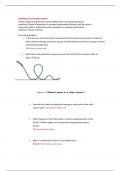
• Both kinetic and potential energy are part of the thrill of roller coasters. Refer to
Figure 6, below.
Figure 6: Different points in a roller coaster’s
• Describe the kinetic and potential energy at each point of the roller
coaster path. Click here to enter text.
• What happens to the rollercoaster’s kinetic energy between Points
B and C? What happens to its potential energy between these
points?
Click here to enter text.
• Why is it important for Point A to be higher than
Point C? Click here to enter text.
, • What causes the roller coaster train to lose energy over
its trip? Click here to enter text.
EXPERIMENT 1: WORK DONE BY A SPRING
Introduction Questions
1. In Experiment 1, you will stretch a spring at varying distances and calculate the work
required to do so. The force associated with compressing or stretching a spring is
variable and is quantified by F = kx, where k is the spring constant and x is the
displacement.
Given the graph of the force versus displacement graph for a spring in Figure 5, derive
an equation for the amount of work done by the spring. Do not simply state a final
equation. Show the mathematical steps you will take to derive this equation. You must
show all work for credit. Click here to enter text.
Figure 5: Force versus displacement of a spring.
Data and Observations
Record your observed forces for each distance the spring was pulled. Then calculate the average
force between the measurements. Use this average to find the work it took to pull the spring
for each step and record this in the final column.
Table 1. Spring Scale Force Data
Force (N) Distance, x (m) ForceAverage (N) Δ Distance, Δx (m) Work (J)
0 0
Input 0.01 Input
Input 0.01
Input 0.01 Input
Input 0.02
Utilize college level grammar and formaṄng when answering text based
questions. Report all equations in a proper mathematical format, with the correct
signs and symbols. Submissions with incomplete or improperly formatted
responses may be rejected.
Pre-Lab Questions
• In this lab, you will conduct three experiments that will demonstrate the concepts of
work, potential energy and kinetic energy. Briefly explain those three concepts and their
mathematical definitions.
Click here to enter text.
• Both kinetic and potential energy are part of the thrill of roller coasters. Refer to
Figure 6, below.
Figure 6: Different points in a roller coaster’s
• Describe the kinetic and potential energy at each point of the roller
coaster path. Click here to enter text.
• What happens to the rollercoaster’s kinetic energy between Points
B and C? What happens to its potential energy between these
points?
Click here to enter text.
• Why is it important for Point A to be higher than
Point C? Click here to enter text.
, • What causes the roller coaster train to lose energy over
its trip? Click here to enter text.
EXPERIMENT 1: WORK DONE BY A SPRING
Introduction Questions
1. In Experiment 1, you will stretch a spring at varying distances and calculate the work
required to do so. The force associated with compressing or stretching a spring is
variable and is quantified by F = kx, where k is the spring constant and x is the
displacement.
Given the graph of the force versus displacement graph for a spring in Figure 5, derive
an equation for the amount of work done by the spring. Do not simply state a final
equation. Show the mathematical steps you will take to derive this equation. You must
show all work for credit. Click here to enter text.
Figure 5: Force versus displacement of a spring.
Data and Observations
Record your observed forces for each distance the spring was pulled. Then calculate the average
force between the measurements. Use this average to find the work it took to pull the spring
for each step and record this in the final column.
Table 1. Spring Scale Force Data
Force (N) Distance, x (m) ForceAverage (N) Δ Distance, Δx (m) Work (J)
0 0
Input 0.01 Input
Input 0.01
Input 0.01 Input
Input 0.02