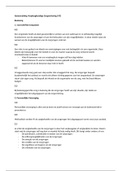
Summary Academic Skills II
Week 1
What is research?
Research quality
= the reliable, validity, credibility and ethical practice of a piece of research
Research is a process
= an on-going, often continuous series of actions intended to achieve a specific result. This often requires the
researcher to follow an established set of routine procedures
Research is identified as
= a process or practice by which we can extend our knowledge or find answers to our questions
Characteristics
1. The question
2. The research process
3. The answer
The nature of research
- Structured and purposeful
- Rigorous (strictly planned and conducted)
- Robust and defensible (how did we arrive to conclusions)
- Systematic
- It is not simply gathering information/facts or divorced from practical life
The four key aspects to research quality
1. Reliability → Can my results be replicated by other researchers using the same methods?
- Dependability
- Transparency
2. Validity and credibility → am I researching the thing that I think I am?
→ are the gathered data relevant to my research question?
3. Generalisability and transferability → How far am I able to claim that the findings are relevant to the
wider population or a different context?
4. Ethical practice → Have i given full consideration to the way I behave as researcher with respect to others
involved
,Some useful things to remember
● Research is a process.
● Research has to be planned. It does not happen by accident.
● Facts and data are not necessarily the same as knowledge.
● Description is not the same as explanation.
● Research must be robust and rigorous. It must be capable of withstanding criticism and challenge from
individuals and organisations who may not agree with the methods used or the findings produced.
Knowledge, theories, paradigms and perspectives
Ontology
= the science of ‘what is’ of the kinds and structures of objects, properties, events, processes and relations in every
area of reality
= the science or study of being; in social research, ontology refers to the way the social world is seen to be and
what can be assumed about the nature and reality of the social phenomena that make up the social world.
Social phenomena can include social groups of people (family, gender, ethnic group, institutions, social behavior
etc.)
❖ Ontological positions
● Objectivism
- the social phenomena that make up our social world have an existence of their own
● Constructivism
- the social phenomena that make up our social world are only real in the sense that they
are constructed ideas which are continually being reviewed and reworked by those
involved in them, through social interaction and reflection
- There is no social reality, it is constructed by the social actors
- For example, ‘family’ is the product of the meaning given to it by the participants
● Realism
- Accepts that the social world has a reality separate from the social actors involved in it, which is
known through the senses.
- Suggests that there are hidden mechanisms and structures which cannot be directly observed
- “We use theories about our social world and ourselves as social beings to help us
to identify potential hidden mechanisms and understand how they work.”
Epistemology
= the theory of knowledge and how we know things
- It presents a view and a justification for what can be regarded as knowledge
- What can be known and what criteria must such knowledge satisfy in order to be called knowledge, rather
than beliefs?
❖ Epistemological positions
● Positivism
, - Knowledge is defined as that which can be observed by the senses rather than subjective
understandings
- Data are gathered to test a hypothesis from existing theory
- Researcher is independent, no impact on the data, = objective
➔ Quantitative data
➔ Social phenomena is measured
➔ Causal relationships
➔ Large data sets and statistical analysis
● Interpetivism
- Social research must prioritize people’s subjective interpretations and understandings of
the social phenomena and their own actions, enabling different perspectives to be
explored
- Uses theories and concepts of the social researcher’s discipline, through the eyes of the
people being researchers
- Gathers data to generate theory
➔ Qualitative data
➔ Uncovering and working with subjective meanings
➔ Interpretation of meaning within specific context
➔ Empathetic understanding, ‘standing in the other’s
shoes’
● Realism
- Knowledge of a social phenomenon is based on both what can be observed and ‘hidden’
structures and mechanisms whose effects can be observed
- Critical realist approach = prioritizes identifying structures/mechanisms that result in
inequality, thus offers social change by changing those that are identified as having these
impacts
➔ Revealing hidden structures and mechanisms
➔ Uncovering power relations and dominant ideologies
➔ Research that leads to action
➔ Collecting qualitative and/or quantitative data
Five ways of knowing
1. Belief
2. Authoritative knowledge
- We may feel convinced that something is true because an authority tells us so
3. Experiential knowing
- Knowledge built up from experience, difficult to express to others
4. Theoretical knowing
- Having a theory or set of ideas helps work out a response to a problem or explain
5. Empirical knowledge
Week 1
What is research?
Research quality
= the reliable, validity, credibility and ethical practice of a piece of research
Research is a process
= an on-going, often continuous series of actions intended to achieve a specific result. This often requires the
researcher to follow an established set of routine procedures
Research is identified as
= a process or practice by which we can extend our knowledge or find answers to our questions
Characteristics
1. The question
2. The research process
3. The answer
The nature of research
- Structured and purposeful
- Rigorous (strictly planned and conducted)
- Robust and defensible (how did we arrive to conclusions)
- Systematic
- It is not simply gathering information/facts or divorced from practical life
The four key aspects to research quality
1. Reliability → Can my results be replicated by other researchers using the same methods?
- Dependability
- Transparency
2. Validity and credibility → am I researching the thing that I think I am?
→ are the gathered data relevant to my research question?
3. Generalisability and transferability → How far am I able to claim that the findings are relevant to the
wider population or a different context?
4. Ethical practice → Have i given full consideration to the way I behave as researcher with respect to others
involved
,Some useful things to remember
● Research is a process.
● Research has to be planned. It does not happen by accident.
● Facts and data are not necessarily the same as knowledge.
● Description is not the same as explanation.
● Research must be robust and rigorous. It must be capable of withstanding criticism and challenge from
individuals and organisations who may not agree with the methods used or the findings produced.
Knowledge, theories, paradigms and perspectives
Ontology
= the science of ‘what is’ of the kinds and structures of objects, properties, events, processes and relations in every
area of reality
= the science or study of being; in social research, ontology refers to the way the social world is seen to be and
what can be assumed about the nature and reality of the social phenomena that make up the social world.
Social phenomena can include social groups of people (family, gender, ethnic group, institutions, social behavior
etc.)
❖ Ontological positions
● Objectivism
- the social phenomena that make up our social world have an existence of their own
● Constructivism
- the social phenomena that make up our social world are only real in the sense that they
are constructed ideas which are continually being reviewed and reworked by those
involved in them, through social interaction and reflection
- There is no social reality, it is constructed by the social actors
- For example, ‘family’ is the product of the meaning given to it by the participants
● Realism
- Accepts that the social world has a reality separate from the social actors involved in it, which is
known through the senses.
- Suggests that there are hidden mechanisms and structures which cannot be directly observed
- “We use theories about our social world and ourselves as social beings to help us
to identify potential hidden mechanisms and understand how they work.”
Epistemology
= the theory of knowledge and how we know things
- It presents a view and a justification for what can be regarded as knowledge
- What can be known and what criteria must such knowledge satisfy in order to be called knowledge, rather
than beliefs?
❖ Epistemological positions
● Positivism
, - Knowledge is defined as that which can be observed by the senses rather than subjective
understandings
- Data are gathered to test a hypothesis from existing theory
- Researcher is independent, no impact on the data, = objective
➔ Quantitative data
➔ Social phenomena is measured
➔ Causal relationships
➔ Large data sets and statistical analysis
● Interpetivism
- Social research must prioritize people’s subjective interpretations and understandings of
the social phenomena and their own actions, enabling different perspectives to be
explored
- Uses theories and concepts of the social researcher’s discipline, through the eyes of the
people being researchers
- Gathers data to generate theory
➔ Qualitative data
➔ Uncovering and working with subjective meanings
➔ Interpretation of meaning within specific context
➔ Empathetic understanding, ‘standing in the other’s
shoes’
● Realism
- Knowledge of a social phenomenon is based on both what can be observed and ‘hidden’
structures and mechanisms whose effects can be observed
- Critical realist approach = prioritizes identifying structures/mechanisms that result in
inequality, thus offers social change by changing those that are identified as having these
impacts
➔ Revealing hidden structures and mechanisms
➔ Uncovering power relations and dominant ideologies
➔ Research that leads to action
➔ Collecting qualitative and/or quantitative data
Five ways of knowing
1. Belief
2. Authoritative knowledge
- We may feel convinced that something is true because an authority tells us so
3. Experiential knowing
- Knowledge built up from experience, difficult to express to others
4. Theoretical knowing
- Having a theory or set of ideas helps work out a response to a problem or explain
5. Empirical knowledge