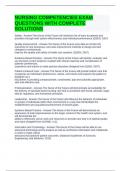
NURSING COMPETENCIES EXAM
QUESTIONS WITH COMPLETE
SOLUTIONS
Safety - Answer-The Nurse of the Future will minimize risk of harm to patients and
providers through both system effectiveness and individual performance (QSEN, 2007)
Quality Improvement - Answer-The Nurse of the Future uses data to monitor the
outcomes of care processes, and uses improvement methods to design and test
changes to continuously
improve the quality and safety of health care systems. (QSEN, 2007)
Evidence-Based Practice - Answer-The Nurse of the Future will identify, evaluate, and
use the best current evidence coupled with clinical expertise and consideration of
patients' preferences,
experience and values to make practice decisions (Adapted from QSEN, 2007).
Patient-Centered Care - Answer-The Nurse of the Future will provide holistic care that
recognizes an individual's preferences, values, and needs and respects the patient or
designee as a
full partner in providing compassionate, coordinated, age and culturally appropriate,
safe and effective care.
Professionalism - Answer-The Nurse of the Future will demonstrate accountability for
the delivery of standard-based nursing care that is consistent with moral, altruistic, legal,
ethical, regulatory, and humanistic principles.
Leadership - Answer-The Nurse of the Future will influence the behavior of individuals
or groups of individuals within their environment in a way that will facilitate the
establishment and acquisition/achievement of shared goals.
Systems-Based Practice - Answer-The Nurse of the Future will demonstrate an
awareness of and responsiveness to the larger context of the health care system, and
will demonstrate the
ability to effectively call on work unit resources to provide care that is of optimal quality
and value (Adapted from ACGME, n.d.).
Informatics and Technology - Answer-The Nurse of the Future will be able to use
advanced technology and to analyze as well as synthesize information and collaborate
in order to make critical
decisions that optimize patient outcomes. (National Academies of Sciences,
Engineering, and Medicine. 2015)
QUESTIONS WITH COMPLETE
SOLUTIONS
Safety - Answer-The Nurse of the Future will minimize risk of harm to patients and
providers through both system effectiveness and individual performance (QSEN, 2007)
Quality Improvement - Answer-The Nurse of the Future uses data to monitor the
outcomes of care processes, and uses improvement methods to design and test
changes to continuously
improve the quality and safety of health care systems. (QSEN, 2007)
Evidence-Based Practice - Answer-The Nurse of the Future will identify, evaluate, and
use the best current evidence coupled with clinical expertise and consideration of
patients' preferences,
experience and values to make practice decisions (Adapted from QSEN, 2007).
Patient-Centered Care - Answer-The Nurse of the Future will provide holistic care that
recognizes an individual's preferences, values, and needs and respects the patient or
designee as a
full partner in providing compassionate, coordinated, age and culturally appropriate,
safe and effective care.
Professionalism - Answer-The Nurse of the Future will demonstrate accountability for
the delivery of standard-based nursing care that is consistent with moral, altruistic, legal,
ethical, regulatory, and humanistic principles.
Leadership - Answer-The Nurse of the Future will influence the behavior of individuals
or groups of individuals within their environment in a way that will facilitate the
establishment and acquisition/achievement of shared goals.
Systems-Based Practice - Answer-The Nurse of the Future will demonstrate an
awareness of and responsiveness to the larger context of the health care system, and
will demonstrate the
ability to effectively call on work unit resources to provide care that is of optimal quality
and value (Adapted from ACGME, n.d.).
Informatics and Technology - Answer-The Nurse of the Future will be able to use
advanced technology and to analyze as well as synthesize information and collaborate
in order to make critical
decisions that optimize patient outcomes. (National Academies of Sciences,
Engineering, and Medicine. 2015)