GED WRITING STUDY GUIDE WITH
CORRECT ANSWERS
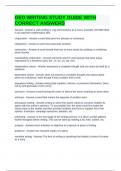
Gerund - Answer-a verb ending in -ing and functions as a noun; example: ESTIMATING
is an important mathematics skill.
conjunction - Answer-a word that joins two phrases or sentences
interjection - Answer-a word that expresses emotion
contraction - Answer-a word formed from two or more words by omitting or combining
some sounds
coordinating conjunction - Answer-connects word or word groups that have equal
importance in a sentence (and, but , or, for, so, yet, nor)
independent clause - Answer-expresses a complete thought and can stand by itself as a
sentence
dependent clause - Answer-does not express a complete thought and cannot stand
alone as a sentence, even though it has a subject and a verb,
expository writing - Answer-writing that explains, informs, or presents information. Does
not try and persuade or tell a story
synonym - Answer-a word having the same or almost the same meaning as some other
antonym - Answer-a word that means the opposite of another word
persuasive writing - Answer-writing in which the author wants to convince readers to
agree with the author's opinions. To accomplish this, the writer must first make the
issues clear to the reader and then provide incidents and facts to support his or her
opinion. Examples: campaign speeches, debates, etc.
prewriting - Answer-is the first stage of the writing process. It is when a writer gathers
his/her thoughts before writing. This can be done by making a list, web, outline, etc.
purpose - Answer-one's intention or objective in a speech or piece of writing
audience - Answer-the intended reader of a piece
narrative writing - Answer-The kind of writing or speaking that relates a series of events
as a story.
CORRECT ANSWERS
Gerund - Answer-a verb ending in -ing and functions as a noun; example: ESTIMATING
is an important mathematics skill.
conjunction - Answer-a word that joins two phrases or sentences
interjection - Answer-a word that expresses emotion
contraction - Answer-a word formed from two or more words by omitting or combining
some sounds
coordinating conjunction - Answer-connects word or word groups that have equal
importance in a sentence (and, but , or, for, so, yet, nor)
independent clause - Answer-expresses a complete thought and can stand by itself as a
sentence
dependent clause - Answer-does not express a complete thought and cannot stand
alone as a sentence, even though it has a subject and a verb,
expository writing - Answer-writing that explains, informs, or presents information. Does
not try and persuade or tell a story
synonym - Answer-a word having the same or almost the same meaning as some other
antonym - Answer-a word that means the opposite of another word
persuasive writing - Answer-writing in which the author wants to convince readers to
agree with the author's opinions. To accomplish this, the writer must first make the
issues clear to the reader and then provide incidents and facts to support his or her
opinion. Examples: campaign speeches, debates, etc.
prewriting - Answer-is the first stage of the writing process. It is when a writer gathers
his/her thoughts before writing. This can be done by making a list, web, outline, etc.
purpose - Answer-one's intention or objective in a speech or piece of writing
audience - Answer-the intended reader of a piece
narrative writing - Answer-The kind of writing or speaking that relates a series of events
as a story.