FTCE Professional Exam ACTUAL Exam
Questions and CORRECT Answers
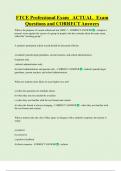
What is the purpose of a norm-referenced test (NRT) ? - CORRECT ANSWER - compare a
person's score against the scores of a group of people who have already taken the same exam,
called the "norming group."
A student's permanent school record should be discussed with the:
a) student's parents/legal guardians, current teachers, and school administrators.
b) parents only.
c)school administrators only.
d) school administrators and parents only. - CORRECT ANSWER - student's parents/legal
guardians, current teachers, and school administrators.
When are students more likely to score higher on a test?
a) when the questions are multiple choice
b) when they are not coached by a teacher
c) when they are familiar with the test format and content
d) when the format is always changing - CORRECT ANSWER - when they are familiar with
the test format and content
When a teacher asks the class if they agree or disagree with a student's response, the teacher is
using:
a) redirect
b) corrective
c) positive feedback
d) direct response - CORRECT ANSWER - redirect
, Written academic feedback is most productive when it:
a) is delayed by a day
b) is uniform
c) includes at least one positive feedback
d) is not specific - CORRECT ANSWER - includes at least one positive feedback
Before working with mathematical word problems, a teacher needs to determine that:
a) the student can complete the math unit
b) the student is at a high enough reading level to understand the problems
c) the math textbook mirrors the skills used in the word problems
d) the class will be on-task for the problems - CORRECT ANSWER - the student is at a high
enough reading level to understand the problems
Children under the age of eight
a) are unable to answer questions
b) process information more slowly than older children
c) can answer the same questions as slightly older children
d) cannot learn in a cooperative environment - CORRECT ANSWER - process information
more slowly than older children
Marshall Rosenberg categorized learners as
a)rigid-inhibited, undisciplined, acceptance-anxious, and creative
b) undisciplined and high achieving
c) undisciplined, disciplined, and high achieving
Questions and CORRECT Answers
What is the purpose of a norm-referenced test (NRT) ? - CORRECT ANSWER - compare a
person's score against the scores of a group of people who have already taken the same exam,
called the "norming group."
A student's permanent school record should be discussed with the:
a) student's parents/legal guardians, current teachers, and school administrators.
b) parents only.
c)school administrators only.
d) school administrators and parents only. - CORRECT ANSWER - student's parents/legal
guardians, current teachers, and school administrators.
When are students more likely to score higher on a test?
a) when the questions are multiple choice
b) when they are not coached by a teacher
c) when they are familiar with the test format and content
d) when the format is always changing - CORRECT ANSWER - when they are familiar with
the test format and content
When a teacher asks the class if they agree or disagree with a student's response, the teacher is
using:
a) redirect
b) corrective
c) positive feedback
d) direct response - CORRECT ANSWER - redirect
, Written academic feedback is most productive when it:
a) is delayed by a day
b) is uniform
c) includes at least one positive feedback
d) is not specific - CORRECT ANSWER - includes at least one positive feedback
Before working with mathematical word problems, a teacher needs to determine that:
a) the student can complete the math unit
b) the student is at a high enough reading level to understand the problems
c) the math textbook mirrors the skills used in the word problems
d) the class will be on-task for the problems - CORRECT ANSWER - the student is at a high
enough reading level to understand the problems
Children under the age of eight
a) are unable to answer questions
b) process information more slowly than older children
c) can answer the same questions as slightly older children
d) cannot learn in a cooperative environment - CORRECT ANSWER - process information
more slowly than older children
Marshall Rosenberg categorized learners as
a)rigid-inhibited, undisciplined, acceptance-anxious, and creative
b) undisciplined and high achieving
c) undisciplined, disciplined, and high achieving