NBME Physiology
Study online at https://quizlet.com/_d44x9c
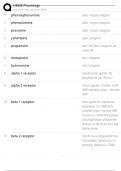
1. phenoxybenamine alpha 1 receptor antagonist
2. phentolamine alpha 1 receptor antagonist
3. prazosine alpha 1 receptor antagonist
4. yohimbine alpha 2 antagonist
5. propanolol beta 1 AND beta 2 antagonist- de-
creases HR
6. metoprolol beta 1 antagonist
7. butoxamine beta 2 antagonist
8. alpha 1 receptor smooth muscle, agonists= NE
phenylephrine, Gq= IP3/Ca+2
9. alpha 2 receptor GI tract, agonists= Clonidine, Gi=IN-
HIBITS adenylate cyclase--> decrease
cAMP
10. beta 1 receptor heart, agonist=NE isoproterenol
dobutamine, Gs= STIMULATES
adenylate cyclase-->increase cAMP
increase Ca+ current during plateau
and phosphorylates phosolambin=
increase Ca+ into SR and more avail-
able for release
11. beta 2 receptor smooth muscle (lungs,skeletal mus-
cle,GI,bladder), agonists=Epi, iso-
proterenol, albuterol,Gs= STIMU-
, NBME Physiology
Study online at https://quizlet.com/_d44x9c
LATES adenylate cyclase-->increase
cAMP
12. Curare Nicotinic (NMJ N1) antagonist= com-
petes with Ach
13. Hexamethonium Nicotinic (ganglionic N2) antagonist
= blocks re-uptake of choline into
presynaptic terminal
14. Atropine muscarinic antagonist= competes
with Ach
15. nicotinic receptors Nm=N1=NMJ, Nn=N2=autonomic
ganglia and adrenal medulla, activat-
ed by ACh or nicotine-> excitation by
opening Na+/K+ channels
16. Muscarinic receptors M1 M1=CNS, Ach--> Gq--> IP3 Ca+2
17. Muscarinic receptors M2 M2=heart, INHIBITORY,
Ach-->Gi-->decrease cAMP (opening
of K+ channels, slowing rate if spon-
taneous phase 4 depolarization, de-
creased HR)
18. Muscarinic receptors M3 M3=glands/smooth muscle, excita-
tory: Ach-->Gq-->PLC-->IP3-->Ca+2
19. opioids receptors for pain are free nerve end-
ings-substance P bind nociceptors
(opioids block release substance P)
20. emmetropia normal vision- light focuses on retina
, NBME Physiology
Study online at https://quizlet.com/_d44x9c
21. hypertropia farsighted-light focuses BEHIND reti-
na- fixed by conVEX lens
22. myopia nearsighted- light focuses in FONT
retina- fixed biconCAVE lens
23. astigmatism curvature of lens not uniform- fixed
by cylindric lens
24. presbyopia loss of accomidation power due to
age- corrected with convex
25. glycosides (digitalis) inhibit Na+/K+ATPase--> decrease
Na+ outside cell and decrease
Na+/Ca+ exchange--> increase Ca+
inside cell-->increase contractility=
+inotropism
26. captopril ACE inhibitor--> block angiotension 1
to angiotension II --> decrease BP
27. losartan Angiotension receptor (AT1) antago-
nist= block action AII and decrease BP
28. angiotension-converting enzyme inhibitors dilate efferent arterioles --> dec GFR
(reduce hyperfiltration and diabetic
nephropathy in diabetes mellitus)
29. Atrial natriuretic peptide (ANP) vasodilation of afferent arteriole (vas-
constriction efferent)--> increase RBF
and GFR
30.
, NBME Physiology
Study online at https://quizlet.com/_d44x9c
prostoglandins E2 and I2, bradykinin, nitric ox- vasodilation of renal arterioles in-
ide, dopamine crease RBF
31. Furosemide (lasix) loop diuretic (TAL) inhibit Na+/K+/Cl-
(causes hypokalemia and inc. Ca+ ex-
cretion: Ca+2 reabsorption coupled
to Na+ reabsorption)
32. ethacrynic acid loop diuretic (TAL) inhibit Na+/K+/Cl-
33. bumetanide loop diuretic (TAL) inhibit Na+/K+/Cl-
34. spironolactone K+ sparing diuretic - aldosterone an-
tagonist
35. triamterene K+ sparing diuretic - principal cells
36. amiloride K+ sparing diuretic - principal cells
37. thiazide distal tubule diuretic (inhibits
Na+/Cl- cotransport) (treatment for
idiopathic hypercalciuria)
38. PTH secretion in response to de-
crease Ca+ - fast- mechanism: ba-
solateral receptor-->adenylate cy-
clase-->cAMP-->urine, Action: de-
crease phosphate reabsorption(PT),
increase Ca+ reabsorption (DT), stim-
ulate 1hydroxylase (PT)
39. ADH Stimulus: inc. osmolarity ,dec. blood
volume-fast- mechanism: basolat-
eral V2-->adenylate cyclase-->cAMP,
Study online at https://quizlet.com/_d44x9c
1. phenoxybenamine alpha 1 receptor antagonist
2. phentolamine alpha 1 receptor antagonist
3. prazosine alpha 1 receptor antagonist
4. yohimbine alpha 2 antagonist
5. propanolol beta 1 AND beta 2 antagonist- de-
creases HR
6. metoprolol beta 1 antagonist
7. butoxamine beta 2 antagonist
8. alpha 1 receptor smooth muscle, agonists= NE
phenylephrine, Gq= IP3/Ca+2
9. alpha 2 receptor GI tract, agonists= Clonidine, Gi=IN-
HIBITS adenylate cyclase--> decrease
cAMP
10. beta 1 receptor heart, agonist=NE isoproterenol
dobutamine, Gs= STIMULATES
adenylate cyclase-->increase cAMP
increase Ca+ current during plateau
and phosphorylates phosolambin=
increase Ca+ into SR and more avail-
able for release
11. beta 2 receptor smooth muscle (lungs,skeletal mus-
cle,GI,bladder), agonists=Epi, iso-
proterenol, albuterol,Gs= STIMU-
, NBME Physiology
Study online at https://quizlet.com/_d44x9c
LATES adenylate cyclase-->increase
cAMP
12. Curare Nicotinic (NMJ N1) antagonist= com-
petes with Ach
13. Hexamethonium Nicotinic (ganglionic N2) antagonist
= blocks re-uptake of choline into
presynaptic terminal
14. Atropine muscarinic antagonist= competes
with Ach
15. nicotinic receptors Nm=N1=NMJ, Nn=N2=autonomic
ganglia and adrenal medulla, activat-
ed by ACh or nicotine-> excitation by
opening Na+/K+ channels
16. Muscarinic receptors M1 M1=CNS, Ach--> Gq--> IP3 Ca+2
17. Muscarinic receptors M2 M2=heart, INHIBITORY,
Ach-->Gi-->decrease cAMP (opening
of K+ channels, slowing rate if spon-
taneous phase 4 depolarization, de-
creased HR)
18. Muscarinic receptors M3 M3=glands/smooth muscle, excita-
tory: Ach-->Gq-->PLC-->IP3-->Ca+2
19. opioids receptors for pain are free nerve end-
ings-substance P bind nociceptors
(opioids block release substance P)
20. emmetropia normal vision- light focuses on retina
, NBME Physiology
Study online at https://quizlet.com/_d44x9c
21. hypertropia farsighted-light focuses BEHIND reti-
na- fixed by conVEX lens
22. myopia nearsighted- light focuses in FONT
retina- fixed biconCAVE lens
23. astigmatism curvature of lens not uniform- fixed
by cylindric lens
24. presbyopia loss of accomidation power due to
age- corrected with convex
25. glycosides (digitalis) inhibit Na+/K+ATPase--> decrease
Na+ outside cell and decrease
Na+/Ca+ exchange--> increase Ca+
inside cell-->increase contractility=
+inotropism
26. captopril ACE inhibitor--> block angiotension 1
to angiotension II --> decrease BP
27. losartan Angiotension receptor (AT1) antago-
nist= block action AII and decrease BP
28. angiotension-converting enzyme inhibitors dilate efferent arterioles --> dec GFR
(reduce hyperfiltration and diabetic
nephropathy in diabetes mellitus)
29. Atrial natriuretic peptide (ANP) vasodilation of afferent arteriole (vas-
constriction efferent)--> increase RBF
and GFR
30.
, NBME Physiology
Study online at https://quizlet.com/_d44x9c
prostoglandins E2 and I2, bradykinin, nitric ox- vasodilation of renal arterioles in-
ide, dopamine crease RBF
31. Furosemide (lasix) loop diuretic (TAL) inhibit Na+/K+/Cl-
(causes hypokalemia and inc. Ca+ ex-
cretion: Ca+2 reabsorption coupled
to Na+ reabsorption)
32. ethacrynic acid loop diuretic (TAL) inhibit Na+/K+/Cl-
33. bumetanide loop diuretic (TAL) inhibit Na+/K+/Cl-
34. spironolactone K+ sparing diuretic - aldosterone an-
tagonist
35. triamterene K+ sparing diuretic - principal cells
36. amiloride K+ sparing diuretic - principal cells
37. thiazide distal tubule diuretic (inhibits
Na+/Cl- cotransport) (treatment for
idiopathic hypercalciuria)
38. PTH secretion in response to de-
crease Ca+ - fast- mechanism: ba-
solateral receptor-->adenylate cy-
clase-->cAMP-->urine, Action: de-
crease phosphate reabsorption(PT),
increase Ca+ reabsorption (DT), stim-
ulate 1hydroxylase (PT)
39. ADH Stimulus: inc. osmolarity ,dec. blood
volume-fast- mechanism: basolat-
eral V2-->adenylate cyclase-->cAMP,