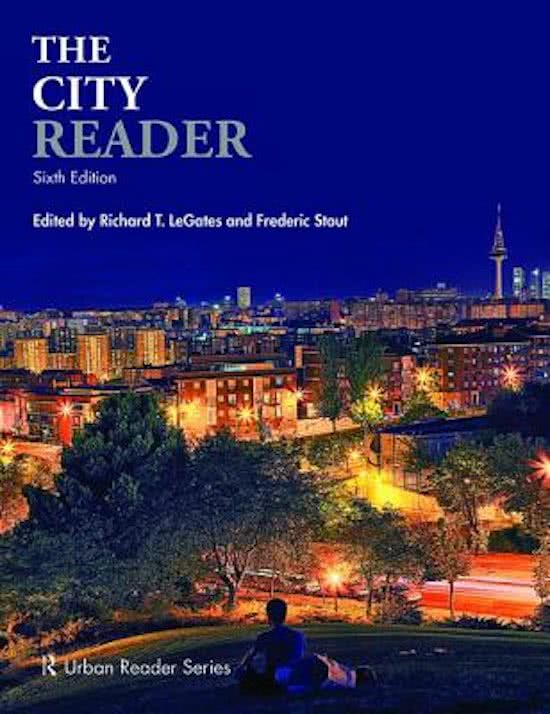
Authors in this summary:
Kingsley Davis
Childe
Kitto
Pirenne
Engels
Warner
Olmsted
Howard
Mumford
Wirth
Tönnies
Jackson
Du Bois
Anderson
Putnam
Bruegmann
Le Corbusier
Wright
Kingsley Davis (1908-1996)
Kingsley Davis concluded that urbanization is primarily caused by rural-urban migration, not because
of other possible factors such as differential birth and mortality rates.
Another finding Kingsley Davis had was that of the so called S-Curve which illustrated the growth of
pre-industrial cities. The cities grow very slowly at the bottom of the S, shoot up at the middle of the
S as they industrialize, and then level off at the top of the S.
1. Urbanization slowly increases
2. Rapid urbanization due to the industrial revolution
3. Urbanization flattening out as the area is almost fully urbanized.
Davis also said that there will be an end to urbanization – but not necessarily to absolute population
growth, the physical size of cities, or the absolute number of people cities contain.
Davis stressed the impact of overall population growth (which he saw as a real danger) on world
urbanization and implies that family planning is essential if cities are to meet human needs.
, Vere Gordon Childe (1892-1957)
Childe’s most important work is that of him throwing out the ‘’three age system’’ (stone, bronze and
iron) that had been left over from nineteenth century conception of human historical development.
In its place he proposed a series of four stages punctuated by three ‘’revolutions’’ or fundamental
shifts in cultural development.
According to childe the first revolution from old stone age hunter-gather cultures to settled
agriculture was the Neolithic Revolution.
The second revolution the movement from Neolithic agriculture to complex, hierarchical systems of
city-based manufacturing and trade was the Urban revolution. And the third major shift in the
record of human cultural and historical development the last true development since the rise of the
cities was the Industrial revolution
He then instead used revolutions:
Paleolithic Neolithic (Tools/fire)
Neolithic Urban (Agriculture/trade)
Urban Industrial (Steam/coal/iron/fertilizers/mass-production/social change)
Industrial ????? (internet, globalization)
Childe felt that the major factors motivating the transformation were rooted in the material base of
the society: its means of production and its available physical and technological resources. It could
be said that all factors that determine a city rest on the need to increase food production through
irrigation systems and that of the community to protect itself by building walls and fortifications.
H.D.F. Kitto (1897-1982)
The ideal polis was a living community, almost an extended family. While the Greek were very
private in many ways, Kitto notes that their public life was very communistic. For example private
houses were low and small, but the Greeks however emphasized public temples, stadiums, the
agora, and theaters. The community often devoted many of its resources to public building and
shrines.
Polis ≠ Greek city-state
Self-governing community
The lack of inter-dependence
Rejects determinism: Not topography nor economy determined the polis
The “character of the Greeks” (cultural determinism?)
Expresses nostalgia of polis-life
Conceptually ahead of his time
The poleis of Greece were self governing and self providing mini states within the country. Each of
them had their own ‘’king’’ and rules and regulations.
Within the great cities of Greece there were also public spaces, the so called agora were the ordinary
working class man could relax. These places can be compared today with local parks.
One of the major differences between the Greek poleis and for example the empire of Rome was
that Rome needed an huge area that provided for the city and that the Greek poleis were more self-
sufficient.
Kingsley Davis
Childe
Kitto
Pirenne
Engels
Warner
Olmsted
Howard
Mumford
Wirth
Tönnies
Jackson
Du Bois
Anderson
Putnam
Bruegmann
Le Corbusier
Wright
Kingsley Davis (1908-1996)
Kingsley Davis concluded that urbanization is primarily caused by rural-urban migration, not because
of other possible factors such as differential birth and mortality rates.
Another finding Kingsley Davis had was that of the so called S-Curve which illustrated the growth of
pre-industrial cities. The cities grow very slowly at the bottom of the S, shoot up at the middle of the
S as they industrialize, and then level off at the top of the S.
1. Urbanization slowly increases
2. Rapid urbanization due to the industrial revolution
3. Urbanization flattening out as the area is almost fully urbanized.
Davis also said that there will be an end to urbanization – but not necessarily to absolute population
growth, the physical size of cities, or the absolute number of people cities contain.
Davis stressed the impact of overall population growth (which he saw as a real danger) on world
urbanization and implies that family planning is essential if cities are to meet human needs.
, Vere Gordon Childe (1892-1957)
Childe’s most important work is that of him throwing out the ‘’three age system’’ (stone, bronze and
iron) that had been left over from nineteenth century conception of human historical development.
In its place he proposed a series of four stages punctuated by three ‘’revolutions’’ or fundamental
shifts in cultural development.
According to childe the first revolution from old stone age hunter-gather cultures to settled
agriculture was the Neolithic Revolution.
The second revolution the movement from Neolithic agriculture to complex, hierarchical systems of
city-based manufacturing and trade was the Urban revolution. And the third major shift in the
record of human cultural and historical development the last true development since the rise of the
cities was the Industrial revolution
He then instead used revolutions:
Paleolithic Neolithic (Tools/fire)
Neolithic Urban (Agriculture/trade)
Urban Industrial (Steam/coal/iron/fertilizers/mass-production/social change)
Industrial ????? (internet, globalization)
Childe felt that the major factors motivating the transformation were rooted in the material base of
the society: its means of production and its available physical and technological resources. It could
be said that all factors that determine a city rest on the need to increase food production through
irrigation systems and that of the community to protect itself by building walls and fortifications.
H.D.F. Kitto (1897-1982)
The ideal polis was a living community, almost an extended family. While the Greek were very
private in many ways, Kitto notes that their public life was very communistic. For example private
houses were low and small, but the Greeks however emphasized public temples, stadiums, the
agora, and theaters. The community often devoted many of its resources to public building and
shrines.
Polis ≠ Greek city-state
Self-governing community
The lack of inter-dependence
Rejects determinism: Not topography nor economy determined the polis
The “character of the Greeks” (cultural determinism?)
Expresses nostalgia of polis-life
Conceptually ahead of his time
The poleis of Greece were self governing and self providing mini states within the country. Each of
them had their own ‘’king’’ and rules and regulations.
Within the great cities of Greece there were also public spaces, the so called agora were the ordinary
working class man could relax. These places can be compared today with local parks.
One of the major differences between the Greek poleis and for example the empire of Rome was
that Rome needed an huge area that provided for the city and that the Greek poleis were more self-
sufficient.