NR 328 CHILD ABUSE CASE STUDY|2025 UPDATE WITH COMPLETE SOLUTION
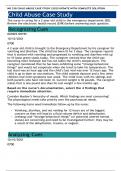
Child Abuse Case Study
The nurse is caring for a 2-year-old child in the emergency department (ED).
Review the electronic health record (EHR) before answering each question.
Recognizing Cues
NURSES NOTES
10/10/20XX
0700
A 2-year-old child is brought to the Emergency Department by his caregiver for
vomiting and diarrhea. The child has been ill for 3 days. The caregiver reports
that it started with vomiting and progressed to vomiting and diarrhea with up
to 10 loose green stools today. The caregiver noticed that the child was
becoming more lethargic but has not taken the child’s temperature. The
caregiver mentioned that he has been exhibiting some “strange behavioral
things” and would not cooperate when she tried to take his temperature. The
last stool was an hour ago and the child’s last void was over 12 hours ago. The
child is up to date on vaccinations. The child attends daycare and a few other
children had mild symptoms last week. The child lives with his siblings and
both parents who have not been ill. Current weight is 30 pounds. The caregiver
states that is one pound less than his last weight a few months ago.
Based on the nurse’s documentation, select the 4 findings that
require immediate attention.
Consider Maslow’s hierarchy of needs. Which findings are most concerning?
The physiological needs take priority over the psychosocial needs.
The following items need immediate follow-up by the nurse:
• Vomiting, diarrhea, and not voiding for 12 hours are of the biggest
concern as they will lead to a fluid volume deficit and dehydration.
• Lethargy and “strange behavioral things” (or potential altered mental
status) are concerning and need to be investigated further; they may be
a result of the dehydration, trauma, or neglect.
Analyzing Cues
10/10/20XX
0700
, A 2-year-old child is brought to the Emergency Department by his caregiver for
vomiting and diarrhea. The child has been ill for 3 days. The caregiver reports
that it started with vomiting and progressed to vomiting and diarrhea with up
to 10 loose green stools today. The caregiver noticed that the child was
becoming more lethargic but has not taken the child’s temperature. The
caregiver mentioned that he has been exhibiting some “strange behavioral
things” and would not cooperate when she tried to take his temperature. The
last stool was an hour ago and the child’s last void was over 12 hours ago. The
child is up to date on vaccinations. The child attends daycare and a few other
children had mild symptoms last week. The child lives with his siblings and
both parents who have not been ill. Current weight is 30 pounds. The caregiver
states that is one pound less than his last weight a few months ago.
10/10/20XX
0730
Initial physical assessment reveals:
Neuro: Screams when touched. Does not respond with any recognizable words.
Quieter if caregiver is close and helping him.
CV: WNL+ 2 pulses in all extremities. Capillary refill > 3 seconds.
Resp: Breath sounds clear on room air. No retractions or upper airway noise,
good aeration.
GI: hyperactive bowel sounds present all quads. Loose, green stools
GU: no void in last 12 hours
Integ: noticeable, hand-size bruising under arms bilaterally. Tented skin
MS: WNL.
ENT: MM dry. Eyes sunken. No tears when crying. Pain FACES 4/5 abdomen
and under arms
VS: BP 78/52, T 38C (100.5 F), P 134, RR 30, oxygen saturation 100%
For each client finding below, click to specify if the finding is
consistent with the disease process. Select only the most likely
disease process for each finding.
Different disease processes can have overlapping symptoms. In some cases,
like with gastroenteritis, the client may also be dehydrated. Here is a list of
some common clinical manifestations (cues) for each of these disease
processes.
• Dehydration
• weight loss
• capillary refill greater than 4 seconds
• tachycardia
Child Abuse Case Study
The nurse is caring for a 2-year-old child in the emergency department (ED).
Review the electronic health record (EHR) before answering each question.
Recognizing Cues
NURSES NOTES
10/10/20XX
0700
A 2-year-old child is brought to the Emergency Department by his caregiver for
vomiting and diarrhea. The child has been ill for 3 days. The caregiver reports
that it started with vomiting and progressed to vomiting and diarrhea with up
to 10 loose green stools today. The caregiver noticed that the child was
becoming more lethargic but has not taken the child’s temperature. The
caregiver mentioned that he has been exhibiting some “strange behavioral
things” and would not cooperate when she tried to take his temperature. The
last stool was an hour ago and the child’s last void was over 12 hours ago. The
child is up to date on vaccinations. The child attends daycare and a few other
children had mild symptoms last week. The child lives with his siblings and
both parents who have not been ill. Current weight is 30 pounds. The caregiver
states that is one pound less than his last weight a few months ago.
Based on the nurse’s documentation, select the 4 findings that
require immediate attention.
Consider Maslow’s hierarchy of needs. Which findings are most concerning?
The physiological needs take priority over the psychosocial needs.
The following items need immediate follow-up by the nurse:
• Vomiting, diarrhea, and not voiding for 12 hours are of the biggest
concern as they will lead to a fluid volume deficit and dehydration.
• Lethargy and “strange behavioral things” (or potential altered mental
status) are concerning and need to be investigated further; they may be
a result of the dehydration, trauma, or neglect.
Analyzing Cues
10/10/20XX
0700
, A 2-year-old child is brought to the Emergency Department by his caregiver for
vomiting and diarrhea. The child has been ill for 3 days. The caregiver reports
that it started with vomiting and progressed to vomiting and diarrhea with up
to 10 loose green stools today. The caregiver noticed that the child was
becoming more lethargic but has not taken the child’s temperature. The
caregiver mentioned that he has been exhibiting some “strange behavioral
things” and would not cooperate when she tried to take his temperature. The
last stool was an hour ago and the child’s last void was over 12 hours ago. The
child is up to date on vaccinations. The child attends daycare and a few other
children had mild symptoms last week. The child lives with his siblings and
both parents who have not been ill. Current weight is 30 pounds. The caregiver
states that is one pound less than his last weight a few months ago.
10/10/20XX
0730
Initial physical assessment reveals:
Neuro: Screams when touched. Does not respond with any recognizable words.
Quieter if caregiver is close and helping him.
CV: WNL+ 2 pulses in all extremities. Capillary refill > 3 seconds.
Resp: Breath sounds clear on room air. No retractions or upper airway noise,
good aeration.
GI: hyperactive bowel sounds present all quads. Loose, green stools
GU: no void in last 12 hours
Integ: noticeable, hand-size bruising under arms bilaterally. Tented skin
MS: WNL.
ENT: MM dry. Eyes sunken. No tears when crying. Pain FACES 4/5 abdomen
and under arms
VS: BP 78/52, T 38C (100.5 F), P 134, RR 30, oxygen saturation 100%
For each client finding below, click to specify if the finding is
consistent with the disease process. Select only the most likely
disease process for each finding.
Different disease processes can have overlapping symptoms. In some cases,
like with gastroenteritis, the client may also be dehydrated. Here is a list of
some common clinical manifestations (cues) for each of these disease
processes.
• Dehydration
• weight loss
• capillary refill greater than 4 seconds
• tachycardia