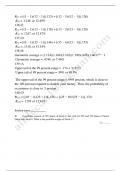
R(5) = [(5 − 1)/(12 − 1)](.123) + [(12 − 5)/(12 − 1)](.126)
R(5) = .1249, or 12.49%
136) E
R(3) = [(3 − 1)/(13 − 1)](.118) + [(13 − 3)/(13 − 1)](.126)
R(3) = .1247, or 12.47%
137) D
R(6) = [(6 − 1)/(15 − 1)](.146) + [(15 − 6)/(15 − 1)](.155)
R(6) = .1518, or 15.18%
138) B
Geometric average = (1.124)(1.166)(1.102)(1.190)(.843)(1.063)1/6 − 1
Geometric average = .0746, or 7.46%
139) A
Upper tail of the 99 percent range = .174 + 3(.275)
Upper tail of 99 percent range = .999, or 99.9%
The upper tail of the 99 percent range is 99.9 percent, which is close to
the 100 percent required to double your money. Thus, the probability of
occurrence is close to .5 percent.
140) D
R(10) = [(10 − 1)/(25 − 1)](.126) + [(25 − 10)/(25 − 1)](.131)
R(10) = .1291 or 12.91%
Student name:
1) A portfolio consists of 185 shares of Stock C that sells for $39 and 150 shares of Stock
Dthat sells for $41. What is the portfolio weight of Stock C?
1)
, A) .4602
B) .3944
C) .5398
D) .6073
E) .5848
Question Details
Difficulty : 1 Basic
Topic : Portfolio weights
Section : 13.2 Portfolios
AACSB : Analytical Thinking
Learning Objective : 13-01 Show how to calculate expected returns, variance, and standard deviation.
Bloom's : Understand
Accessibility : Keyboard Navigation
Accessibility : Screen Reader Compatible
2) You own the following portfolio of stocks. What is the portfolio weight of Stock C?
Stock Number of Shares Price per Share
A 120 $ 29
B 720 $ 25
C 450 $ 49
D 220 $ 48
2)
A) .6882
B) .3328
C) .1952
D) .0643
E) .4077
,Question Details
Difficulty : 1 Basic
Topic : Portfolio weights
Section : 13.2 Portfolios
AACSB : Analytical Thinking
Learning Objective : 13-01 Show how to calculate expected returns, variance, and standard deviation.
Bloom's : Understand
Accessibility : Keyboard Navigation
Accessibility : Screen Reader Compatible
3) You own 370 shares of Stock X at a price of $31 per share, 240 shares of Stock Y at a
price of $54 per share, and 305 shares of Stock Z at a price of $77 per share. What is the
portfolio weight of Stock Y?
3)
A) .2705
B) .2394
C) .3043
D) .4901
E) .4201
Question Details
Difficulty : 1 Basic
Topic : Portfolio weights
Section : 13.2 Portfolios
AACSB : Analytical Thinking
Learning Objective : 13-01 Show how to calculate expected returns, variance, and standard deviation.
Bloom's : Understand
Accessibility : Keyboard Navigation
Accessibility : Screen Reader Compatible
4) You have a portfolio of two stocks that has a total value of $49,000. The portfolio is 61
percent invested in Stock J. If you own 290 shares of Stock K, what is Stock K's share price?
4)
, A) $65.90
B) $58.57
C) $62.90
D) $61.50
E) $60.41
Question Details
Difficulty : 1 Basic
Topic : Portfolio weights
Section : 13.2 Portfolios
AACSB : Analytical Thinking
Learning Objective : 13-01 Show how to calculate expected returns, variance, and standard deviation.
Bloom's : Understand
Accessibility : Keyboard Navigation
Accessibility : Screen Reader Compatible
5) A portfolio consists of $15,200 in Stock M and $23,400 invested in Stock N. The
expected return on these stocks is 8.90 percent and 12.50 percent, respectively. What is the
expected return on the portfolio?
5)
A) 10.32%
B) 9.46%
C) 11.79%
D) 10.70%
E) 11.08%
Question Details
Difficulty : 1 Basic
Section : 13.2 Portfolios
AACSB : Analytical Thinking
Learning Objective : 13-01 Show how to calculate expected returns, variance, and standard deviation.
Topic : Portfolio return
Bloom's : Understand
Accessibility : Keyboard Navigation
Accessibility : Screen Reader Compatible
R(5) = .1249, or 12.49%
136) E
R(3) = [(3 − 1)/(13 − 1)](.118) + [(13 − 3)/(13 − 1)](.126)
R(3) = .1247, or 12.47%
137) D
R(6) = [(6 − 1)/(15 − 1)](.146) + [(15 − 6)/(15 − 1)](.155)
R(6) = .1518, or 15.18%
138) B
Geometric average = (1.124)(1.166)(1.102)(1.190)(.843)(1.063)1/6 − 1
Geometric average = .0746, or 7.46%
139) A
Upper tail of the 99 percent range = .174 + 3(.275)
Upper tail of 99 percent range = .999, or 99.9%
The upper tail of the 99 percent range is 99.9 percent, which is close to
the 100 percent required to double your money. Thus, the probability of
occurrence is close to .5 percent.
140) D
R(10) = [(10 − 1)/(25 − 1)](.126) + [(25 − 10)/(25 − 1)](.131)
R(10) = .1291 or 12.91%
Student name:
1) A portfolio consists of 185 shares of Stock C that sells for $39 and 150 shares of Stock
Dthat sells for $41. What is the portfolio weight of Stock C?
1)
, A) .4602
B) .3944
C) .5398
D) .6073
E) .5848
Question Details
Difficulty : 1 Basic
Topic : Portfolio weights
Section : 13.2 Portfolios
AACSB : Analytical Thinking
Learning Objective : 13-01 Show how to calculate expected returns, variance, and standard deviation.
Bloom's : Understand
Accessibility : Keyboard Navigation
Accessibility : Screen Reader Compatible
2) You own the following portfolio of stocks. What is the portfolio weight of Stock C?
Stock Number of Shares Price per Share
A 120 $ 29
B 720 $ 25
C 450 $ 49
D 220 $ 48
2)
A) .6882
B) .3328
C) .1952
D) .0643
E) .4077
,Question Details
Difficulty : 1 Basic
Topic : Portfolio weights
Section : 13.2 Portfolios
AACSB : Analytical Thinking
Learning Objective : 13-01 Show how to calculate expected returns, variance, and standard deviation.
Bloom's : Understand
Accessibility : Keyboard Navigation
Accessibility : Screen Reader Compatible
3) You own 370 shares of Stock X at a price of $31 per share, 240 shares of Stock Y at a
price of $54 per share, and 305 shares of Stock Z at a price of $77 per share. What is the
portfolio weight of Stock Y?
3)
A) .2705
B) .2394
C) .3043
D) .4901
E) .4201
Question Details
Difficulty : 1 Basic
Topic : Portfolio weights
Section : 13.2 Portfolios
AACSB : Analytical Thinking
Learning Objective : 13-01 Show how to calculate expected returns, variance, and standard deviation.
Bloom's : Understand
Accessibility : Keyboard Navigation
Accessibility : Screen Reader Compatible
4) You have a portfolio of two stocks that has a total value of $49,000. The portfolio is 61
percent invested in Stock J. If you own 290 shares of Stock K, what is Stock K's share price?
4)
, A) $65.90
B) $58.57
C) $62.90
D) $61.50
E) $60.41
Question Details
Difficulty : 1 Basic
Topic : Portfolio weights
Section : 13.2 Portfolios
AACSB : Analytical Thinking
Learning Objective : 13-01 Show how to calculate expected returns, variance, and standard deviation.
Bloom's : Understand
Accessibility : Keyboard Navigation
Accessibility : Screen Reader Compatible
5) A portfolio consists of $15,200 in Stock M and $23,400 invested in Stock N. The
expected return on these stocks is 8.90 percent and 12.50 percent, respectively. What is the
expected return on the portfolio?
5)
A) 10.32%
B) 9.46%
C) 11.79%
D) 10.70%
E) 11.08%
Question Details
Difficulty : 1 Basic
Section : 13.2 Portfolios
AACSB : Analytical Thinking
Learning Objective : 13-01 Show how to calculate expected returns, variance, and standard deviation.
Topic : Portfolio return
Bloom's : Understand
Accessibility : Keyboard Navigation
Accessibility : Screen Reader Compatible