Week 1: Introduction to Marketing
Chapter 1: Introduction to Marketing
What is marketing?
The definition of marketing can be described as engaging with customers and managing
profitable customer relationships.
The goal of marketing consists of two parts:
● Attract new customers by promising superior value;
● Grow the current customer base by delivering satisfaction.
Because marketing can be found anywhere in the world, we experience it every day. Classic
examples are billboards, television commercials, or magazine advertisements. However, due
to the introduction of the PC and the internet, a new way of approaching customers has
evolved. Examples are banners on websites, smartphone apps, and online social networks.
Marketing defined
Marketing can be distinguished between two views:
Old view: marketing is “telling and selling” (which focuses on simply selling a product)
New view: marketing is “satisfying customer needs” (Here, selling is simply a part of the
marketing mix)
Marketing is the process by which companies create value for customers and build strong
customer relationships in order to capture value from customers in return.
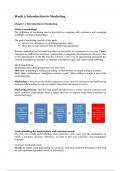
Marketing process: This five-step model describes how to create value for customers and
build customer relationships (first 4 steps) and how to capture value from customers in
return (last step).
Understanding the marketplace and customer needs
The first step entails understanding what customers need, want, and the marketplace in
which a marketer operates. Therefore, we look at five core customer- and marketplace
concepts.
Customer needs and wants
Needs are states of felt deprivation. For instance, with food, needs for belonging or the need
for self-expression (physical, social, or individual).
,Wants are the form ‘’human needs’’ take, as they are shaped by culture and individual
personality. We need food, but we want a hamburger.
Demands are ‘’human wants’’ that are backed by buying power. More money allows us to
demand better quality.
Market offerings – products, services and, experiences
The needs and wants are satisfied through market offerings. This is a combination of
products, services, information, and/or experiences which are offered on a market, in order
to satisfy a need or a want.
Another part of market offerings are various entities, such as persons, places, organisations,
information, and ideas. A common mistake of paying more attention to the specific products
a company offers, rather than to the benefits and experiences produced by these products, is
called marketing myopia. This means that companies tend to forget that customers are
buying a solution (a hole in the wall) rather than the product itself (a drill).
Customer value and satisfaction
Consumers buy products that satisfy their needs and, consequently, will purchase them
again. However, dissatisfied customers do not buy again. Setting the right level of
expectations is therefore very important for marketers.
Exchanges and relationships
The meaning of exchange entails the act of obtaining a desired good or service from an
individual by offering something in return. Therefore, we can say that marketing consists of
creating, maintaining, and growing desirable exchange relationships.
Markets
These exchanges take place on the market, which is defined by the set of all actual and
potential buyers of a product or service. A marketing system consists of suppliers,
companies, marketing intermediaries and consumers. All parties are affected by major
environmental forces (political, economic, natural etc.). Consumers also carry out marketing
when they search for products, interact with companies to obtain information, and finally
make their purchase. Therefore, marketing is a two-way affair. Marketers no longer simply
ask how they can serve a customer, but will now also look at how customers can influence
them. Here, marketers engage in customer-managed relationships.
Creating a Customer-Focused Marketing Strategy
The second step in the marketing process is to design the marketing strategy. Marketing
management is defined as the art and science of choosing target markets and building
profitable relationships with them. Therefore, marketing managers focus on engaging,
keeping, and growing target customers by creating, delivering, and communicating superior
customer value.
Selecting customers to serve
When a company develops a marketing strategy, it must first choose whom it will serve.
Dividing the market into segments of customers (market segmentation) can help the
selection of which segments to target (target marketing).
Secondly, the company has to decide how it will serve the targeted customers. In other
words, how it will differentiate and position itself in the marketplace. A value proposition
is the set of values a company promises to deliver to consumers in order to satisfy their
,needs.
Marketing management orientations
Five thoughts under which organisations design and carry out their marketing strategies:
● Production Concept:
○ Consumers will favour products that are available and highly affordable;
therefore, the organisation should focus on improving production and
distribution efficiency.
● Product Concept:
○ Consumers will favour quality, performance, and various features the most;
therefore, the organisation should devote its energy to making continuous
product improvements.
● Selling Concept:
○ Consumers will only buy enough of the firm’s products when the firm undertakes
a large-scale selling and promotion effort. Here the aim is mainly to sell what a
company produces, rather than what a consumer asks for. Often, this does not
lead to a long-term customer relationship.
● Marketing Concept:
○ This concept means that achieving organisational goals depends on knowing the
needs and wants of target markets and delivering the desired satisfactions better
to the competitors. Instead of the make- and sell concept, companies focus on the
sense-and-respond philosophy. Here, the selling concept can be seen as an
inside-out perspective, where in contrast the latter is called an outside-in
perspective.
● Societal Marketing Concept:
○ A company’s marketing decision should consider consumers’ wants, the
company’s requirements, consumers’ long-run welfare, and society’s long-run
interests. There are three considerations in their marketing strategy: company,
consumers and society.
Preparing an integrated marketing plan and program
In the third step, the marketing plan is of importance. The Marketing mix is typically used
to define the set of marketing tools the firm uses to implement its marketing strategy. The
marketing mix consists of:
● Product: need-satisfying market offering;
● Price: the cost of the product;
● Place: where the product will be available;
● Promotion: communication with target customers.
Building customer relationships
The first three steps in the marketing process all lead up to the fourth and most important
step: building and managing profitable customer relationships.
Customer relationship management
The overall process of building and maintaining profitable customer relationships by
delivering superior customer value and satisfaction is called customer relationship
management (CRM).
A customer buys from a firm that offers the highest customer-perceived value. This is
the customers’ evaluation of the difference between all the benefits and all the costs of a
, marketing offer relative to those of competing offers. Customer satisfaction deals with
the extent to which a product’s perceived performance matches a buyer’s expectations.
Higher levels of customer satisfaction often lead to higher levels of loyalty.
Customer relationships can exist on different levels. Companies can have basic
relationships with low-margins customers that hardly have contact.
On the other hand, full partnerships are characterised by personal contact and higher
margins. Many companies create frequency marketing programs in order to reward
returning customers. Other companies create club marketing programs in order to offer
special benefits to members.
There are changes occurring in the way that companies deal with their customers. Whereas
in the past mass marketing was broadly used, nowadays, companies are trying to build
deeper, more direct and longer lasting relationships with carefully selected customers.
Marketers do not want a relationship with every possible customer because in some cases the
costs are higher than the potential revenues.
The change in communication due to new technologies also created the shift that customer
relationships are more interactive. For example, Facebook, Pinterest, Twitter, and other
media are being used by companies to become “part of the conversation”.
Customer-engagement marketing is making the brand a meaningful part of consumer’s
conversations and lives by fostering direct and continuous customer involvement in shaping
brand conversations, experiences, and communities. Because consumer empowerment has
grown over time, companies can no longer rely on marketing by intrusion. Instead, they
must practice marketing by attraction, where market offerings are created by engaging with
consumers, rather than by interrupting them.
Consumer-generated marketing is when a brand engages with consumers, both invited
and uninvited. Here, consumers are playing an increasing role in shaping their own brand
experiences and those of other consumers. In addition, there is partner relationship
management, which is working closely with partners in other company departments and
outside the company to jointly bring greater value to customers.
Capturing Customer Value
As a result of the first four steps of the marketing process, firms are able to capture customer
value. Satisfied customers are very important in doing business. Satisfied customers remain
loyal and favourably to other customers about the company.
Customer lifetime value is the value of the entire stream of purchases a customer makes
over a lifetime of patronage. Share of customers deals with the portion of the customer’s
purchasing that a company gets in its product categories.
Customer equity is the total combined customer lifetime values of all the company’s
customers. The more loyal the firm’s profitable customers are, the higher it’s customer
equity. Sales and market share reflect past results of a company, whereas customer equity
says something about the future.
Customer relationship groups are defined on two dimensions; potential profitability (PP)
and projected loyalty (PL). The four different groups:
● Strangers: low PP and low PL;
Chapter 1: Introduction to Marketing
What is marketing?
The definition of marketing can be described as engaging with customers and managing
profitable customer relationships.
The goal of marketing consists of two parts:
● Attract new customers by promising superior value;
● Grow the current customer base by delivering satisfaction.
Because marketing can be found anywhere in the world, we experience it every day. Classic
examples are billboards, television commercials, or magazine advertisements. However, due
to the introduction of the PC and the internet, a new way of approaching customers has
evolved. Examples are banners on websites, smartphone apps, and online social networks.
Marketing defined
Marketing can be distinguished between two views:
Old view: marketing is “telling and selling” (which focuses on simply selling a product)
New view: marketing is “satisfying customer needs” (Here, selling is simply a part of the
marketing mix)
Marketing is the process by which companies create value for customers and build strong
customer relationships in order to capture value from customers in return.
Marketing process: This five-step model describes how to create value for customers and
build customer relationships (first 4 steps) and how to capture value from customers in
return (last step).
Understanding the marketplace and customer needs
The first step entails understanding what customers need, want, and the marketplace in
which a marketer operates. Therefore, we look at five core customer- and marketplace
concepts.
Customer needs and wants
Needs are states of felt deprivation. For instance, with food, needs for belonging or the need
for self-expression (physical, social, or individual).
,Wants are the form ‘’human needs’’ take, as they are shaped by culture and individual
personality. We need food, but we want a hamburger.
Demands are ‘’human wants’’ that are backed by buying power. More money allows us to
demand better quality.
Market offerings – products, services and, experiences
The needs and wants are satisfied through market offerings. This is a combination of
products, services, information, and/or experiences which are offered on a market, in order
to satisfy a need or a want.
Another part of market offerings are various entities, such as persons, places, organisations,
information, and ideas. A common mistake of paying more attention to the specific products
a company offers, rather than to the benefits and experiences produced by these products, is
called marketing myopia. This means that companies tend to forget that customers are
buying a solution (a hole in the wall) rather than the product itself (a drill).
Customer value and satisfaction
Consumers buy products that satisfy their needs and, consequently, will purchase them
again. However, dissatisfied customers do not buy again. Setting the right level of
expectations is therefore very important for marketers.
Exchanges and relationships
The meaning of exchange entails the act of obtaining a desired good or service from an
individual by offering something in return. Therefore, we can say that marketing consists of
creating, maintaining, and growing desirable exchange relationships.
Markets
These exchanges take place on the market, which is defined by the set of all actual and
potential buyers of a product or service. A marketing system consists of suppliers,
companies, marketing intermediaries and consumers. All parties are affected by major
environmental forces (political, economic, natural etc.). Consumers also carry out marketing
when they search for products, interact with companies to obtain information, and finally
make their purchase. Therefore, marketing is a two-way affair. Marketers no longer simply
ask how they can serve a customer, but will now also look at how customers can influence
them. Here, marketers engage in customer-managed relationships.
Creating a Customer-Focused Marketing Strategy
The second step in the marketing process is to design the marketing strategy. Marketing
management is defined as the art and science of choosing target markets and building
profitable relationships with them. Therefore, marketing managers focus on engaging,
keeping, and growing target customers by creating, delivering, and communicating superior
customer value.
Selecting customers to serve
When a company develops a marketing strategy, it must first choose whom it will serve.
Dividing the market into segments of customers (market segmentation) can help the
selection of which segments to target (target marketing).
Secondly, the company has to decide how it will serve the targeted customers. In other
words, how it will differentiate and position itself in the marketplace. A value proposition
is the set of values a company promises to deliver to consumers in order to satisfy their
,needs.
Marketing management orientations
Five thoughts under which organisations design and carry out their marketing strategies:
● Production Concept:
○ Consumers will favour products that are available and highly affordable;
therefore, the organisation should focus on improving production and
distribution efficiency.
● Product Concept:
○ Consumers will favour quality, performance, and various features the most;
therefore, the organisation should devote its energy to making continuous
product improvements.
● Selling Concept:
○ Consumers will only buy enough of the firm’s products when the firm undertakes
a large-scale selling and promotion effort. Here the aim is mainly to sell what a
company produces, rather than what a consumer asks for. Often, this does not
lead to a long-term customer relationship.
● Marketing Concept:
○ This concept means that achieving organisational goals depends on knowing the
needs and wants of target markets and delivering the desired satisfactions better
to the competitors. Instead of the make- and sell concept, companies focus on the
sense-and-respond philosophy. Here, the selling concept can be seen as an
inside-out perspective, where in contrast the latter is called an outside-in
perspective.
● Societal Marketing Concept:
○ A company’s marketing decision should consider consumers’ wants, the
company’s requirements, consumers’ long-run welfare, and society’s long-run
interests. There are three considerations in their marketing strategy: company,
consumers and society.
Preparing an integrated marketing plan and program
In the third step, the marketing plan is of importance. The Marketing mix is typically used
to define the set of marketing tools the firm uses to implement its marketing strategy. The
marketing mix consists of:
● Product: need-satisfying market offering;
● Price: the cost of the product;
● Place: where the product will be available;
● Promotion: communication with target customers.
Building customer relationships
The first three steps in the marketing process all lead up to the fourth and most important
step: building and managing profitable customer relationships.
Customer relationship management
The overall process of building and maintaining profitable customer relationships by
delivering superior customer value and satisfaction is called customer relationship
management (CRM).
A customer buys from a firm that offers the highest customer-perceived value. This is
the customers’ evaluation of the difference between all the benefits and all the costs of a
, marketing offer relative to those of competing offers. Customer satisfaction deals with
the extent to which a product’s perceived performance matches a buyer’s expectations.
Higher levels of customer satisfaction often lead to higher levels of loyalty.
Customer relationships can exist on different levels. Companies can have basic
relationships with low-margins customers that hardly have contact.
On the other hand, full partnerships are characterised by personal contact and higher
margins. Many companies create frequency marketing programs in order to reward
returning customers. Other companies create club marketing programs in order to offer
special benefits to members.
There are changes occurring in the way that companies deal with their customers. Whereas
in the past mass marketing was broadly used, nowadays, companies are trying to build
deeper, more direct and longer lasting relationships with carefully selected customers.
Marketers do not want a relationship with every possible customer because in some cases the
costs are higher than the potential revenues.
The change in communication due to new technologies also created the shift that customer
relationships are more interactive. For example, Facebook, Pinterest, Twitter, and other
media are being used by companies to become “part of the conversation”.
Customer-engagement marketing is making the brand a meaningful part of consumer’s
conversations and lives by fostering direct and continuous customer involvement in shaping
brand conversations, experiences, and communities. Because consumer empowerment has
grown over time, companies can no longer rely on marketing by intrusion. Instead, they
must practice marketing by attraction, where market offerings are created by engaging with
consumers, rather than by interrupting them.
Consumer-generated marketing is when a brand engages with consumers, both invited
and uninvited. Here, consumers are playing an increasing role in shaping their own brand
experiences and those of other consumers. In addition, there is partner relationship
management, which is working closely with partners in other company departments and
outside the company to jointly bring greater value to customers.
Capturing Customer Value
As a result of the first four steps of the marketing process, firms are able to capture customer
value. Satisfied customers are very important in doing business. Satisfied customers remain
loyal and favourably to other customers about the company.
Customer lifetime value is the value of the entire stream of purchases a customer makes
over a lifetime of patronage. Share of customers deals with the portion of the customer’s
purchasing that a company gets in its product categories.
Customer equity is the total combined customer lifetime values of all the company’s
customers. The more loyal the firm’s profitable customers are, the higher it’s customer
equity. Sales and market share reflect past results of a company, whereas customer equity
says something about the future.
Customer relationship groups are defined on two dimensions; potential profitability (PP)
and projected loyalty (PL). The four different groups:
● Strangers: low PP and low PL;