

STRATEGIC MANAGEMENT 2024-2025
THEME 1 – INTRODUCTION STRATEGY
If you were to start working for Netflix and became part of the strategic team, how would you feel about this
organization? Do you think Netflix is an "easy win," with no problems or competition?
When looking at Netflix's stock price, it's clear that the company's strategy is based on a vision and mission that prepare
it for the future, but these need to be translated into measurable performance. While the stock price has generally been
increasing, on October 1, 2022, it experienced a drop. Why? Because in 2021, new competitors entered the market,
such as Amazon Prime and Disney Plus, creating significant strategic competition. This means some consumers might
move away from Netflix and switch to competitors, potentially reducing Netflix's profitability.
However, the stock price has since risen again. Why? Because internationally, Netflix is still expanding, and the overall
market is growing, which means the "pie" is getting larger.
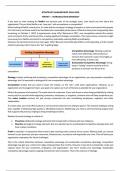
Competitive Advantage: Meeting customer
needs more effectively, with products or
services that customers value more highly, or
more efficiently, at lower cost.
Sustainable Competitive Advantage: Giving
buyers “lasting” reasons to prefer a firm’s
products or services over those of its
competitors.
Strategy is about achieving and sustaining a competitive advantage. As an organization, you may possess competitive
advantage, but it's important to distinguish it from comparative advantage.
Competition implies that you need to share the market—or the "pie"—with other organizations. However, as an
organization and management team, your goal is to capture as much of that pie as possible for your organization.
What is the purpose of a business? To create value for customers. If your sole focus is maximizing profitability by making
money only for yourself while neglecting customers, employees, or suppliers, someone else will likely outperform you.
True value creation involves not just serving consumers but also considering employees, suppliers, and other
stakeholders.
To create value, you must offer products or services that customers are willing to pay for. This requires building a strong
team capable of delivering high-quality or affordable products. Additionally, you need a well-functioning supply chain
that supports the process, helping to bring everything to fruition.
Realized (current) strategy is a blend of:
• Proactive (deliberate) strategy elements that include both continued and new initiatives.
• Reactive (emergent) strategy elements that are required due to unanticipated competitive developments and
fresh market conditions.
Profit is essential—it represents what remains after covering costs (revenue minus costs). Without profit, you cannot
reinvest in your business, and your resources, infrastructure, or products will depreciate over time. This will leave your
organization unprepared for future challenges.
This is the critical distinction between competitive advantage and sustainable competitive advantage. Competitive
advantage may give you a short-term edge, lasting perhaps five months. However, if you fail to consistently create and
capture value—for your customers, employees, and organization—you won't sustain your advantage. Sustainable
competitive advantage requires ongoing reinvestment and innovation. That is the essence of strategy.
,How to Prepare an Organization for a Sustainable Competitive Advantage? Creating a competitive advantage is
important, but the real challenge lies in building a sustainable competitive advantage. This involves preparing your
organization not just to succeed today but to remain competitive and resilient in the long term.
(EXAM) The Strategy of Netflix: Three Stages of Evolution
1. Things started because they reacted to an upsetting, triggering event. Netflix was the first company to use the
internet to stream movies, which initially positioned it as a logistics company. But it did something more: it
became the first to create its own content. Today, Netflix is truly an entertainment company, competing with
Disney in terms of content creation, which has significantly changed its investment strategy.
2. From logistics to entertainment. Why would Netflix take the risk of transitioning from a logistics company to
competing with a company like Disney, which has been successfully operating in the entertainment industry for
over 70 years? The answer lies in Netflix’s innovative use of artificial intelligence (AI). Netflix is seen as having
an AI system capable of predicting which movies will be liked by most viewers. This AI allows Netflix to
proactively invest in the risky entertainment business while maintaining high returns.
3. AI-driven investment and competitive advantage. Netflix’s AI enables the company to predict which movies, or
series will attract enough viewers to justify the investment. For example, AI ensures that whatever Netflix
produces is viewed by enough people—say, 2 million subscribers—to generate a strong return on investment.
This data-driven approach minimizes risk, as audience preferences do not change overnight.
Netflix’s competitive advantage lies in its proactive investment strategy. By using AI to forecast audience preferences,
Netflix ensures that its content generates significant revenue, contributing to its profitability and rising stock prices. This
strategic approach has solidified Netflix’s position as a leading entertainment company.
Nowadays Netflix has a lot of competitors (thanks to attractiveness of the market): HBO, Apple, amazon. To stay
competitive Netflix decided to make their own content. A risky but successful move.
Why is it that Netflix is daring to invest in making movies/shows? In order to finance the content, they have to use a lot
of money. This money they get from subscribers. But there is an important synergy: when we watch, we leave traces and
data, which makes Netflix able to predict and read our preferred content: they know exactly which kind of movie or show
we like. This data is allowing Netflix to predict that if they invest in some kind of movie, they are pretty sure that X amount
of people is going to like this movie. Strategy is about the future, but the future is uncertain. But the more data these
companies have, the easier they can predict the future (=advantage)! => Importance of statistic’s and AI.
Common additional question is explaining the stock price of a company. What is the stock price? = based on today’s
cashflow and expected cashflow in future.
Strategy changes over time: deliberateness vs. emergence: you start with an intended strategy (plan of action) which
will be carried out with the deliberate strategy. This partially result in an unrealized strategy. A new emergent strategy
emerges which result in the realized strategy (pattern of actions)
The Honda Case: Competing with Harley-Davidson in the U.S. Market
In the 1950s, Honda made a strategic decision to enter the U.S. motorcycle market and directly compete with Harley-
Davidson, a dominant player in the industry. At the time, Honda was known for its big bikes and believed that its
motorcycles were superior to Harley-Davidson’s in terms of quality and performance.
The Initial Plan: Honda’s initial strategy was to introduce its large motorcycles to the Californian market, assuming that
American consumers would prefer these models, as they were popular in Japan. The company was confident that their
bikes could compete head-on with Harley-Davidson.
The Challenge: Unfortunately, things did not go as expected:
• Technical Issues: Honda had tested its bikes in Tokyo, where the climate is significantly different from
California's. The warmer temperatures in California exposed weaknesses in the bikes that hadn't been apparent
during testing.
, • Mechanical Failures: The bikes began leaking oil and showing other mechanical problems, undermining their
reliability.
• Market Reaction: These issues damaged Honda’s reputation, and sales of the large motorcycles fell far short of
expectations.
A Shift in Strategy: Faced with these setbacks, Honda pivoted its strategy. Instead of focusing on large motorcycles, they
began promoting their smaller, lighter bikes, such as the Honda Super Cub. These bikes were affordable, easy to use
(man&woman), lifestyle oriented.
The Outcome: By focusing on small bikes, Honda became the market leader in the motorcycle industry. They expanded
the customer base beyond traditional bikers to include families, commuters, and casual users.
Lessons from the Honda Case:
• Adaptability: Honda’s ability to pivot when their initial strategy failed highlights the importance of flexibility in
business.
• Understanding Local Conditions: Success in one market does not guarantee success in another. Honda
underestimated the impact of environmental and cultural differences.
• Segmentation: By identifying and targeting a new market segment, Honda turned a failure into an opportunity for
growth.
Business is About Creating Value, Not Just Profit: Profit is not the ultimate goal of business—it is the consequence
of creating value. Business is about expanding the "pie" and making it bigger. If an
organization can grow the pie significantly, it can focus on serving a particular audience or
market segment while ensuring value creation for all stakeholders.
Beyond Zero-Sum Thinking: Contrary to the idea that business is a zero-sum game
(where one party's gain is another's loss), strategy can often create opportunities where
everyone benefits. Sometimes, businesses innovate by creating something entirely new—
something that didn’t exist before—and consumers are willing to pay for it. This is the
beauty of business: you create value and expand the pie for everyone involved.
In economies with sufficient purchasing power, there’s typically enough demand to
support multiple players. The challenge, then, is not competition for a fixed slice of the pie
but growing the pie itself. How to Increase the Pie?
Wellness to Pay and Wellness to Supply
In business, we can think of two concepts:
1. Wellness to Pay (WTP): This refers to the maximum price a customer is willing to pay for a product or service.
2. Wellness to Supply: This relates to the cost incurred by the company to provide that product or service.
Key principles of Value-based Strategy
• Companies that excel at creating value focus squarely on Value or WTP (enhance the customer experience) and
WTS (make it more attractive for vendors and employees to work with the company).
• Companies that outperform their peers increase WTP or decrease WTS in ways that are difficult to imitate
• Simplicity opens up room for creativity and broad engagement
• Many of the most successful companies focus on their competitive position inside an industry, as opposed to the
average performance of their segment of the economy
Customer delight = Customer Value Proposition: Satisfying the wants and needs at a price customers will consider a
good value. The higher the value provided (WTP) and the lower the price (P), the more attractive the value proposition
is to customers.
Firm margin = value capturing by the company - Companies create value by increasing WTP & decreasing WTS ->
These companies capture value by setting prices and compensation. -> this is important since cash is king!
, The Supplier & Employee Value Proposition - difference between WTS (e.g wanted salary) and cost is the degree of
satisfaction of the employee, e.g good atmosphere, room for errors, flexible - It is also a surplus that the suppliers
earn.
Customer Value: The difference between a customer’s WTP and the actual
price they pay represents the value created for the customer. This value is not
just economic but also psychological—it’s about how customers perceive
and feel about the product or service they are purchasing. Customers ask
themselves: "Is this worth the price I’m paying?" The perceived value drives
satisfaction and loyalty.
• Satisfying buyer wants and needs at a price customers will consider a good
value.
• The greater the value provided (V or WTP) and the lower the price (P), the
more attractive the value proposition is to customers
Value Capturing
• Companies create value by increasing WTP and decreasing WTS.
• These companies capture value by setting prices and compensation
The Supplier & Employee Value Proposition
• The share to the suppliers is the difference between how much they get paid
by the firm (i.e. the firm’s cost) and their Value or WTS. Think of it as a surplus that the suppliers earn from the
transaction.
• A similar logic applies to the employee. The compensation – WTS represents the satisfaction of the employee.
Why is Samsung Less
Profitable Than Apple?
One reason for the
profitability gap lies in how
each company creates and
captures value:
• Samsung: When
Samsung sells a product, it
often shares profits with
multiple stakeholders, such
as component suppliers and
distribution partners.
• Apple: Apple has
chosen to control every
aspect of its business, from
product design to manufacturing and even distribution. By vertically integrating its operations, Apple captures
a larger share of the value created, maximizing profitability.
Value Creation and Stakeholders: Value creation extends beyond customers to encompass all stakeholders
impacted by the organization. Stakeholders include:
1. Customers: The primary recipients of the product or service.
2. Employees: Those who create and deliver the product or service.
3. Suppliers: Partners in the supply chain.
4. Investors: Shareholders who take financial risks and provide capital.
5. Communities: Broader groups affected by the organization’s operations, such as through job creation or
environmental impact.
Among these, shareholders are key stakeholders as they take significant financial risks and hold ownership in the
organization.
THEME 1 – INTRODUCTION STRATEGY
If you were to start working for Netflix and became part of the strategic team, how would you feel about this
organization? Do you think Netflix is an "easy win," with no problems or competition?
When looking at Netflix's stock price, it's clear that the company's strategy is based on a vision and mission that prepare
it for the future, but these need to be translated into measurable performance. While the stock price has generally been
increasing, on October 1, 2022, it experienced a drop. Why? Because in 2021, new competitors entered the market,
such as Amazon Prime and Disney Plus, creating significant strategic competition. This means some consumers might
move away from Netflix and switch to competitors, potentially reducing Netflix's profitability.
However, the stock price has since risen again. Why? Because internationally, Netflix is still expanding, and the overall
market is growing, which means the "pie" is getting larger.
Competitive Advantage: Meeting customer
needs more effectively, with products or
services that customers value more highly, or
more efficiently, at lower cost.
Sustainable Competitive Advantage: Giving
buyers “lasting” reasons to prefer a firm’s
products or services over those of its
competitors.
Strategy is about achieving and sustaining a competitive advantage. As an organization, you may possess competitive
advantage, but it's important to distinguish it from comparative advantage.
Competition implies that you need to share the market—or the "pie"—with other organizations. However, as an
organization and management team, your goal is to capture as much of that pie as possible for your organization.
What is the purpose of a business? To create value for customers. If your sole focus is maximizing profitability by making
money only for yourself while neglecting customers, employees, or suppliers, someone else will likely outperform you.
True value creation involves not just serving consumers but also considering employees, suppliers, and other
stakeholders.
To create value, you must offer products or services that customers are willing to pay for. This requires building a strong
team capable of delivering high-quality or affordable products. Additionally, you need a well-functioning supply chain
that supports the process, helping to bring everything to fruition.
Realized (current) strategy is a blend of:
• Proactive (deliberate) strategy elements that include both continued and new initiatives.
• Reactive (emergent) strategy elements that are required due to unanticipated competitive developments and
fresh market conditions.
Profit is essential—it represents what remains after covering costs (revenue minus costs). Without profit, you cannot
reinvest in your business, and your resources, infrastructure, or products will depreciate over time. This will leave your
organization unprepared for future challenges.
This is the critical distinction between competitive advantage and sustainable competitive advantage. Competitive
advantage may give you a short-term edge, lasting perhaps five months. However, if you fail to consistently create and
capture value—for your customers, employees, and organization—you won't sustain your advantage. Sustainable
competitive advantage requires ongoing reinvestment and innovation. That is the essence of strategy.
,How to Prepare an Organization for a Sustainable Competitive Advantage? Creating a competitive advantage is
important, but the real challenge lies in building a sustainable competitive advantage. This involves preparing your
organization not just to succeed today but to remain competitive and resilient in the long term.
(EXAM) The Strategy of Netflix: Three Stages of Evolution
1. Things started because they reacted to an upsetting, triggering event. Netflix was the first company to use the
internet to stream movies, which initially positioned it as a logistics company. But it did something more: it
became the first to create its own content. Today, Netflix is truly an entertainment company, competing with
Disney in terms of content creation, which has significantly changed its investment strategy.
2. From logistics to entertainment. Why would Netflix take the risk of transitioning from a logistics company to
competing with a company like Disney, which has been successfully operating in the entertainment industry for
over 70 years? The answer lies in Netflix’s innovative use of artificial intelligence (AI). Netflix is seen as having
an AI system capable of predicting which movies will be liked by most viewers. This AI allows Netflix to
proactively invest in the risky entertainment business while maintaining high returns.
3. AI-driven investment and competitive advantage. Netflix’s AI enables the company to predict which movies, or
series will attract enough viewers to justify the investment. For example, AI ensures that whatever Netflix
produces is viewed by enough people—say, 2 million subscribers—to generate a strong return on investment.
This data-driven approach minimizes risk, as audience preferences do not change overnight.
Netflix’s competitive advantage lies in its proactive investment strategy. By using AI to forecast audience preferences,
Netflix ensures that its content generates significant revenue, contributing to its profitability and rising stock prices. This
strategic approach has solidified Netflix’s position as a leading entertainment company.
Nowadays Netflix has a lot of competitors (thanks to attractiveness of the market): HBO, Apple, amazon. To stay
competitive Netflix decided to make their own content. A risky but successful move.
Why is it that Netflix is daring to invest in making movies/shows? In order to finance the content, they have to use a lot
of money. This money they get from subscribers. But there is an important synergy: when we watch, we leave traces and
data, which makes Netflix able to predict and read our preferred content: they know exactly which kind of movie or show
we like. This data is allowing Netflix to predict that if they invest in some kind of movie, they are pretty sure that X amount
of people is going to like this movie. Strategy is about the future, but the future is uncertain. But the more data these
companies have, the easier they can predict the future (=advantage)! => Importance of statistic’s and AI.
Common additional question is explaining the stock price of a company. What is the stock price? = based on today’s
cashflow and expected cashflow in future.
Strategy changes over time: deliberateness vs. emergence: you start with an intended strategy (plan of action) which
will be carried out with the deliberate strategy. This partially result in an unrealized strategy. A new emergent strategy
emerges which result in the realized strategy (pattern of actions)
The Honda Case: Competing with Harley-Davidson in the U.S. Market
In the 1950s, Honda made a strategic decision to enter the U.S. motorcycle market and directly compete with Harley-
Davidson, a dominant player in the industry. At the time, Honda was known for its big bikes and believed that its
motorcycles were superior to Harley-Davidson’s in terms of quality and performance.
The Initial Plan: Honda’s initial strategy was to introduce its large motorcycles to the Californian market, assuming that
American consumers would prefer these models, as they were popular in Japan. The company was confident that their
bikes could compete head-on with Harley-Davidson.
The Challenge: Unfortunately, things did not go as expected:
• Technical Issues: Honda had tested its bikes in Tokyo, where the climate is significantly different from
California's. The warmer temperatures in California exposed weaknesses in the bikes that hadn't been apparent
during testing.
, • Mechanical Failures: The bikes began leaking oil and showing other mechanical problems, undermining their
reliability.
• Market Reaction: These issues damaged Honda’s reputation, and sales of the large motorcycles fell far short of
expectations.
A Shift in Strategy: Faced with these setbacks, Honda pivoted its strategy. Instead of focusing on large motorcycles, they
began promoting their smaller, lighter bikes, such as the Honda Super Cub. These bikes were affordable, easy to use
(man&woman), lifestyle oriented.
The Outcome: By focusing on small bikes, Honda became the market leader in the motorcycle industry. They expanded
the customer base beyond traditional bikers to include families, commuters, and casual users.
Lessons from the Honda Case:
• Adaptability: Honda’s ability to pivot when their initial strategy failed highlights the importance of flexibility in
business.
• Understanding Local Conditions: Success in one market does not guarantee success in another. Honda
underestimated the impact of environmental and cultural differences.
• Segmentation: By identifying and targeting a new market segment, Honda turned a failure into an opportunity for
growth.
Business is About Creating Value, Not Just Profit: Profit is not the ultimate goal of business—it is the consequence
of creating value. Business is about expanding the "pie" and making it bigger. If an
organization can grow the pie significantly, it can focus on serving a particular audience or
market segment while ensuring value creation for all stakeholders.
Beyond Zero-Sum Thinking: Contrary to the idea that business is a zero-sum game
(where one party's gain is another's loss), strategy can often create opportunities where
everyone benefits. Sometimes, businesses innovate by creating something entirely new—
something that didn’t exist before—and consumers are willing to pay for it. This is the
beauty of business: you create value and expand the pie for everyone involved.
In economies with sufficient purchasing power, there’s typically enough demand to
support multiple players. The challenge, then, is not competition for a fixed slice of the pie
but growing the pie itself. How to Increase the Pie?
Wellness to Pay and Wellness to Supply
In business, we can think of two concepts:
1. Wellness to Pay (WTP): This refers to the maximum price a customer is willing to pay for a product or service.
2. Wellness to Supply: This relates to the cost incurred by the company to provide that product or service.
Key principles of Value-based Strategy
• Companies that excel at creating value focus squarely on Value or WTP (enhance the customer experience) and
WTS (make it more attractive for vendors and employees to work with the company).
• Companies that outperform their peers increase WTP or decrease WTS in ways that are difficult to imitate
• Simplicity opens up room for creativity and broad engagement
• Many of the most successful companies focus on their competitive position inside an industry, as opposed to the
average performance of their segment of the economy
Customer delight = Customer Value Proposition: Satisfying the wants and needs at a price customers will consider a
good value. The higher the value provided (WTP) and the lower the price (P), the more attractive the value proposition
is to customers.
Firm margin = value capturing by the company - Companies create value by increasing WTP & decreasing WTS ->
These companies capture value by setting prices and compensation. -> this is important since cash is king!
, The Supplier & Employee Value Proposition - difference between WTS (e.g wanted salary) and cost is the degree of
satisfaction of the employee, e.g good atmosphere, room for errors, flexible - It is also a surplus that the suppliers
earn.
Customer Value: The difference between a customer’s WTP and the actual
price they pay represents the value created for the customer. This value is not
just economic but also psychological—it’s about how customers perceive
and feel about the product or service they are purchasing. Customers ask
themselves: "Is this worth the price I’m paying?" The perceived value drives
satisfaction and loyalty.
• Satisfying buyer wants and needs at a price customers will consider a good
value.
• The greater the value provided (V or WTP) and the lower the price (P), the
more attractive the value proposition is to customers
Value Capturing
• Companies create value by increasing WTP and decreasing WTS.
• These companies capture value by setting prices and compensation
The Supplier & Employee Value Proposition
• The share to the suppliers is the difference between how much they get paid
by the firm (i.e. the firm’s cost) and their Value or WTS. Think of it as a surplus that the suppliers earn from the
transaction.
• A similar logic applies to the employee. The compensation – WTS represents the satisfaction of the employee.
Why is Samsung Less
Profitable Than Apple?
One reason for the
profitability gap lies in how
each company creates and
captures value:
• Samsung: When
Samsung sells a product, it
often shares profits with
multiple stakeholders, such
as component suppliers and
distribution partners.
• Apple: Apple has
chosen to control every
aspect of its business, from
product design to manufacturing and even distribution. By vertically integrating its operations, Apple captures
a larger share of the value created, maximizing profitability.
Value Creation and Stakeholders: Value creation extends beyond customers to encompass all stakeholders
impacted by the organization. Stakeholders include:
1. Customers: The primary recipients of the product or service.
2. Employees: Those who create and deliver the product or service.
3. Suppliers: Partners in the supply chain.
4. Investors: Shareholders who take financial risks and provide capital.
5. Communities: Broader groups affected by the organization’s operations, such as through job creation or
environmental impact.
Among these, shareholders are key stakeholders as they take significant financial risks and hold ownership in the
organization.


