MNG3702
Strategic Implementation and Control IIIB
Unique Number: 773821
Assignment: 01
Semester: 02
Year: 2020
Due Date: 28 August 2020
Page 1 of 8
,Question 1
Which of the following statements regarding organisational learning is correct?
A Organisational learning should be continuous and never ending
B Individuals learn, not organisations
C When learning is applied to strategic decisions and management practices in organisations, it starts
becoming an organisational capability
D The acquisition of knowledge is a guarantee that no mistakes will happen
1 ABD
2 ABC
3 BD
4 CD
Answer is 2
Practising Strategy: A Southern African Context page 100
D is false. Organisational learning is experimental, because the acquisition of knowledge is no guarantee that
mistakes will not be made.
Question 2
Very few of the leading film camera manufacturers today, are also market leaders in the digital camera age.
Which one of the following could be singled out as the main barrier to organisational learning of these film camera
manufacturers?
1 limited organisational resources
2 management ignorance
3 dominant general management logic
4 availability of external information
Answer is 3
Practising Strategy: A Southern African Context page 101
Question 3
Various mechanisms can be used to transfer knowledge to others.
When an experienced machine operator writes a manual for inexperienced employees to teach them how to
operate a particular machine, he/she is transferring (i) _____ knowledge by making use of the (ii) _____ mechanism.
1 (i) explicit; (ii) combination
2 (i) explicit; (ii) articulation
3 (i) tacit; (ii) socialisation
4 (i) tacit; (ii) internalisation
Answer is 1
Practising Strategy: A Southern African Context page 104
Page 2 of 8
, Question 4
Which one of the following provides the correct explanation of the term ‘double-loop learning’?
Double-loop learning is learning that takes place when an individual or organisation aims to _____.
1 achieve a goal, and when they do not succeed, evaluate what went wrong
2 achieve a goal, and when they do not succeed, they re-evaluate and question their own mental models, goals,
values and beliefs
3 solve a problem and gather as much internal and external information as they possibly can from all historical
and current sources
4 forecast trends and when they fail to do so, they re-evaluate their sources of information, forecasting models
and the integrity of the data used in the models
Answer is 2
Practising Strategy: A Southern African Context page 106
Point 1 is single-loop learning
Point 2 is double-loop learning
Question 5
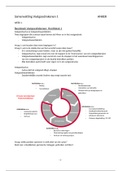
The following figure depicts a knowledge management system. Fill in the missing spaces to answer this question.
1 (i) Capturing data; (ii) Analysing data; (iii) Storing data; (iv) Retrieving information
2 (i) Capturing information; (ii) Sharing information; (iii) Manipulating information; (iv) Storing knowledge
3 (i) Analysing knowledge; (ii) Sharing knowledge; (iii) Modelling knowledge; (iv) Disseminating knowledge
4 (i) Capturing knowledge; (ii) Organising knowledge; (iii) Sharing knowledge; (iv) Using knowledge
Answer is 4
Practising Strategy: A Southern African Context page 110
Page 3 of 8
Strategic Implementation and Control IIIB
Unique Number: 773821
Assignment: 01
Semester: 02
Year: 2020
Due Date: 28 August 2020
Page 1 of 8
,Question 1
Which of the following statements regarding organisational learning is correct?
A Organisational learning should be continuous and never ending
B Individuals learn, not organisations
C When learning is applied to strategic decisions and management practices in organisations, it starts
becoming an organisational capability
D The acquisition of knowledge is a guarantee that no mistakes will happen
1 ABD
2 ABC
3 BD
4 CD
Answer is 2
Practising Strategy: A Southern African Context page 100
D is false. Organisational learning is experimental, because the acquisition of knowledge is no guarantee that
mistakes will not be made.
Question 2
Very few of the leading film camera manufacturers today, are also market leaders in the digital camera age.
Which one of the following could be singled out as the main barrier to organisational learning of these film camera
manufacturers?
1 limited organisational resources
2 management ignorance
3 dominant general management logic
4 availability of external information
Answer is 3
Practising Strategy: A Southern African Context page 101
Question 3
Various mechanisms can be used to transfer knowledge to others.
When an experienced machine operator writes a manual for inexperienced employees to teach them how to
operate a particular machine, he/she is transferring (i) _____ knowledge by making use of the (ii) _____ mechanism.
1 (i) explicit; (ii) combination
2 (i) explicit; (ii) articulation
3 (i) tacit; (ii) socialisation
4 (i) tacit; (ii) internalisation
Answer is 1
Practising Strategy: A Southern African Context page 104
Page 2 of 8
, Question 4
Which one of the following provides the correct explanation of the term ‘double-loop learning’?
Double-loop learning is learning that takes place when an individual or organisation aims to _____.
1 achieve a goal, and when they do not succeed, evaluate what went wrong
2 achieve a goal, and when they do not succeed, they re-evaluate and question their own mental models, goals,
values and beliefs
3 solve a problem and gather as much internal and external information as they possibly can from all historical
and current sources
4 forecast trends and when they fail to do so, they re-evaluate their sources of information, forecasting models
and the integrity of the data used in the models
Answer is 2
Practising Strategy: A Southern African Context page 106
Point 1 is single-loop learning
Point 2 is double-loop learning
Question 5
The following figure depicts a knowledge management system. Fill in the missing spaces to answer this question.
1 (i) Capturing data; (ii) Analysing data; (iii) Storing data; (iv) Retrieving information
2 (i) Capturing information; (ii) Sharing information; (iii) Manipulating information; (iv) Storing knowledge
3 (i) Analysing knowledge; (ii) Sharing knowledge; (iii) Modelling knowledge; (iv) Disseminating knowledge
4 (i) Capturing knowledge; (ii) Organising knowledge; (iii) Sharing knowledge; (iv) Using knowledge
Answer is 4
Practising Strategy: A Southern African Context page 110
Page 3 of 8