M.Kriel
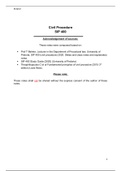
Civil Procedure
SIP 400
Acknowledgement of sources:
These notes were composed based on:
Prof T Bekker, Lecturer in the Department of Procedural law, University of
Pretoria, SIP 400 (civil procedure) 2020. Slides and class notes and explanatory
notes.
SIP 400 Study Guide (2020) (University of Pretoria)
Theophilopoulos C et al Fundamental principles of civil procedure (2015 3rd
edition) Lexis Nexis.
Please note:
These notes shall not be shared without the express consent of the author of these
notes.
Theme 6: Chapter 8
1
, M.Kriel
Refer back to differences between action and application procedures.
1. Types of application:
A. Ex parte:
Is an application where no notice is given to the party (if any)
against whom or which legal relief is being sought and the
applicant is the only party before the court.
The applicant addresses the application directly to the registrar or
the clerk, who must be given prior notice of the proposed
application.
Since there is no respondent that needs to be cited, and ex parte
application is also termed a unliteral application.
B. Bilateral
Is brought when it is clear from the outset that another person’s
right will be affected and that such person must receive prior
notice of the proceedings.
The nature of the matter is such that prior notice to the other party
will not defeat the object of the application.
The application is directed to the registrar (or the clerk) as well as
the respondent, and both are informed of the proceedings.
C. Interlocutory application
A provisional or temporary application which is brought in order to
obtain ancillary relief to certain main proceedings pending
between parties.
This in essence is an intervening step which may be taken after
the commencement of an action or motion proceedings and which
decides a procedural point.
Where the respondent is obliged to take a procedural step or to
conform with a procedural rule and does not do so, the applicant
may by means of an interlocutory application force the respondent
to take such step or to conform with such a rule.
2
Civil Procedure
SIP 400
Acknowledgement of sources:
These notes were composed based on:
Prof T Bekker, Lecturer in the Department of Procedural law, University of
Pretoria, SIP 400 (civil procedure) 2020. Slides and class notes and explanatory
notes.
SIP 400 Study Guide (2020) (University of Pretoria)
Theophilopoulos C et al Fundamental principles of civil procedure (2015 3rd
edition) Lexis Nexis.
Please note:
These notes shall not be shared without the express consent of the author of these
notes.
Theme 6: Chapter 8
1
, M.Kriel
Refer back to differences between action and application procedures.
1. Types of application:
A. Ex parte:
Is an application where no notice is given to the party (if any)
against whom or which legal relief is being sought and the
applicant is the only party before the court.
The applicant addresses the application directly to the registrar or
the clerk, who must be given prior notice of the proposed
application.
Since there is no respondent that needs to be cited, and ex parte
application is also termed a unliteral application.
B. Bilateral
Is brought when it is clear from the outset that another person’s
right will be affected and that such person must receive prior
notice of the proceedings.
The nature of the matter is such that prior notice to the other party
will not defeat the object of the application.
The application is directed to the registrar (or the clerk) as well as
the respondent, and both are informed of the proceedings.
C. Interlocutory application
A provisional or temporary application which is brought in order to
obtain ancillary relief to certain main proceedings pending
between parties.
This in essence is an intervening step which may be taken after
the commencement of an action or motion proceedings and which
decides a procedural point.
Where the respondent is obliged to take a procedural step or to
conform with a procedural rule and does not do so, the applicant
may by means of an interlocutory application force the respondent
to take such step or to conform with such a rule.
2