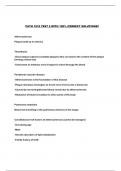
PATH 1016 TEST 2 WITH 100% CORRECT SOLUTIONS!!
Atherosclerosis
Plaque build-up in arteries
Thrombosis
-Once plaque ruptures (unstable plaques) this can lead to the content of the plaque
forming a blood clot
-It becomes an embolus once it begins to travel through the blood
Peripheral vascular disease
-Atherosclerosis is the foundation of this disease
-Plaque develops and begins to travel once it forms into a blood clot
-Caused by narrowing/blocked blood vessel due to atherosclerosis
-Reduction of blood circulation to other parts of the body
Pulmonary embolism
Blood clot travelling in the pulmonary arteries (in the lungs)
Constitutional risk factors of atherosclerosis (cannot be changed)
-Increasing age
-Male
-Genetic disorders of lipid metabolism
-Family history of CAD
,Modifiable risk factors of atherosclerosis
-Smoking
-Obesity
-Hypertension
-Hyperlipidemia
-Diabetes mellitus
List the key events occurring in each stage of atherosclerosis formation
-Endothelial injury
-Migration of inflammatory cells
-Lipid accumulation and smooth muscle proliferation
-Plaque formation
Endothelial injury (atherosclerosis formation)
-'Injury' includes anything that causes an internal injury to the blood vessel such as
exposure to the risk factors which includes smoking or LDL
-Creates like an open wound inside the blood vessel
-Vascular endothelium protects the subendothelial
Migration of inflammatory cells (atherosclerosis formation)
-Monocytes come to the site of injury in attempt to seal the injury
-Intima (most inner aspect of the blood vessel that contacts blood)
-Monocytes situate and get stuck in the intima - become macrophages and engulf LDLs
to remove them with the intention of protecting the vessel but leads to the beginning of
plaque formation
,Lipid accumulation and smooth muscle proliferation (atherosclerosis formation)
-Macrophages release toxic oxygen species to oxidize the LDL (destroy them) which
results in foam cells
-Activated macrophages produce growth factors which cause migration and
proliferation of smooth muscles cells (SMCs) and elaboration of extracellular matrix -
this is to seal off site of injury
Plaque formation (atherosclerosis)
Macrophages + smooth muscle cells + extracellular matrix
Hypertension
-Elevation in systolic or diastolic BP
-More common in men
-Can be caused by Increase in CO or increase in peripheral resistance (force required
to effectively push blood throughout the body)
-BP = CO x SVR (systemic vascular resistance)
Blood pressure is influenced by
-Stroke volume
-Rapidity that blood is ejected from the heart
-Elastic properties of the heart
-Resistance of blood vessels (PVR)
, Neural mechanisms of blood pressure regulation
-Located in reticular formation of medulla/pons
-ANS (SNS)
> Intrinsic reflexes
> Extrinsic reflexes
Humoral mechanisms of blood pressure regulation
-Renin-angiotensin aldosterone (RAA)
-Vasopressin
> ADH released by posterior pituitary
Primary risk factors of hypertension
-Family history
-Age
-Race
-Sodium intake
-Obesity
-Excessive alcohol
Secondary risk factors of hypertension
-Kidney disease
-Adrenal cortical disorder
-Oral contraceptives
Atherosclerosis
Plaque build-up in arteries
Thrombosis
-Once plaque ruptures (unstable plaques) this can lead to the content of the plaque
forming a blood clot
-It becomes an embolus once it begins to travel through the blood
Peripheral vascular disease
-Atherosclerosis is the foundation of this disease
-Plaque develops and begins to travel once it forms into a blood clot
-Caused by narrowing/blocked blood vessel due to atherosclerosis
-Reduction of blood circulation to other parts of the body
Pulmonary embolism
Blood clot travelling in the pulmonary arteries (in the lungs)
Constitutional risk factors of atherosclerosis (cannot be changed)
-Increasing age
-Male
-Genetic disorders of lipid metabolism
-Family history of CAD
,Modifiable risk factors of atherosclerosis
-Smoking
-Obesity
-Hypertension
-Hyperlipidemia
-Diabetes mellitus
List the key events occurring in each stage of atherosclerosis formation
-Endothelial injury
-Migration of inflammatory cells
-Lipid accumulation and smooth muscle proliferation
-Plaque formation
Endothelial injury (atherosclerosis formation)
-'Injury' includes anything that causes an internal injury to the blood vessel such as
exposure to the risk factors which includes smoking or LDL
-Creates like an open wound inside the blood vessel
-Vascular endothelium protects the subendothelial
Migration of inflammatory cells (atherosclerosis formation)
-Monocytes come to the site of injury in attempt to seal the injury
-Intima (most inner aspect of the blood vessel that contacts blood)
-Monocytes situate and get stuck in the intima - become macrophages and engulf LDLs
to remove them with the intention of protecting the vessel but leads to the beginning of
plaque formation
,Lipid accumulation and smooth muscle proliferation (atherosclerosis formation)
-Macrophages release toxic oxygen species to oxidize the LDL (destroy them) which
results in foam cells
-Activated macrophages produce growth factors which cause migration and
proliferation of smooth muscles cells (SMCs) and elaboration of extracellular matrix -
this is to seal off site of injury
Plaque formation (atherosclerosis)
Macrophages + smooth muscle cells + extracellular matrix
Hypertension
-Elevation in systolic or diastolic BP
-More common in men
-Can be caused by Increase in CO or increase in peripheral resistance (force required
to effectively push blood throughout the body)
-BP = CO x SVR (systemic vascular resistance)
Blood pressure is influenced by
-Stroke volume
-Rapidity that blood is ejected from the heart
-Elastic properties of the heart
-Resistance of blood vessels (PVR)
, Neural mechanisms of blood pressure regulation
-Located in reticular formation of medulla/pons
-ANS (SNS)
> Intrinsic reflexes
> Extrinsic reflexes
Humoral mechanisms of blood pressure regulation
-Renin-angiotensin aldosterone (RAA)
-Vasopressin
> ADH released by posterior pituitary
Primary risk factors of hypertension
-Family history
-Age
-Race
-Sodium intake
-Obesity
-Excessive alcohol
Secondary risk factors of hypertension
-Kidney disease
-Adrenal cortical disorder
-Oral contraceptives