ECS2606
Assignment 2
(COMPLETE
ANSWERS)
Semester 1 2025
(157760) - DUE
22 April 2025
[Type the document subtitle]
[Pick the date]
[Type the company name]
, Exam (elaborations)
ECS2606 Assignment 2 (COMPLETE
ANSWERS) Semester 1 2025 (157760) - DUE
22 April 2025 Environmental Economics (ECS2606)
Institution
University Of South Africa (Unisa)
Book
Environmental Economics
ECS2606 Assignment 2 (COMPLETE ANSWERS) Semester 1 2025 (157760) -
DUE 22 April 2025; 100% TRUSTED Complete, trusted solutions and
explanations. Ensure your success with us...
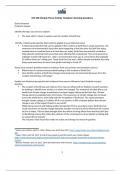
1.1 You want to clean up a lake where ten households live. Explain the
problem of free riding given that you want to charge each household the
same amount for cleaning the lake. (10) 1.2 Explain what you understand by
internalizing and externality. (5) 1.3 Explain the equimarginal principle and
why it leads to minimum aggregate abatement costs (no graph). (5) 1.4
What are externalities? Describe positive and negative externalities. (5)
Question 2 Read the excerpt below and answer the question that follows:
Africa has made significant strides in the growth of its solar energy industry
in recent years, with the continent seeing an increase of over 1.8W in new
solar installations, primarily led by Egypt, South Africa, Kenya, Namibia, and
Ghana. In order to simultaneously speed up energy access and support
sustainable economic growth, Africa’s renewable energy mix has
increasingly switched away from conventional hydropower and thermal
facilities to renewable alternatives. htps://earth.org/environmental-issues-in-
africa/ 2.1 Explain and graphically illustrate how this technology will affect
Africa’s marginal cost curve for the supply of electricity. (10) Read the
excerpt below and answer the question that follows: Over 40 million litres of
crude oil are spilled in the Niger Delta each year, killing people and harming
the ecosystem there in the process. Between 1976 and 2014, the oil-rich
region experienced more than 12,000 oil spill occurrences, according to a
2018 report by the Journal of Health and Pollution. More than half of them
were a result of tanker accidents and pipeline degradation. 2.2 Discuss the
different types of pollutants. Which type of pollutant is associated with the
excerpt above? (10)
Assignment 2
(COMPLETE
ANSWERS)
Semester 1 2025
(157760) - DUE
22 April 2025
[Type the document subtitle]
[Pick the date]
[Type the company name]
, Exam (elaborations)
ECS2606 Assignment 2 (COMPLETE
ANSWERS) Semester 1 2025 (157760) - DUE
22 April 2025 Environmental Economics (ECS2606)
Institution
University Of South Africa (Unisa)
Book
Environmental Economics
ECS2606 Assignment 2 (COMPLETE ANSWERS) Semester 1 2025 (157760) -
DUE 22 April 2025; 100% TRUSTED Complete, trusted solutions and
explanations. Ensure your success with us...
1.1 You want to clean up a lake where ten households live. Explain the
problem of free riding given that you want to charge each household the
same amount for cleaning the lake. (10) 1.2 Explain what you understand by
internalizing and externality. (5) 1.3 Explain the equimarginal principle and
why it leads to minimum aggregate abatement costs (no graph). (5) 1.4
What are externalities? Describe positive and negative externalities. (5)
Question 2 Read the excerpt below and answer the question that follows:
Africa has made significant strides in the growth of its solar energy industry
in recent years, with the continent seeing an increase of over 1.8W in new
solar installations, primarily led by Egypt, South Africa, Kenya, Namibia, and
Ghana. In order to simultaneously speed up energy access and support
sustainable economic growth, Africa’s renewable energy mix has
increasingly switched away from conventional hydropower and thermal
facilities to renewable alternatives. htps://earth.org/environmental-issues-in-
africa/ 2.1 Explain and graphically illustrate how this technology will affect
Africa’s marginal cost curve for the supply of electricity. (10) Read the
excerpt below and answer the question that follows: Over 40 million litres of
crude oil are spilled in the Niger Delta each year, killing people and harming
the ecosystem there in the process. Between 1976 and 2014, the oil-rich
region experienced more than 12,000 oil spill occurrences, according to a
2018 report by the Journal of Health and Pollution. More than half of them
were a result of tanker accidents and pipeline degradation. 2.2 Discuss the
different types of pollutants. Which type of pollutant is associated with the
excerpt above? (10)