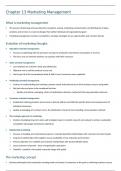
Chapter 13 Marketing Management
What is marketing management
The process of planning and executing the conception, pricing, marketing communication and distribution of ideas,
products and services to create exchanges that satisfy individual and organizational goals
Marketing management monitors competitors, develops strategies to use opportunities and counters threats
Evolution of marketing thought:
Operation-oriented management:
Focuses on optimising internal processes to improve production and delivery of products or services
The focus was on what the business can produce with their resources
Sales-oriented management:
Less emphasis on customer needs and satisfaction
Objective was to sell the products at any cost
Had to get rid of the overproduced stock & didn’t care if consumers were exploited
Marketing-oriented management:
Centres on understanding and meeting customer needs and preferences to drive business success and growth
Not just sales and price to be considered but also:
– Quality of products, packaging, choice of distribution channels, method of informing potential customers
Consumer-oriented management:
Emphasises tailoring products and services to directly address and fulfil the specific desires and requirements of
individual consumers
Quality & packaging of a product, price, the distribution channel & the marketing communication methods
The strategic approach to marketing:
Involves developing long-term plans and strategies based on market research and analysis to achieve sustainable
competitive advantage and business objectives
Relationship marketing:
Focuses on building and maintaining long-term, mutually beneficial relationships with customers to foster loyalty
Long term relationships with suppliers ensure availability of raw materials and inventory
Primary objective is to establish and maintain relationships with loyal profitable clients
Loyal customers important - basis of organization operations
Goodwill - establish a favourable corporate image with public
The marketing concept
Business philosophy that emphasizes meeting needs and wants of customers as the path to achieving business success
, Directs all marketing decisions about products, distribution methods, marketing communication and price determination
Four principles of the marketing concept
Profitability
Consumer orientation
Social responsibility
Organisational integration
Principle of profitability
The primary aim of marketing
Long-term profit maximisation, which supports the development of products that meet market demands
Principle of Consumer Orientation
Emphasis is placed on what the consumer needs
Even though consumer is very important - satisfaction of consumer needs can never be achieved
Satisfaction can only be given within constraints of profit objective and resources of business
Consumer oriented means consumer must be supplied with adequate and correct info
If needs of consumers not met, competitors will use opportunity as advantage, by producing products demanded
Principle of Social responsibility
Business should make a contribution to the community with whom it does business.
Business often discharge this responsibility by spending money on projects like housing, education
Objectives = create a stable economic, social and political environment for future profits
Enhances corporate image with employees, consumers & public
Principle of Organizational Integration
Cooperation between different departments in organisation to attain the business’s mission and objectives
The components of the marketing process
Product Transfer:
Marketing involves moving a product from a business to a consumer, aiming to satisfy needs through an exchange
Consumer Choice:
Free-market society, consumers choose products based on needs and price willing to pay, without being compelled
Persuasion and Transaction:
Marketers use strategies to persuade consumers, leading to transactions between the marketer and the consumer
4 variables are used to make decisions: (4 P’s)
Product itself
Place where it is offered (distribution)
Marketing communication methods to inform customer (Promotion)
Price - reflects the products value
Decisions about use of 4 Ps → marketing strategy
Marketing offering should not satisfy individual but market segment
, From the different market segments, a target market is selected
Market research
Gain information about the market, competitors & other environmental challenges
Management receives feedback from customers & the environment by conducting market research
Do SWOT analysis before decisions are made
Info collected via environmental scanning should include:
External variables and internal resources (records and reports) about prices
Sales figures and market trends
Changes in market share
Information from market research needs to:
Consumer preferences
Increase understanding of relevant market segments
New legislation
Be pertinent to planning and controlling
Product schedules
Help in decision-making.
Internal financial problems
What is marketing management
The process of planning and executing the conception, pricing, marketing communication and distribution of ideas,
products and services to create exchanges that satisfy individual and organizational goals
Marketing management monitors competitors, develops strategies to use opportunities and counters threats
Evolution of marketing thought:
Operation-oriented management:
Focuses on optimising internal processes to improve production and delivery of products or services
The focus was on what the business can produce with their resources
Sales-oriented management:
Less emphasis on customer needs and satisfaction
Objective was to sell the products at any cost
Had to get rid of the overproduced stock & didn’t care if consumers were exploited
Marketing-oriented management:
Centres on understanding and meeting customer needs and preferences to drive business success and growth
Not just sales and price to be considered but also:
– Quality of products, packaging, choice of distribution channels, method of informing potential customers
Consumer-oriented management:
Emphasises tailoring products and services to directly address and fulfil the specific desires and requirements of
individual consumers
Quality & packaging of a product, price, the distribution channel & the marketing communication methods
The strategic approach to marketing:
Involves developing long-term plans and strategies based on market research and analysis to achieve sustainable
competitive advantage and business objectives
Relationship marketing:
Focuses on building and maintaining long-term, mutually beneficial relationships with customers to foster loyalty
Long term relationships with suppliers ensure availability of raw materials and inventory
Primary objective is to establish and maintain relationships with loyal profitable clients
Loyal customers important - basis of organization operations
Goodwill - establish a favourable corporate image with public
The marketing concept
Business philosophy that emphasizes meeting needs and wants of customers as the path to achieving business success
, Directs all marketing decisions about products, distribution methods, marketing communication and price determination
Four principles of the marketing concept
Profitability
Consumer orientation
Social responsibility
Organisational integration
Principle of profitability
The primary aim of marketing
Long-term profit maximisation, which supports the development of products that meet market demands
Principle of Consumer Orientation
Emphasis is placed on what the consumer needs
Even though consumer is very important - satisfaction of consumer needs can never be achieved
Satisfaction can only be given within constraints of profit objective and resources of business
Consumer oriented means consumer must be supplied with adequate and correct info
If needs of consumers not met, competitors will use opportunity as advantage, by producing products demanded
Principle of Social responsibility
Business should make a contribution to the community with whom it does business.
Business often discharge this responsibility by spending money on projects like housing, education
Objectives = create a stable economic, social and political environment for future profits
Enhances corporate image with employees, consumers & public
Principle of Organizational Integration
Cooperation between different departments in organisation to attain the business’s mission and objectives
The components of the marketing process
Product Transfer:
Marketing involves moving a product from a business to a consumer, aiming to satisfy needs through an exchange
Consumer Choice:
Free-market society, consumers choose products based on needs and price willing to pay, without being compelled
Persuasion and Transaction:
Marketers use strategies to persuade consumers, leading to transactions between the marketer and the consumer
4 variables are used to make decisions: (4 P’s)
Product itself
Place where it is offered (distribution)
Marketing communication methods to inform customer (Promotion)
Price - reflects the products value
Decisions about use of 4 Ps → marketing strategy
Marketing offering should not satisfy individual but market segment
, From the different market segments, a target market is selected
Market research
Gain information about the market, competitors & other environmental challenges
Management receives feedback from customers & the environment by conducting market research
Do SWOT analysis before decisions are made
Info collected via environmental scanning should include:
External variables and internal resources (records and reports) about prices
Sales figures and market trends
Changes in market share
Information from market research needs to:
Consumer preferences
Increase understanding of relevant market segments
New legislation
Be pertinent to planning and controlling
Product schedules
Help in decision-making.
Internal financial problems