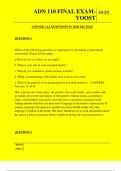
ADN 110 FINAL EXAM- 2025
YOOST
ANSWER ALL QUESTIONS IN THIS SECTION
QUESTION 1
Which of the following questions are appropriate to ask during a transcultural
assessment? (Select all that apply.)
a. How do you act when you are angry?
b. What is your role in your extended family?
c. Why do you continue to speak German at home?
d. When communicating with friends, how close do you stand?
e. What is the purpose of not preparing beef with milk products? - ANSWERS-
Answers: A, B, D
How a person acts when angry, the person's role in the family, and comfort with
proximity all are relevant aspects of the patient's cultural norms, according to
Giger, and should be assessed to raise the nurse's awareness of patient needs.
Asking patients why they use their native language in the home is unnecessary. If
primary language information is needed, the nurse should simply ask what
language is spoken in the home. The nurse should not try to seek information about
the reason a person maintains dietary traditions during the assessment process.
QUESTION 2
END OF
PAGE 1
, ADN 110 FINAL EXAM- 2025
YOOST
How best can a nurse evaluate goal attainment for a patient with a culturally
diverse background?
a. Assume that gender roles will be a challenge to overcome regardless of the
patient's ethnicity.
b. Base decisions on feedback from the patient and the nurse's professional
judgment.
c. Collaborate with future community care providers to determine patient strengths.
d. Seek input from members of the patient's support system to avoid biased patient
responses. - ANSWERS-Answer: B
Decisions about whether a patient has met treatment goals or outcomes should be
based on patient feedback and a nurse's professional judgment. Gender role
considerations are unlikely to play a role in evaluation. Future community care
providers are unable to help in the evaluation of patient goals before participating
in a patient's care. The patient is the primary person from whom information
should be obtained in evaluating goals and outcomes.
QUESTION 3
What aspect of culture is a full-time employed granddaughter of an elderly female
exhibiting if she asks the social worker to place her grandmother in an extended-
care facility against the wishes of her parents?
END OF
PAGE 2
, ADN 110 FINAL EXAM- 2025
YOOST
a. System change
b. Gender role
c. Cultural norms
d. Shared attributes - ANSWERS-Answer: A
As one aspect of a society changes, the systems within that society change. The
granddaughter in this case is employed full time and unable to adequately care for
her grandmother at home. Therefore her request to have the grandmother placed in
an extended-care facility reflects societal changes that affect traditional culture
expectations of one generation's providing care in the home. Shared attributes,
cultural norms, and gender role are all challenged by the granddaughter's actions.
QUESTION 4
Culturally competent care would encourage which action by a patient's family?
a. Asking the family's spiritual advisor to visit the patient
b. Speaking English to everyone involved in patient care
c. Adhering to highly publicized restrictive unit visiting hours
d. Limiting food consumption to items provided by the cafeteria - ANSWERS-
Answer: A
Culturally competent care allows for flexibility within safety guidelines and patient
care limitations. Allowing a patient to meet with a spiritual advisor recognizes the
importance of a patient's spiritual needs. Limiting language use, food consumption,
and visiting hours in a strict manner without sensitivity to a patient's preference do
not reflect culturally competent nursing care.
END OF
PAGE 3
, ADN 110 FINAL EXAM- 2025
YOOST
QUESTION 5
If a patient's primary language differs from that of the health care professionals
providing care, which action is most appropriate for the nurse to take?
a. Use colorful pictures, whiteboards, and gestures to communicate all important
information.
b. Verify patient understanding of questions asked when the patient responds with
continuous affirmative answers.
c. Arrange for a professional language translator to be present 24 hours each day.
d. Decrease interaction with the patient and family to avoid making them
uncomfortable for not understanding. - ANSWERS-Answer: B
Consistent affirmative answers from a patient in the form of verbal responses of
nods may indicate that a patient does not really understand what is being asked and
is just trying to be cooperative. It is important for the nurse to double check to
make sure a patient understands instructions and questions to ensure safety and
proper care. Not all information can be conveyed via pictures or gestures, and a
professional interpreter need not be present 24 hours a day. Ignoring or avoiding
patients or families with culturally diverse backgrounds serves to isolate them and
is never appropriate.
QUESTION 6
END OF
PAGE 4
YOOST
ANSWER ALL QUESTIONS IN THIS SECTION
QUESTION 1
Which of the following questions are appropriate to ask during a transcultural
assessment? (Select all that apply.)
a. How do you act when you are angry?
b. What is your role in your extended family?
c. Why do you continue to speak German at home?
d. When communicating with friends, how close do you stand?
e. What is the purpose of not preparing beef with milk products? - ANSWERS-
Answers: A, B, D
How a person acts when angry, the person's role in the family, and comfort with
proximity all are relevant aspects of the patient's cultural norms, according to
Giger, and should be assessed to raise the nurse's awareness of patient needs.
Asking patients why they use their native language in the home is unnecessary. If
primary language information is needed, the nurse should simply ask what
language is spoken in the home. The nurse should not try to seek information about
the reason a person maintains dietary traditions during the assessment process.
QUESTION 2
END OF
PAGE 1
, ADN 110 FINAL EXAM- 2025
YOOST
How best can a nurse evaluate goal attainment for a patient with a culturally
diverse background?
a. Assume that gender roles will be a challenge to overcome regardless of the
patient's ethnicity.
b. Base decisions on feedback from the patient and the nurse's professional
judgment.
c. Collaborate with future community care providers to determine patient strengths.
d. Seek input from members of the patient's support system to avoid biased patient
responses. - ANSWERS-Answer: B
Decisions about whether a patient has met treatment goals or outcomes should be
based on patient feedback and a nurse's professional judgment. Gender role
considerations are unlikely to play a role in evaluation. Future community care
providers are unable to help in the evaluation of patient goals before participating
in a patient's care. The patient is the primary person from whom information
should be obtained in evaluating goals and outcomes.
QUESTION 3
What aspect of culture is a full-time employed granddaughter of an elderly female
exhibiting if she asks the social worker to place her grandmother in an extended-
care facility against the wishes of her parents?
END OF
PAGE 2
, ADN 110 FINAL EXAM- 2025
YOOST
a. System change
b. Gender role
c. Cultural norms
d. Shared attributes - ANSWERS-Answer: A
As one aspect of a society changes, the systems within that society change. The
granddaughter in this case is employed full time and unable to adequately care for
her grandmother at home. Therefore her request to have the grandmother placed in
an extended-care facility reflects societal changes that affect traditional culture
expectations of one generation's providing care in the home. Shared attributes,
cultural norms, and gender role are all challenged by the granddaughter's actions.
QUESTION 4
Culturally competent care would encourage which action by a patient's family?
a. Asking the family's spiritual advisor to visit the patient
b. Speaking English to everyone involved in patient care
c. Adhering to highly publicized restrictive unit visiting hours
d. Limiting food consumption to items provided by the cafeteria - ANSWERS-
Answer: A
Culturally competent care allows for flexibility within safety guidelines and patient
care limitations. Allowing a patient to meet with a spiritual advisor recognizes the
importance of a patient's spiritual needs. Limiting language use, food consumption,
and visiting hours in a strict manner without sensitivity to a patient's preference do
not reflect culturally competent nursing care.
END OF
PAGE 3
, ADN 110 FINAL EXAM- 2025
YOOST
QUESTION 5
If a patient's primary language differs from that of the health care professionals
providing care, which action is most appropriate for the nurse to take?
a. Use colorful pictures, whiteboards, and gestures to communicate all important
information.
b. Verify patient understanding of questions asked when the patient responds with
continuous affirmative answers.
c. Arrange for a professional language translator to be present 24 hours each day.
d. Decrease interaction with the patient and family to avoid making them
uncomfortable for not understanding. - ANSWERS-Answer: B
Consistent affirmative answers from a patient in the form of verbal responses of
nods may indicate that a patient does not really understand what is being asked and
is just trying to be cooperative. It is important for the nurse to double check to
make sure a patient understands instructions and questions to ensure safety and
proper care. Not all information can be conveyed via pictures or gestures, and a
professional interpreter need not be present 24 hours a day. Ignoring or avoiding
patients or families with culturally diverse backgrounds serves to isolate them and
is never appropriate.
QUESTION 6
END OF
PAGE 4