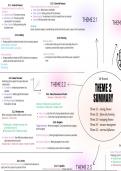
2.1.2 - External finance:
2.1.1 - Internal finance:
Finance that comes from outside the business:
Finance that comes from within the
Loan capital: Bank loans, overdrafts
business:
Share capital: Selling a share of the business
Owners funds: The owners money
Venture capital: Investment in risk for rewards from an investor
Retained profit: Previous profits
reinvested in the company
Leasing: Renting rather than buying
THEME 2.1 THEME
Sale of assets: Selling someting the
Sources:
business owns
banks, business angels, crowdfunding, family and friends, peer to peer, other businesses
2.1.3- Liability:
Limited liability: 2.1.4- Planning:
Responsibiltiy for debts is limtied to the comanys assets: Business plans:
Limited liabilty companies A document setting out the aims and objectives of a
Public limited liability companies business, and how they hope to achieve them
Unlimted liability: Cash fow forecast:
Responsibility for debts is NOT limited to the companys A forecast of cash inflows and outflows over a period of
assets, personal assets are at risk: time
Sole trader
Partnership
2.2.1 -Sales forecast: Mr Bennett
Sales
Predicting future sales from past data and
THEME 2.2
THEME 2
market data
Correlation: realtionsip between two
variable
SUMMARY
Extrapolation: Making prediction based Time 2.2.2 -Sales, Revenue and Costs:
arund trend Revenue - Total costs = Profit
Moving averages: Smooting out
fluctuations in data Revenue = Selling price x Quantity sold
Total costs = Frixed costs + Variable costs
Theme 2.1 - raising finance
2.2.3 -Break even:
When a business makes niether a profit or a loss Fixed costs: costs that dont change depending on output Theme 2.2 - financial planning
(Revenue = Total costs) Variable costs: Costs that change depending on output
Theme 2.3- managing finance
2.2.4 -Budgets:
1. Selling price - Variable costs per unit = Target (financial) = Revenue budgets, Cost (expenditure) budgets, Theme 2.4 - resource managment
contribution per unit profit budgets
2. Fixed costs / CPU = Break even point Theme 2.5 - external influences
Historical budgeting: Setting budgets based on previous year data
Margin of saftey: the difference betwen actual
sales and break even point Zero based budgetting: Making budgets from scratch
Actual output - break even output = margin of saftey
2.4
Variance analysis: Comparing actual results to budgets
Just In Time (JIT)
Ordering ‘just in ti
Reduces wast
2.3.1 -Profit: Reduces stora
Statment of comprehensive income = shows the revenue and Relies heavily
costs over the course of a period of time
2.3.2 - Liquidity:
Statment of financial position = shows value of a THEME 2.3
2.1.1 - Internal finance:
Finance that comes from outside the business:
Finance that comes from within the
Loan capital: Bank loans, overdrafts
business:
Share capital: Selling a share of the business
Owners funds: The owners money
Venture capital: Investment in risk for rewards from an investor
Retained profit: Previous profits
reinvested in the company
Leasing: Renting rather than buying
THEME 2.1 THEME
Sale of assets: Selling someting the
Sources:
business owns
banks, business angels, crowdfunding, family and friends, peer to peer, other businesses
2.1.3- Liability:
Limited liability: 2.1.4- Planning:
Responsibiltiy for debts is limtied to the comanys assets: Business plans:
Limited liabilty companies A document setting out the aims and objectives of a
Public limited liability companies business, and how they hope to achieve them
Unlimted liability: Cash fow forecast:
Responsibility for debts is NOT limited to the companys A forecast of cash inflows and outflows over a period of
assets, personal assets are at risk: time
Sole trader
Partnership
2.2.1 -Sales forecast: Mr Bennett
Sales
Predicting future sales from past data and
THEME 2.2
THEME 2
market data
Correlation: realtionsip between two
variable
SUMMARY
Extrapolation: Making prediction based Time 2.2.2 -Sales, Revenue and Costs:
arund trend Revenue - Total costs = Profit
Moving averages: Smooting out
fluctuations in data Revenue = Selling price x Quantity sold
Total costs = Frixed costs + Variable costs
Theme 2.1 - raising finance
2.2.3 -Break even:
When a business makes niether a profit or a loss Fixed costs: costs that dont change depending on output Theme 2.2 - financial planning
(Revenue = Total costs) Variable costs: Costs that change depending on output
Theme 2.3- managing finance
2.2.4 -Budgets:
1. Selling price - Variable costs per unit = Target (financial) = Revenue budgets, Cost (expenditure) budgets, Theme 2.4 - resource managment
contribution per unit profit budgets
2. Fixed costs / CPU = Break even point Theme 2.5 - external influences
Historical budgeting: Setting budgets based on previous year data
Margin of saftey: the difference betwen actual
sales and break even point Zero based budgetting: Making budgets from scratch
Actual output - break even output = margin of saftey
2.4
Variance analysis: Comparing actual results to budgets
Just In Time (JIT)
Ordering ‘just in ti
Reduces wast
2.3.1 -Profit: Reduces stora
Statment of comprehensive income = shows the revenue and Relies heavily
costs over the course of a period of time
2.3.2 - Liquidity:
Statment of financial position = shows value of a THEME 2.3