SERIES 7 REGULATIONS 2025
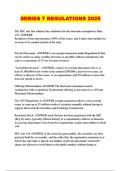
The SEC rule that outlines the conditions for the intrastate exemption is Rule
147: ANSWER.
Residents of that state purchase 100% of the issues, and it takes nine months for
an issue to be created outside of the state.
Private Placement: ANSWER is an exempt transaction under Regulation D that
can be sold to as many wealthy investors as possible without a prospectus, but
only to a maximum of 35 low-income investors.
"Accredited Investor" - ANSWER: a buyer of a private placement who is at
least $1,000,000 in net worth or has earned $200,000 a year for two years, an
officer or director of the issuer, or an organization with $5 million or more that
does not intend to invest
Offering Memorandum-ANSWER The disclosure document used in
conjunction with a regulation D placement offering is also known as a Private
Placement Memorandum.
The 1933 Regulation A-ANSWER exempt transaction allows a non-exempt
issuer to issue up to $5 million worth of securities annually without having to
register them with the Securities and Exchange Commission.
Restricted Stock: ANSWER stock that has not been registered with the SEC
(Reg D) and is typically offered directly to a corporation's officers or directors
in a private placement is free from this requirement; resales must adhere to Rule
144.
SEC rule 144-ANSWER: If the issuer has gone public, the securities are fully
paid and held for six months, and the seller files the registration statement at or
before the sell order is placed, the holders of private placement "restricted"
shares are allowed to resell them in the public markets without doing so.
The SEC rule that outlines the conditions for the intrastate exemption is Rule
147: ANSWER.
Residents of that state purchase 100% of the issues, and it takes nine months for
an issue to be created outside of the state.
Private Placement: ANSWER is an exempt transaction under Regulation D that
can be sold to as many wealthy investors as possible without a prospectus, but
only to a maximum of 35 low-income investors.
"Accredited Investor" - ANSWER: a buyer of a private placement who is at
least $1,000,000 in net worth or has earned $200,000 a year for two years, an
officer or director of the issuer, or an organization with $5 million or more that
does not intend to invest
Offering Memorandum-ANSWER The disclosure document used in
conjunction with a regulation D placement offering is also known as a Private
Placement Memorandum.
The 1933 Regulation A-ANSWER exempt transaction allows a non-exempt
issuer to issue up to $5 million worth of securities annually without having to
register them with the Securities and Exchange Commission.
Restricted Stock: ANSWER stock that has not been registered with the SEC
(Reg D) and is typically offered directly to a corporation's officers or directors
in a private placement is free from this requirement; resales must adhere to Rule
144.
SEC rule 144-ANSWER: If the issuer has gone public, the securities are fully
paid and held for six months, and the seller files the registration statement at or
before the sell order is placed, the holders of private placement "restricted"
shares are allowed to resell them in the public markets without doing so.