

CIRCULATORY SYSTEM
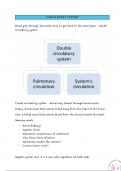
Blood goes through the heart twice to get back to the same place – double
circulatory system
Closed circulatory system – blood only travels through blood vessels
Artery: blood vessel that carries blood away from the heart to the tissue
Vein: a blood vessel that carries blood from the tissue towards the heart
Naming vessels:
- Renal (kidney)
- Hepatic (liver)
- Mesenteric (membranes of intestines)
- Iliac (ileum bone of pelvis)
- Subclavian (under the clavicle)
- Corona (outer circle)
Hepatic portal vein: it is a vein with capillaries at both ends
, THE STRUCTURE OF THE HEART:
EXTERNAL STRUCTURE:
Middle of chest (thorax)
Surrounded by lungs and protected by ribs
Pericardium: strong outer skin of the heart
The right pump sends blood to the lungs
The left pump sends blood around the body
INTERAL STRUCTURE:
Septum: muscular tissue that divides the heart into two halves
Tricuspid valve – valve with three flaps
Bicuspid valve – valve with two flaps
There are tendons on each flap so that the blood in the ventricles does not
push the flap upwards into the atria
Semilunar valve – opening of the artery
HOW THE HEART BEATS
FLOW OF BLOOD:
Cardiac muscle is found in the heart only
Systole – cardiac muscle contracts
Diastole – cardiac muscle relaxes
CONTROL OF THE CARDIAC CYCLE:
Pacemaker – controls the rate of your heartbeat
It is found in the wall of the right atrium
Steps in the process of changing your heart rate:
1: Your blood pressure and the amount of carbon dioxide in your blood
are sensed in the large blood vessels near the heart
Blood goes through the heart twice to get back to the same place – double
circulatory system
Closed circulatory system – blood only travels through blood vessels
Artery: blood vessel that carries blood away from the heart to the tissue
Vein: a blood vessel that carries blood from the tissue towards the heart
Naming vessels:
- Renal (kidney)
- Hepatic (liver)
- Mesenteric (membranes of intestines)
- Iliac (ileum bone of pelvis)
- Subclavian (under the clavicle)
- Corona (outer circle)
Hepatic portal vein: it is a vein with capillaries at both ends
, THE STRUCTURE OF THE HEART:
EXTERNAL STRUCTURE:
Middle of chest (thorax)
Surrounded by lungs and protected by ribs
Pericardium: strong outer skin of the heart
The right pump sends blood to the lungs
The left pump sends blood around the body
INTERAL STRUCTURE:
Septum: muscular tissue that divides the heart into two halves
Tricuspid valve – valve with three flaps
Bicuspid valve – valve with two flaps
There are tendons on each flap so that the blood in the ventricles does not
push the flap upwards into the atria
Semilunar valve – opening of the artery
HOW THE HEART BEATS
FLOW OF BLOOD:
Cardiac muscle is found in the heart only
Systole – cardiac muscle contracts
Diastole – cardiac muscle relaxes
CONTROL OF THE CARDIAC CYCLE:
Pacemaker – controls the rate of your heartbeat
It is found in the wall of the right atrium
Steps in the process of changing your heart rate:
1: Your blood pressure and the amount of carbon dioxide in your blood
are sensed in the large blood vessels near the heart


