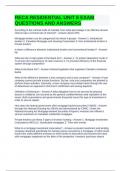
RECA RESIDENTIAL UNIT 6 EXAM
QUESTIONS AND ANSWERS
According to the criminal code of Canada, from what percentage is an effective annual
interest rate a criminal rate of interest? - Answer-above 60%
Mortgage lenders can be categorized into these 4 groups - Answer-1. Institutional
lenders 2. Canadian Mortgage and Housing Corporation 3. Non-Institutional lenders 4.
Private lenders
Is there a difference between Institutional lenders and conventional lenders? - Answer-
No
What are the 3 main goals of the Bank Act? - Answer-1. To protect depositors' funds 2.
To ensure the maintenance of cash reserves 3. To promote efficiency of the financial
system through competition
What is the Bank Act? - Answer-Federal legislation that regulates Canada's chartered
banks
What is the difference between a loan company and a trust company? - Answer-A loan
company cannot provide trustee functions. By law, only trust companies are allowed to
perform these activities. Secondly, a loan company must obtain funds through the use
of debentures as opposed to short-term certificates and saving deposits.
Definition of Debenture - Answer-A debt obligation that is not secured by physical
assets or collateral, but secured by the general creditworthiness and reputation of the
issuer. Both corporations and governments frequently issue this type of investment in
order to secure capital.
How does the federal government offer mortgage-backed securities? (MBS) - Answer-
through the National Housing Act (NHA) and administered by CMHC. Under the
National Housing Act Mortgage-backed Securities Program, investors are offered a
secure investment in Canadian residential mortgages.
Private lenders use these 3 types of investor funding - Answer-1. Mortgage investment
Corporations (MICs) 2. Syndicated mortgages 3. Their own money
What is a mortgage investment corporation? - Answer-a private investment and lending
company designed specifically for loaning money secured by a mortgage. An MIC pools
funds from many different investors to lend money to borrowers and secures the loans
with mortgages registered on the titles of the properties. Investors purchase shares
, Must a MIC only invest in residential Mortgages? - Answer-Mortgage investment
corporations must have at least 50% of their assets in residential mortgages. Typically,
invests in first and second mortgages on residential property, but also invests in other
types of real estate, such as: commercial or construction mortgages, bridge financing
secured by a mortgage, debt consolidation, home equity loans, Alternative mortgage
financing.
What is riskier, a MIC or a syndicated mortgage - Answer-Syndicated mortgage usually
as it is on just one property (when 2 or more investors participate), so if there is a
shortfall as a result of buyer default or foreclosure then more will be lost than the fund
type investment with more properties in a MIC
A life insurance companies considered an institutional lender? - Answer-Yes
The 5 C's of borrower credit - Answer-Character, Capital, Capacity, Collateral, Credit
The 5 C's of borrower credit - 4 criteria evaluated when looking at "Character" - Answer-
1. Education 2. Professional experience 3. time at current employer 4. Current
residence of the borrower
2 reporting agencies in Canada that keep credit history data - Answer-Equifax Canada
and TransUnion of Canada
What is the range of credit scores - Answer-typically 300 to 900
components and percentage weight credit scoring systems use (x 5) - Answer-35% -
Payment history, 30% current level of debt, 15% Length of credit history, 10% Number
or frequency of new credit card inquiries, 10% Type iof credit owned
What is the GDS ratio? - Answer-Gross Debt Service Ratio is the percentage of gross
income needed monthly to cover housing costs divided by gross monthly income.
Generally should not exceed approximately 30% of a borrower's gross monthly income.
Housing costs include: Mortgage payments (principle and interest), property taxes,
heating expenses. If a condominium, GDS must also include 50% of the monthly
condominium fees.
What does PITH refer to (in the mortgage industry)? - Answer-The cost of principle,
interest, taxes and heating,
Calculation for GDS - Answer-Gross debt service ratio = PITH divided by Gross Monthly
income
What is the TDS calculation? - Answer-Total Debt Service Ratio: Borrower's total
monthly debt load (including PITH and all debts such as car loans, bank loans, credit
card payments, and other financial commitments.) divided by gross monthly income.
QUESTIONS AND ANSWERS
According to the criminal code of Canada, from what percentage is an effective annual
interest rate a criminal rate of interest? - Answer-above 60%
Mortgage lenders can be categorized into these 4 groups - Answer-1. Institutional
lenders 2. Canadian Mortgage and Housing Corporation 3. Non-Institutional lenders 4.
Private lenders
Is there a difference between Institutional lenders and conventional lenders? - Answer-
No
What are the 3 main goals of the Bank Act? - Answer-1. To protect depositors' funds 2.
To ensure the maintenance of cash reserves 3. To promote efficiency of the financial
system through competition
What is the Bank Act? - Answer-Federal legislation that regulates Canada's chartered
banks
What is the difference between a loan company and a trust company? - Answer-A loan
company cannot provide trustee functions. By law, only trust companies are allowed to
perform these activities. Secondly, a loan company must obtain funds through the use
of debentures as opposed to short-term certificates and saving deposits.
Definition of Debenture - Answer-A debt obligation that is not secured by physical
assets or collateral, but secured by the general creditworthiness and reputation of the
issuer. Both corporations and governments frequently issue this type of investment in
order to secure capital.
How does the federal government offer mortgage-backed securities? (MBS) - Answer-
through the National Housing Act (NHA) and administered by CMHC. Under the
National Housing Act Mortgage-backed Securities Program, investors are offered a
secure investment in Canadian residential mortgages.
Private lenders use these 3 types of investor funding - Answer-1. Mortgage investment
Corporations (MICs) 2. Syndicated mortgages 3. Their own money
What is a mortgage investment corporation? - Answer-a private investment and lending
company designed specifically for loaning money secured by a mortgage. An MIC pools
funds from many different investors to lend money to borrowers and secures the loans
with mortgages registered on the titles of the properties. Investors purchase shares
, Must a MIC only invest in residential Mortgages? - Answer-Mortgage investment
corporations must have at least 50% of their assets in residential mortgages. Typically,
invests in first and second mortgages on residential property, but also invests in other
types of real estate, such as: commercial or construction mortgages, bridge financing
secured by a mortgage, debt consolidation, home equity loans, Alternative mortgage
financing.
What is riskier, a MIC or a syndicated mortgage - Answer-Syndicated mortgage usually
as it is on just one property (when 2 or more investors participate), so if there is a
shortfall as a result of buyer default or foreclosure then more will be lost than the fund
type investment with more properties in a MIC
A life insurance companies considered an institutional lender? - Answer-Yes
The 5 C's of borrower credit - Answer-Character, Capital, Capacity, Collateral, Credit
The 5 C's of borrower credit - 4 criteria evaluated when looking at "Character" - Answer-
1. Education 2. Professional experience 3. time at current employer 4. Current
residence of the borrower
2 reporting agencies in Canada that keep credit history data - Answer-Equifax Canada
and TransUnion of Canada
What is the range of credit scores - Answer-typically 300 to 900
components and percentage weight credit scoring systems use (x 5) - Answer-35% -
Payment history, 30% current level of debt, 15% Length of credit history, 10% Number
or frequency of new credit card inquiries, 10% Type iof credit owned
What is the GDS ratio? - Answer-Gross Debt Service Ratio is the percentage of gross
income needed monthly to cover housing costs divided by gross monthly income.
Generally should not exceed approximately 30% of a borrower's gross monthly income.
Housing costs include: Mortgage payments (principle and interest), property taxes,
heating expenses. If a condominium, GDS must also include 50% of the monthly
condominium fees.
What does PITH refer to (in the mortgage industry)? - Answer-The cost of principle,
interest, taxes and heating,
Calculation for GDS - Answer-Gross debt service ratio = PITH divided by Gross Monthly
income
What is the TDS calculation? - Answer-Total Debt Service Ratio: Borrower's total
monthly debt load (including PITH and all debts such as car loans, bank loans, credit
card payments, and other financial commitments.) divided by gross monthly income.