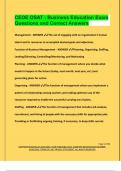
CEOE OSAT - Business Education Exam
Questions and Correct Answers
Management - ANSWER ✔✔The act of engaging with an organization's human
talent and its resources to accomplish desired goals and objectives.
Function of Business Management - ANSWER ✔✔Planning, Organizing, Staffing,
Leading/Directing, Controlling/Monitoring, and Motivating
Planning - ANSWER ✔✔The function of management where you decide what
needs to happen in the future (today, next month, next year, etc.) and
generating plans for action.
Organizing - ANSWER ✔✔The function of management where you implement a
pattern of relationships among workers and making optimum use of the
resources required to enable the successful carrying out of plans.
Staffing - ANSWER ✔✔The function of management that includes Job analysis,
recruitment, and hiring of people with the necessary skills for appropriate jobs.
Providing or facilitating ongoing training, if necessary, to keep skills current.
Page 1 of 33
COPYRIGHT©JOSHCLAY 2025/2026. YEAR PUBLISHED 2025. COMPANY REGISTRATION NUMBER:
619652435. TERMS OF USE. PRIVACY STATEMENT. ALL RIGHTS RESERVED
,Leading/Directing - ANSWER ✔✔The function of management that involves
determining what needs to be done in a situation and getting the right people
to do it.
Controlling/Monitoring - ANSWER ✔✔The function of management that
involves checking current outcomes against forecast plans and making
adjustments when necessary so that goals are achieved.
Motivating - ANSWER ✔✔The function of management that consists of
energizing, channeling and sustaining people's behavior towards the goals of
the organization.
Stakeholders - ANSWER ✔✔Persons or organizations with a legitimate interest
in a given situation, action ,or enterprise which are directly affected by the
organization's actions.
Theoretical - ANSWER ✔✔Of or relating to the underlying principles or methods
of a given technical skill, art, etc., as opposed to its practice.
Shareholder - ANSWER ✔✔Through owning stock ,the real owner of a publicly
traded business that is run by management.
Capital expenditure - ANSWER ✔✔Funds spent by a company to acquire or
upgrade a long-term asset.
Page 2 of 33
COPYRIGHT©JOSHCLAY 2025/2026. YEAR PUBLISHED 2025. COMPANY REGISTRATION NUMBER:
619652435. TERMS OF USE. PRIVACY STATEMENT. ALL RIGHTS RESERVED
,Controller - ANSWER ✔✔A person who audits and manages the financial affairs
of a company or government; a comptroller.
Delegation - ANSWER ✔✔The act of committing a task to someone, especially a
subordinate.
Line Authority - ANSWER ✔✔Managers have the formal power to direct and
control immediate subordinates executing specific tasks within a chain of
command, usually within a specific department.
Functional Authority - ANSWER ✔✔Managers have formal power over a specific
subset of activities that include outside departments. (Before a production
manager buys a new machine, a expenditure proposal must be submitted.)
Staff Authority - ANSWER ✔✔Staff specialists manage operations in their areas
of expertise.
Tall Structure - ANSWER ✔✔Management structure characterized by an overall
narrow span of management, a relatively large number of hierarchical levels,
tight control, and reduced communication overhead.
Flat Structure - ANSWER ✔✔Management structure characterized by an overall
broad span of management and relatively few hierarchical levels, loose control
and ease of delegation.
Page 3 of 33
COPYRIGHT©JOSHCLAY 2025/2026. YEAR PUBLISHED 2025. COMPANY REGISTRATION NUMBER:
619652435. TERMS OF USE. PRIVACY STATEMENT. ALL RIGHTS RESERVED
, Centralization - ANSWER ✔✔The location of decision making authority near top
organizational levels. This expedites decision-making from the top down.
Decentralization - ANSWER ✔✔The location of decision making authority is
relatively evenly dispersed across the company. This works well when creativity
and independent operations create value for the organization.
Laissez-faire - ANSWER ✔✔An environment in which an organization's
employees are free from excessive oversight or management, with sufficient
control only to ensure organizational goals are met.
Accounting - ANSWER ✔✔The systematic and detailed recording of financial
transactions of a business.
Why is accounting important? - ANSWER ✔✔Helps track income and
expenditures, ensure statutory compliance, and provide investors,
management, and government with quantitative financial information which
can be used in making business decisions.
Income Statement - ANSWER ✔✔Provides you with information about the
profit and loss
The Balance Sheet - ANSWER ✔✔Gives you a clear picture on the financial
position of your business on a particular date.
Page 4 of 33
COPYRIGHT©JOSHCLAY 2025/2026. YEAR PUBLISHED 2025. COMPANY REGISTRATION NUMBER:
619652435. TERMS OF USE. PRIVACY STATEMENT. ALL RIGHTS RESERVED
Questions and Correct Answers
Management - ANSWER ✔✔The act of engaging with an organization's human
talent and its resources to accomplish desired goals and objectives.
Function of Business Management - ANSWER ✔✔Planning, Organizing, Staffing,
Leading/Directing, Controlling/Monitoring, and Motivating
Planning - ANSWER ✔✔The function of management where you decide what
needs to happen in the future (today, next month, next year, etc.) and
generating plans for action.
Organizing - ANSWER ✔✔The function of management where you implement a
pattern of relationships among workers and making optimum use of the
resources required to enable the successful carrying out of plans.
Staffing - ANSWER ✔✔The function of management that includes Job analysis,
recruitment, and hiring of people with the necessary skills for appropriate jobs.
Providing or facilitating ongoing training, if necessary, to keep skills current.
Page 1 of 33
COPYRIGHT©JOSHCLAY 2025/2026. YEAR PUBLISHED 2025. COMPANY REGISTRATION NUMBER:
619652435. TERMS OF USE. PRIVACY STATEMENT. ALL RIGHTS RESERVED
,Leading/Directing - ANSWER ✔✔The function of management that involves
determining what needs to be done in a situation and getting the right people
to do it.
Controlling/Monitoring - ANSWER ✔✔The function of management that
involves checking current outcomes against forecast plans and making
adjustments when necessary so that goals are achieved.
Motivating - ANSWER ✔✔The function of management that consists of
energizing, channeling and sustaining people's behavior towards the goals of
the organization.
Stakeholders - ANSWER ✔✔Persons or organizations with a legitimate interest
in a given situation, action ,or enterprise which are directly affected by the
organization's actions.
Theoretical - ANSWER ✔✔Of or relating to the underlying principles or methods
of a given technical skill, art, etc., as opposed to its practice.
Shareholder - ANSWER ✔✔Through owning stock ,the real owner of a publicly
traded business that is run by management.
Capital expenditure - ANSWER ✔✔Funds spent by a company to acquire or
upgrade a long-term asset.
Page 2 of 33
COPYRIGHT©JOSHCLAY 2025/2026. YEAR PUBLISHED 2025. COMPANY REGISTRATION NUMBER:
619652435. TERMS OF USE. PRIVACY STATEMENT. ALL RIGHTS RESERVED
,Controller - ANSWER ✔✔A person who audits and manages the financial affairs
of a company or government; a comptroller.
Delegation - ANSWER ✔✔The act of committing a task to someone, especially a
subordinate.
Line Authority - ANSWER ✔✔Managers have the formal power to direct and
control immediate subordinates executing specific tasks within a chain of
command, usually within a specific department.
Functional Authority - ANSWER ✔✔Managers have formal power over a specific
subset of activities that include outside departments. (Before a production
manager buys a new machine, a expenditure proposal must be submitted.)
Staff Authority - ANSWER ✔✔Staff specialists manage operations in their areas
of expertise.
Tall Structure - ANSWER ✔✔Management structure characterized by an overall
narrow span of management, a relatively large number of hierarchical levels,
tight control, and reduced communication overhead.
Flat Structure - ANSWER ✔✔Management structure characterized by an overall
broad span of management and relatively few hierarchical levels, loose control
and ease of delegation.
Page 3 of 33
COPYRIGHT©JOSHCLAY 2025/2026. YEAR PUBLISHED 2025. COMPANY REGISTRATION NUMBER:
619652435. TERMS OF USE. PRIVACY STATEMENT. ALL RIGHTS RESERVED
, Centralization - ANSWER ✔✔The location of decision making authority near top
organizational levels. This expedites decision-making from the top down.
Decentralization - ANSWER ✔✔The location of decision making authority is
relatively evenly dispersed across the company. This works well when creativity
and independent operations create value for the organization.
Laissez-faire - ANSWER ✔✔An environment in which an organization's
employees are free from excessive oversight or management, with sufficient
control only to ensure organizational goals are met.
Accounting - ANSWER ✔✔The systematic and detailed recording of financial
transactions of a business.
Why is accounting important? - ANSWER ✔✔Helps track income and
expenditures, ensure statutory compliance, and provide investors,
management, and government with quantitative financial information which
can be used in making business decisions.
Income Statement - ANSWER ✔✔Provides you with information about the
profit and loss
The Balance Sheet - ANSWER ✔✔Gives you a clear picture on the financial
position of your business on a particular date.
Page 4 of 33
COPYRIGHT©JOSHCLAY 2025/2026. YEAR PUBLISHED 2025. COMPANY REGISTRATION NUMBER:
619652435. TERMS OF USE. PRIVACY STATEMENT. ALL RIGHTS RESERVED