ABMDI Registry Exam
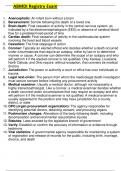
1. Anencephalic: An infant born without a brain
2. Bereavement: Sorrow following the death of a loved one
3. Brain death: Final cessation of activity in the central nervous system, as
indicated by a flat electroencephalogram (EEG) or absence of cerebral blood
flow for a predetermined period of time
4. Cardiac death: Final cessation of activity in the cardiovascular system
involving the heart and blood vessels
5. Cessation: The final stoppage of action
6. Coroner: Typically an elected official who decides whether a death occurred
under circumstances that require an autopsy, either by law or to determine
manner or cause. A coroner can determine the scope of an autopsy and who
will perform it if the elected coroner is not qualified. Only Kansas, Louisiana,
North Dakota, and Ohio require, without exception, that coroners be medical
doctors
7. Jurisdiction: The power or authority a court or office has over individuals or
trauma
8. Legal next-of-kin: The person from whom the medicolegal death investigator
must secure consent before initiating any procurement activity
9. Medical examiner: Usually a medical doctor, although not necessarily a
highly trained pathologist. Like a coroner, a medical examiner decides whether
a death occurred under circumstances that may require an autopsy and who
will perform it if the medical examiner is not qualified. A medical examiner is
usually appointed to the position and may have jurisdiction for a county,
district, or state
10. OPO (organ procurement organization): The agency responsible for
identifying potential donors, obtaining consent, and procuring organs
11. Postmortem changes: Alterations of the body following death, including
decomposition and environmental resuscitative injuries
12. Statutes: Laws enacted by the legislative branch of government
13. Verify: Establish or confirm the accuracy of information or evidence through
testimony
14. Vital statistics: A governmental agency responsible for maintaining a system
of registration and release of records for the public, including birth, marriage,
divorce, and death
, ABMDI Registry Exam
15. Antemortem blood sample: An initial blood sample that usually is obtained
when the subject arrives at the hospital emergency room, before additional
diagnostic or therapeutic treatment is initiated
16. Authorization: Official permission granted by a superior
17. Common-law marriage: A marriage that is recognized because the couple
have been cohabiting for a determined length of time, yet a legal marriage
ceremony has not been performed
18. Confidential: Revealed in confidence (trust, assurance), to be kept secret
19. Cremation: The reduction of a dead human body to inorganic bone fragments
by intense heat in a specially designed chamber
20. Demographic information: Personal identifying and specific information
regarding an individual's age, social security number, gender, address, and so on
21. Disinterment: The opening of a grave and removal of the body for the
purpose of reexamination or removal to another site
22. Embalmer: An individual licensed by the state to disinfect, preserve, and
cosmetically restore dead human bodies
23. Euphemism: A mild or inoffensive term or phrase that is substituted for
another, more explicit term
24. Funeral director: An individual or corporation licensed by a state to prepare
dead human remains, other than by embalming, for interment or other means of
disposal. The person also conducts funeral services and counsels the decedent's
families
25. Guardianship or power of attorney: Legal authorization to act on another
individual's behalf. This authority usually ceases after death, so be sure to check
the law in your state
26. Interrogation: The formal act of examining a person by asking questions,
usually a law enforcement function
27. Interview: A formal face-to-face conversation between a reported (the
medicolegal death investigator) and a person from whom information is sought
(the witness)
28. Legal next-of-kin: The hierarchical succession of survivors established by
law
29. Media: Any news-reporting agency (e.g. newspaper, magazine, radio,
television) and its representatives
30. Objective report: A report made in an independent and unbiased manner,
without regard for personal attitudes or thoughts
1. Anencephalic: An infant born without a brain
2. Bereavement: Sorrow following the death of a loved one
3. Brain death: Final cessation of activity in the central nervous system, as
indicated by a flat electroencephalogram (EEG) or absence of cerebral blood
flow for a predetermined period of time
4. Cardiac death: Final cessation of activity in the cardiovascular system
involving the heart and blood vessels
5. Cessation: The final stoppage of action
6. Coroner: Typically an elected official who decides whether a death occurred
under circumstances that require an autopsy, either by law or to determine
manner or cause. A coroner can determine the scope of an autopsy and who
will perform it if the elected coroner is not qualified. Only Kansas, Louisiana,
North Dakota, and Ohio require, without exception, that coroners be medical
doctors
7. Jurisdiction: The power or authority a court or office has over individuals or
trauma
8. Legal next-of-kin: The person from whom the medicolegal death investigator
must secure consent before initiating any procurement activity
9. Medical examiner: Usually a medical doctor, although not necessarily a
highly trained pathologist. Like a coroner, a medical examiner decides whether
a death occurred under circumstances that may require an autopsy and who
will perform it if the medical examiner is not qualified. A medical examiner is
usually appointed to the position and may have jurisdiction for a county,
district, or state
10. OPO (organ procurement organization): The agency responsible for
identifying potential donors, obtaining consent, and procuring organs
11. Postmortem changes: Alterations of the body following death, including
decomposition and environmental resuscitative injuries
12. Statutes: Laws enacted by the legislative branch of government
13. Verify: Establish or confirm the accuracy of information or evidence through
testimony
14. Vital statistics: A governmental agency responsible for maintaining a system
of registration and release of records for the public, including birth, marriage,
divorce, and death
, ABMDI Registry Exam
15. Antemortem blood sample: An initial blood sample that usually is obtained
when the subject arrives at the hospital emergency room, before additional
diagnostic or therapeutic treatment is initiated
16. Authorization: Official permission granted by a superior
17. Common-law marriage: A marriage that is recognized because the couple
have been cohabiting for a determined length of time, yet a legal marriage
ceremony has not been performed
18. Confidential: Revealed in confidence (trust, assurance), to be kept secret
19. Cremation: The reduction of a dead human body to inorganic bone fragments
by intense heat in a specially designed chamber
20. Demographic information: Personal identifying and specific information
regarding an individual's age, social security number, gender, address, and so on
21. Disinterment: The opening of a grave and removal of the body for the
purpose of reexamination or removal to another site
22. Embalmer: An individual licensed by the state to disinfect, preserve, and
cosmetically restore dead human bodies
23. Euphemism: A mild or inoffensive term or phrase that is substituted for
another, more explicit term
24. Funeral director: An individual or corporation licensed by a state to prepare
dead human remains, other than by embalming, for interment or other means of
disposal. The person also conducts funeral services and counsels the decedent's
families
25. Guardianship or power of attorney: Legal authorization to act on another
individual's behalf. This authority usually ceases after death, so be sure to check
the law in your state
26. Interrogation: The formal act of examining a person by asking questions,
usually a law enforcement function
27. Interview: A formal face-to-face conversation between a reported (the
medicolegal death investigator) and a person from whom information is sought
(the witness)
28. Legal next-of-kin: The hierarchical succession of survivors established by
law
29. Media: Any news-reporting agency (e.g. newspaper, magazine, radio,
television) and its representatives
30. Objective report: A report made in an independent and unbiased manner,
without regard for personal attitudes or thoughts