ABMDI
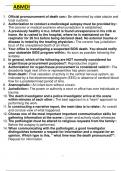
1. Official pronouncement of death can:: Be defermined by state statute and
local customs.
2. Authorization to conduct a medicolegal autopsy must be provided by::
The coroner or medical examiner when jurisdiction is established.
3. A previously healthy 4 m.o. Infant is found unresponsive in his crib at
home. He is rushed to the hospital, where he is maintained on the
respirator for 26 hrs before being declared dead. No external trauma or
disease is noted by the treating physician.: The coroner has jurisdiction
bcuz of the unexplained death of an infant.
4. Your office is investigating a suspected SIDS death. You should notify
your statewide SIDS program within:: As soon as possible following the
autopsy.
5. In general, which of the following are NOT normally considered for
organ/tissue procurement purposes?: Reproductive organs
6. Authorization for organ/tissue procurement is considered valid if:: The
decedents legal next of kin or representitive has given consent.
7. Brain death:: Final cessation of activity in the central nervous system, as
indicated by a flat electroencephalogram (EEG) or absence of cerebral blood
flow for a predetermined period of time.
8. Anencephalic:: An infant born without a brain.
9. Jurisdiction:: The power or authority a court or office has over individuals or
trauma.
10. The death investigator and a police investigator arrive at the scene
within minutes of each other:: The best approach is a "team" approach to
performing the work.
11. In constructing a narrative report, the main idea is to relate:: An overall
and concise view of what happened.
12. Choose one of the most important important communication skills for
gathering information at the scene:: Listen and actively study witnesses.
13. The pathologist must be altered to religious requests from the family::
Before the autopsy is performed.
14. When communicating with the pathologist, a good investigator
distinguishes between a request for information and a request for an
opinion. Which type is this, " what time was the death pronounced?":
Request for information.
1/6
, ABMDI
15. Common law marriage:: Marriage that is recognized because the couple
have been cohabiting for a determined length of time, but there has been no
legal ceremony.
16. Disinterment: The opening of a grave and removal of the body for the
purpose of reexamination or removal to another site.
17. Euphemism: A mild or inoffensive term or phrase that is substituted for
another, more explicit term.
18. Objective report:: A report made in an independent and unbiased manner,
without regard for personal attitudes or thoughts.
19. Retort:: A vessel or chamber in which substances are decomposed by heat.
20. Statutory:: Authorized by law.
21. When obtaining information about a decadent from family, the first
priority should always be to obtain info from:: The last family member who
saw and/or talked with the decedent, or has first hand knowledge regarding
the circumstances surrounding the death and/or medical history.
22. Family members often ask why the ME/Coroner is involved. When
discussing the case with family, what is the best prescribed answer to
give them?: Explain what is believed to have occurred (420,405,unexpected
death) and why the ME/coroner is investigating the death.
23. When investigating a homicide death case, you discover that the victim
and surviving family are Orthodox Jews. The family voice objection to an
autopsy being performed. What is best recommended procedure to
follow?: Counsel the family. Explain the circumstances surrounding the
investigation and why (criminal prosecution) the autopsy needs to be
performed.
24. If the deceased is decomposed, mutilated or burned beyond recognition
and the family still insists, for religious or cultural reasons, on viewing
the body, the investigator should:: Prepare the family before viewing with a
verbal explanation and possibly photographs of the remains.
25. A clandestine meth. Lab has exploded and the "chemists" body is on the
scene. You may undertake your scene investigaton when:: The fire
department and haz mat team think the scene is safe.
26. You arrive at an outdoor homicide and find that the crime scene tape
binds too small a perimeter. Onlookers and media are beginning to
gather, you should :: Keep the tape in place and advise the investigating
police agency of the need to enlarge the perimeter.
2/6
1. Official pronouncement of death can:: Be defermined by state statute and
local customs.
2. Authorization to conduct a medicolegal autopsy must be provided by::
The coroner or medical examiner when jurisdiction is established.
3. A previously healthy 4 m.o. Infant is found unresponsive in his crib at
home. He is rushed to the hospital, where he is maintained on the
respirator for 26 hrs before being declared dead. No external trauma or
disease is noted by the treating physician.: The coroner has jurisdiction
bcuz of the unexplained death of an infant.
4. Your office is investigating a suspected SIDS death. You should notify
your statewide SIDS program within:: As soon as possible following the
autopsy.
5. In general, which of the following are NOT normally considered for
organ/tissue procurement purposes?: Reproductive organs
6. Authorization for organ/tissue procurement is considered valid if:: The
decedents legal next of kin or representitive has given consent.
7. Brain death:: Final cessation of activity in the central nervous system, as
indicated by a flat electroencephalogram (EEG) or absence of cerebral blood
flow for a predetermined period of time.
8. Anencephalic:: An infant born without a brain.
9. Jurisdiction:: The power or authority a court or office has over individuals or
trauma.
10. The death investigator and a police investigator arrive at the scene
within minutes of each other:: The best approach is a "team" approach to
performing the work.
11. In constructing a narrative report, the main idea is to relate:: An overall
and concise view of what happened.
12. Choose one of the most important important communication skills for
gathering information at the scene:: Listen and actively study witnesses.
13. The pathologist must be altered to religious requests from the family::
Before the autopsy is performed.
14. When communicating with the pathologist, a good investigator
distinguishes between a request for information and a request for an
opinion. Which type is this, " what time was the death pronounced?":
Request for information.
1/6
, ABMDI
15. Common law marriage:: Marriage that is recognized because the couple
have been cohabiting for a determined length of time, but there has been no
legal ceremony.
16. Disinterment: The opening of a grave and removal of the body for the
purpose of reexamination or removal to another site.
17. Euphemism: A mild or inoffensive term or phrase that is substituted for
another, more explicit term.
18. Objective report:: A report made in an independent and unbiased manner,
without regard for personal attitudes or thoughts.
19. Retort:: A vessel or chamber in which substances are decomposed by heat.
20. Statutory:: Authorized by law.
21. When obtaining information about a decadent from family, the first
priority should always be to obtain info from:: The last family member who
saw and/or talked with the decedent, or has first hand knowledge regarding
the circumstances surrounding the death and/or medical history.
22. Family members often ask why the ME/Coroner is involved. When
discussing the case with family, what is the best prescribed answer to
give them?: Explain what is believed to have occurred (420,405,unexpected
death) and why the ME/coroner is investigating the death.
23. When investigating a homicide death case, you discover that the victim
and surviving family are Orthodox Jews. The family voice objection to an
autopsy being performed. What is best recommended procedure to
follow?: Counsel the family. Explain the circumstances surrounding the
investigation and why (criminal prosecution) the autopsy needs to be
performed.
24. If the deceased is decomposed, mutilated or burned beyond recognition
and the family still insists, for religious or cultural reasons, on viewing
the body, the investigator should:: Prepare the family before viewing with a
verbal explanation and possibly photographs of the remains.
25. A clandestine meth. Lab has exploded and the "chemists" body is on the
scene. You may undertake your scene investigaton when:: The fire
department and haz mat team think the scene is safe.
26. You arrive at an outdoor homicide and find that the crime scene tape
binds too small a perimeter. Onlookers and media are beginning to
gather, you should :: Keep the tape in place and advise the investigating
police agency of the need to enlarge the perimeter.
2/6