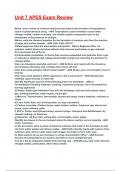
Unit 7 APES Exam Review
Below, write a series of chemical reactions that leads to the formation of tropospheric
ozone in photochemical smog. - ANS Tropospheric ozone formation occurs when
nitrogen oxides, carbon monoxide, and volatile organic compounds react in the
atmosphere in the presence of sunlight
\Below, write the chemical equation for the formation of carbonic acid from the reaction
of water with carbon dioxide. - ANS CO2+ H20= H2CO3
\Define baghouse filter and electrostatic precipitator - ANS a) Baghouse filter: air
pollution control device and dust collector that removes particulates or gas released
from processes out of the air
b) Electrostatic precipitator: A device that removes suspended dust particles from a gas
or exhaust by applying high voltage electrostatic charge and collecting the particles on
charged plates
\How can limestone neutralize acid rain? - ANS Sulfuric acid reacts with the limestone
and limestone dissolves and crumbles then leaves off acid
\How does noise pollution affect human health? - ANS Stress, poor concentration, loss of
hearing
\How does noise pollution affect organisms in the environment? - ANS Hearing loss,
infertility, rapid increase in heart rate
\Identify significant sources of the following indoor air pollutants: - ANS a)
Formaldehyde: Building materials, smoking, household products, use of unvented fuel
burning appliances
b) Radon: Radon gas infiltration from soil into buildings, rock and soil produce radon
gas, building materials, water supply, natural gas
c) Mercury: Thermometers, thermostats, fluorescent lamps, button batteries, switches or
relays
d) Lead: Paint, dust, soil, drinking water, air, toys and jewelry
e) Carbon monoxide: Clothes dryers, water heaters, boilers, fireplaces, gas stoves and
ovens, motor vehicles, grills
f) VOC's: Paints, wood preservatives, aerosol sprays, cleansers and disinfectants, dry
cleaned clothing, air freshners
g) Asbestos: old floor tiles, ceiling tiles, roof shingles, ducts, pipies
\Identify two places in the environment where the above reaction occurs naturally - ANS
rocks, volcanoes
\In the box below, write a series of chemical reactions that leads to the formation of acid
rain from sulfur oxides and nitrous oxides. - ANS Sulfur dioxide reacts with water to form
sulfurous acid, nitrous oxide reacts with oxygen and water to form nitric acid
\In what seasons do we see increases in smog concentration? Why? - ANS Summer
because the temperatures are warmer and there is more sunlight present
\List ALL the air pollutants emitted from burning coal. - ANS Mercury, lead, sulfur dioxide,
nitrogen oxides, particulates, other heavy metals
Below, write a series of chemical reactions that leads to the formation of tropospheric
ozone in photochemical smog. - ANS Tropospheric ozone formation occurs when
nitrogen oxides, carbon monoxide, and volatile organic compounds react in the
atmosphere in the presence of sunlight
\Below, write the chemical equation for the formation of carbonic acid from the reaction
of water with carbon dioxide. - ANS CO2+ H20= H2CO3
\Define baghouse filter and electrostatic precipitator - ANS a) Baghouse filter: air
pollution control device and dust collector that removes particulates or gas released
from processes out of the air
b) Electrostatic precipitator: A device that removes suspended dust particles from a gas
or exhaust by applying high voltage electrostatic charge and collecting the particles on
charged plates
\How can limestone neutralize acid rain? - ANS Sulfuric acid reacts with the limestone
and limestone dissolves and crumbles then leaves off acid
\How does noise pollution affect human health? - ANS Stress, poor concentration, loss of
hearing
\How does noise pollution affect organisms in the environment? - ANS Hearing loss,
infertility, rapid increase in heart rate
\Identify significant sources of the following indoor air pollutants: - ANS a)
Formaldehyde: Building materials, smoking, household products, use of unvented fuel
burning appliances
b) Radon: Radon gas infiltration from soil into buildings, rock and soil produce radon
gas, building materials, water supply, natural gas
c) Mercury: Thermometers, thermostats, fluorescent lamps, button batteries, switches or
relays
d) Lead: Paint, dust, soil, drinking water, air, toys and jewelry
e) Carbon monoxide: Clothes dryers, water heaters, boilers, fireplaces, gas stoves and
ovens, motor vehicles, grills
f) VOC's: Paints, wood preservatives, aerosol sprays, cleansers and disinfectants, dry
cleaned clothing, air freshners
g) Asbestos: old floor tiles, ceiling tiles, roof shingles, ducts, pipies
\Identify two places in the environment where the above reaction occurs naturally - ANS
rocks, volcanoes
\In the box below, write a series of chemical reactions that leads to the formation of acid
rain from sulfur oxides and nitrous oxides. - ANS Sulfur dioxide reacts with water to form
sulfurous acid, nitrous oxide reacts with oxygen and water to form nitric acid
\In what seasons do we see increases in smog concentration? Why? - ANS Summer
because the temperatures are warmer and there is more sunlight present
\List ALL the air pollutants emitted from burning coal. - ANS Mercury, lead, sulfur dioxide,
nitrogen oxides, particulates, other heavy metals