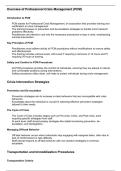
Overview of Professional Crisis Management (PCM)
Introduction to PCM
PCM stands for Professional Crisis Management, an association that provides training and
certification in crisis management.
The training focuses on prevention and de-escalation strategies to handle minor behavior
problems effectively.
Practitioners are trained to use only the necessary procedures to stop a crisis, emphasizing
minimal intervention.
Key Principles of PCM
Practitioners must adhere strictly to PCM procedures without modifications to ensure safety
and effectiveness.
The training includes various levels, with Level P requiring a minimum of 14 hours and P1
requiring 16 hours of training.
Safety and Comfort in PCM Procedures
All PCM procedures prioritize the comfort of individuals, ensuring they are placed in natural
and comfortable positions during interventions.
Safety procedures utilize clean, soft mats to protect individuals during crisis management.
Crisis Intervention Strategies
Prevention and De-escalation
Prevention strategies aim to increase on-task behaviors that are incompatible with crisis
behaviors.
Knowledge about the individual is crucial for selecting effective prevention strategies
tailored to their needs.
The Cycle of Crisis
The Cycle of Crisis includes stages such as Pre-crisis, Crisis, and Post-crisis, each
requiring specific strategies from staff.
At each level, staff should employ strategies like stable functioning prevention, de-
escalation, and reintegration.
Managing Off-task Behavior
Off-task behavior occurs when individuals stop engaging with assigned tasks, often due to
lack of reinforcement or task difficulty.
Staff should respond to off-task behavior with non-reactive strategies to minimize
escalation.
Transportation and Immobilization Procedures
Transportation Criteria
, Transportation is only used under specific conditions such as continuous aggression, self-
injury, or high magnitude disruption.
The goal of transportation is to remove individuals from situations that may reinforce crisis
behavior.
Vertical Immobilization
Only practitioners at Level P1 or higher are authorized to use vertical immobilization
techniques.
Vertical immobilization can only be applied when there is a breakdown or imminent
breakdown of transportation.
Post-Crisis Management
After a crisis, individuals should be quickly re-engaged in high probability behaviors to
facilitate recovery.
Staff must monitor for any signs of pre-crisis behavior as individuals transition back to
tasks.
,PCM Crisis Management Taken by: Denice304
Practice Test 15% Score
1. Describe how the principle of 'least restrictive intervention' contributes to
an individual's dignity during a crisis.
It prioritizes physical restraint over verbal de-escalation.
It focuses solely on the practitioner's authority.
It allows individuals to maintain autonomy and make choices.
It limits their options to ensure safety.
2. What is the primary outcome associated with higher levels of positive
reinforcement in classroom and treatment programs?
Engagement
Aggression
Isolation
Disengagement
3. What are the four strategies for staff to use at each level of the Cycle of
Crisis according to the PCM system?
Prevention, de-escalation, crisis intervention, and reintegration
Stabilization, intervention, recovery, and support
Assessment, intervention, resolution, and follow-up
Prevention, management, resolution, and aftercare
4. What are the three continuous behaviors mentioned in the PCM system
that require specific intervention strategies?
Crisis management, behavior management and intervention
Aggression, self-injury and disruption
, Positive reinforcement, dignity and comfort
De-escalation, prevention and intervention
5. What is the likely behavior of an individual after a personal safety release if
staff do not use transportation or immobilization?
Calm down
Leave the area
Attack again
Seek help
6. If a practitioner has completed 16 hours of training, which level of PCM
training have they achieved, and what implications does this have for their
ability to manage crises?
They have achieved Level P, which is sufficient for all crisis
situations.
They have not completed any level of training.
They have achieved Level P1, which allows them to manage more
complex crisis situations than Level P.
They have achieved Level P2P, which is unnecessary for basic crisis
management.
7. What term describes the nature of behavior and physiology changes
during the crisis cycle?
Spontaneous
Uncertain
Random
Predictable
Introduction to PCM
PCM stands for Professional Crisis Management, an association that provides training and
certification in crisis management.
The training focuses on prevention and de-escalation strategies to handle minor behavior
problems effectively.
Practitioners are trained to use only the necessary procedures to stop a crisis, emphasizing
minimal intervention.
Key Principles of PCM
Practitioners must adhere strictly to PCM procedures without modifications to ensure safety
and effectiveness.
The training includes various levels, with Level P requiring a minimum of 14 hours and P1
requiring 16 hours of training.
Safety and Comfort in PCM Procedures
All PCM procedures prioritize the comfort of individuals, ensuring they are placed in natural
and comfortable positions during interventions.
Safety procedures utilize clean, soft mats to protect individuals during crisis management.
Crisis Intervention Strategies
Prevention and De-escalation
Prevention strategies aim to increase on-task behaviors that are incompatible with crisis
behaviors.
Knowledge about the individual is crucial for selecting effective prevention strategies
tailored to their needs.
The Cycle of Crisis
The Cycle of Crisis includes stages such as Pre-crisis, Crisis, and Post-crisis, each
requiring specific strategies from staff.
At each level, staff should employ strategies like stable functioning prevention, de-
escalation, and reintegration.
Managing Off-task Behavior
Off-task behavior occurs when individuals stop engaging with assigned tasks, often due to
lack of reinforcement or task difficulty.
Staff should respond to off-task behavior with non-reactive strategies to minimize
escalation.
Transportation and Immobilization Procedures
Transportation Criteria
, Transportation is only used under specific conditions such as continuous aggression, self-
injury, or high magnitude disruption.
The goal of transportation is to remove individuals from situations that may reinforce crisis
behavior.
Vertical Immobilization
Only practitioners at Level P1 or higher are authorized to use vertical immobilization
techniques.
Vertical immobilization can only be applied when there is a breakdown or imminent
breakdown of transportation.
Post-Crisis Management
After a crisis, individuals should be quickly re-engaged in high probability behaviors to
facilitate recovery.
Staff must monitor for any signs of pre-crisis behavior as individuals transition back to
tasks.
,PCM Crisis Management Taken by: Denice304
Practice Test 15% Score
1. Describe how the principle of 'least restrictive intervention' contributes to
an individual's dignity during a crisis.
It prioritizes physical restraint over verbal de-escalation.
It focuses solely on the practitioner's authority.
It allows individuals to maintain autonomy and make choices.
It limits their options to ensure safety.
2. What is the primary outcome associated with higher levels of positive
reinforcement in classroom and treatment programs?
Engagement
Aggression
Isolation
Disengagement
3. What are the four strategies for staff to use at each level of the Cycle of
Crisis according to the PCM system?
Prevention, de-escalation, crisis intervention, and reintegration
Stabilization, intervention, recovery, and support
Assessment, intervention, resolution, and follow-up
Prevention, management, resolution, and aftercare
4. What are the three continuous behaviors mentioned in the PCM system
that require specific intervention strategies?
Crisis management, behavior management and intervention
Aggression, self-injury and disruption
, Positive reinforcement, dignity and comfort
De-escalation, prevention and intervention
5. What is the likely behavior of an individual after a personal safety release if
staff do not use transportation or immobilization?
Calm down
Leave the area
Attack again
Seek help
6. If a practitioner has completed 16 hours of training, which level of PCM
training have they achieved, and what implications does this have for their
ability to manage crises?
They have achieved Level P, which is sufficient for all crisis
situations.
They have not completed any level of training.
They have achieved Level P1, which allows them to manage more
complex crisis situations than Level P.
They have achieved Level P2P, which is unnecessary for basic crisis
management.
7. What term describes the nature of behavior and physiology changes
during the crisis cycle?
Spontaneous
Uncertain
Random
Predictable