

100% satisfaction guarantee Immediately available after payment Both online and in PDF No strings attached 4.2 TrustPilot
logo-home
Exam (elaborations)

A & P Module 3 Case Study AP1 (A & P Module 3 Case Study AP1)

Rating
-
Sold
-
Pages
3
Grade
A+
Uploaded on
13-02-2025
Written in
2024/2025

A & P Module 3 Case Study AP1 is a key component in the Anatomy and Physiology (A & P) curriculum, focusing on the study of the human body’s structure and function at a deeper level. This module specifically addresses various anatomical structures, physiological processes, and case-based scenarios designed to enhance students' critical thinking and application of theoretical knowledge to real-life clinical situations. By using case studies, this module encourages students to integrate their understanding of A&P concepts in a practical, problem-solving context, allowing them to bridge the gap between textbook learning and clinical practice. Key Learning Outcomes: Understanding Human Anatomy and Physiology: Students will explore the structure and function of human body systems, including musculoskeletal, nervous, endocrine, cardiovascular, respiratory, digestive, and renal systems. A focus is placed on understanding how each system works independently and how they interact with one another to maintain homeostasis. The case study will provide real-life examples of how dysfunction in one system can affect the overall health of the body, emphasizing the interconnected nature of human physiology. Case Study Approach: Through case study-based learning, students will analyze medical scenarios, diagnose conditions, and apply anatomical and physiological knowledge to develop treatment plans or care strategies. These case studies often involve patients presenting with specific symptoms or diseases, and students must use their understanding of anatomy and physiology to determine possible diagnoses and treatments. This hands-on learning technique will enhance students' ability to think critically and make decisions based on evidence, simulating the work of healthcare professionals. Critical Thinking and Clinical Decision-Making: The module encourages the development of clinical decision-making skills, as students will be tasked with identifying underlying problems in case study patients, determining appropriate tests or examinations, and suggesting potential treatment approaches based on their understanding of human anatomy and physiology. In addition, students will gain insight into how certain physiological conditions (e.g., respiratory failure, cardiac arrest, or metabolic imbalances) manifest in the body and affect the organs and systems involved. Application of A&P Knowledge to Disease Processes: The module dives into how common and complex disease processes (such as heart disease, diabetes, respiratory disorders, and neurological conditions) are linked to structural and functional abnormalities within the body. Students will explore how these disorders disrupt the body's normal physiology and the clinical implications for treatment and management. By analyzing case studies, students will also learn about the pathophysiology of various diseases, understanding how changes at the cellular or organ level lead to clinical symptoms and the progression of disease. Diagnostic and Monitoring Tools: As part of the module, students will learn how to interpret laboratory tests, imaging results, and other diagnostic tools commonly used in healthcare to evaluate a patient’s anatomy and physiology. Students will be asked to integrate this data into their case study analysis, determining how abnormal lab values or imaging findings correlate with the patient’s symptoms and overall condition. Communication of Findings: Students will also be taught how to communicate their findings clearly and effectively, particularly in the context of patient care. This involves writing clear and concise case reports, as well as learning how to discuss patient conditions, diagnostic findings, and treatment plans with colleagues, healthcare providers, and patients. Ethical considerations and patient-centered care are also emphasized, as students learn how to navigate sensitive patient interactions and present information in an empathetic, professional manner. Collaboration and Interdisciplinary Learning: The case study format encourages collaborative learning, where students may work in groups to analyze cases, share insights, and discuss different perspectives. This simulates real-world healthcare settings, where interdisciplinary teams often collaborate on complex cases. Practical Skills and Knowledge Gained: Detailed understanding of body systems: Students will gain detailed knowledge about various body systems, their functions, and the consequences when they are impaired. Pathophysiology comprehension: Ability to relate how structural and functional changes at the cellular, tissue, and organ levels impact the body. Case study problem-solving: Ability to use case-based scenarios to make clinical decisions based on A&P principles. Interpreting diagnostic results: Understanding how to assess and use lab results, medical imaging, and clinical data to support diagnoses. Team-based learning: Experience in collaborative learning environments, enhancing teamwork and communication skills in healthcare.

Show more Read less
Institution
A & P Module 3 Case Study AP1 (A & P Module 3 Case
Course
A & P Module 3 Case Study AP1 (A & P Module 3 Case


Whoops! We can’t load your doc right now. Try again or contact support.

Written for

Institution
A & P Module 3 Case Study AP1 (A & P Module 3 Case
Course
A & P Module 3 Case Study AP1 (A & P Module 3 Case

Document information

Uploaded on
February 13, 2025
Number of pages
3
Written in
2024/2025
Type
Exam (elaborations)
Contains
Questions & answers

Subjects

Content preview

A & P Module 3 Case Study AP1 (A & P Module 3 Case Study AP1)

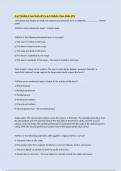
1.The plane that divides the body into anterior and posterior parts is called the __________. - frontal
plane

2.Which cavity contains the brain? - cranial cavity


3.Which of the following directional terms is accurate?

a) The heart is medial to the lungs.

b) The heart is inferior to the lungs.

c) The lungs are distal to the heart.

d) The heart is superficial to the lungs.

e) The heart is posterior to the lungs. - The heart is medial to the lungs


(hint: medial = closer to the midline. The heart is not inferior (below), posterior (behind), or
superficial (external) to the lungs as the lungs wrap mostly around the heart.)


4.Which serous membrane layer is closest to the surface of the heart?

a) Visceral pleura

b) Parietal peritoneum

c) Parietal pleura

d) Parietal pericardium

e) Visceral pericardium

f) Visceral peritoneum - Visceral pericardium


(explanation: The visceral pericardium covers the surface of the heart. The parietal pericardium lines
the pericardium wall. The parietal pleurae line the walls of the thoracic cavity, and the visceral
pleurae cover the lungs. The parietal peritoneum is associated with the walls of the abdominopelvic
cavity, while the visceral peritoneum covers most of the organs within that cavity.)


5.Which of the following statements with regards to regional terms is correct?

a) Calcaneal refers to the ankle.

b) The proper order from superior to inferior is cervical, cephalic, lumbar, and sacral.

c) The term digital can pertain to both the pedal and manus.

d) Tarsal refers to the heel. - The term digital can pertain to both the pedal and manus

$7.99
Get access to the full document:

100% satisfaction guarantee
Immediately available after payment
Both online and in PDF
No strings attached

Get to know the seller
Seller avatar
odhiambobroad65

Get to know the seller

Seller avatar
odhiambobroad65 City University New York
View profile
Follow You need to be logged in order to follow users or courses
Sold
0
Member since
1 year
Number of followers
0
Documents
15
Last sold
-

0.0

0 reviews

5
0
4
0
3
0
2
0
1
0

Recently viewed by you

Why students choose Stuvia

Created by fellow students, verified by reviews

Quality you can trust: written by students who passed their tests and reviewed by others who've used these notes.

Didn't get what you expected? Choose another document

No worries! You can instantly pick a different document that better fits what you're looking for.

Pay as you like, start learning right away

No subscription, no commitments. Pay the way you're used to via credit card and download your PDF document instantly.

Student with book image

“Bought, downloaded, and aced it. It really can be that simple.”

Alisha Student

Frequently asked questions

