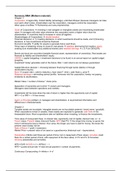
Summary BMA (Midterm material):
Chapter 1:
Corporation legal entity, limited liability (advantage), unlimited lifespan (because managers can take
over each other's jobs), shareholders own the corporation, managers control the corporation.
Other types of entities Partnership and sole proprietorship.
Goals of Corporations investing in real (tangible or intangible) assets and maximising shareholder
value managers will raise value whenever the corporation earns a higher return than the
shareholders incentives lead to increase in value all together.
Disadvantages of Corporations double-taxation.
Financial decisions 1) investing decisions what investments should be made, and 2) financing
decisions how investments should be financed.
Economic benefits ability for assets to generate future cash flows.
Three ways of obtaining money to invest in real assets liabilities (borrowing from banks), equity
(making sure shareholders buy additional shares) and retained earnings L E R (in DEALER).
Bonds and stock are securities (tradable financial asset, representation of ownership). Real assets are
financed by liability and shareholders' equity.
CAPEX = capital budgeting = investment decisions to be found in an annual report on capital budget
(projects).
Investment 'today' generates cash in the future. Risk = cash returns are not always guaranteed.
Capital Structure decision = choosing between financing through banks (debts) or through
stockholders (equity).
Bond coupon rate r, yield to maturity y, face value F, time t, cash flows c, price P.
Retained earnings = reinvesting earned profits / revenues into the corporation, hereby not paying
dividends to stockholders.
Market Value = number of shares * share price.
Separation of ownership and control owners and managers.
Managers stand between operations and markets.
Investments will be done when the rate of return is higher than the opportunity cost of capital.
NPV > 0 or IRR > r then invest.
Agent vs Principle problem managers and stockholders asymmetrical information and
differences in interests/needs.
Chapter 2:
Tangible assets are touchable, intangible assets are not touchable (patents / brand name / goodwill).
When corporations invest (in assets), these assets are expected to generate cash flows in the
foreseeable future. Most corporations take on liabilities when investing, to finance the investments.
Time value of money/cash flows interest rate, opportunity cost of capital, discount rate r
Future Value, Present Value, Discount Factor, NPV (Net PV) the longer time money is saved, the
more it will become due to interest. Vice versa, the longer you have to wait for money, the lower the
present value (today) will be.
Rate of Return = profit / investment.
Market Price = present value of an asset or a good/service (historical cost – depreciation).
Perpetuities (infinite cash flows per period of time, but no repayment of face value), Annuities (cash
flows for a certain period of time, with repayment of the face value) PV and FV of Annuities.
Growing perpetuities and annuities.
APR ≠ EAR EAR = (1 + APR/n)n – 1
APR = quoted annual rate total annual payment / number of payments.
Continuous Compounding infinite n ert
Chapter 1:
Corporation legal entity, limited liability (advantage), unlimited lifespan (because managers can take
over each other's jobs), shareholders own the corporation, managers control the corporation.
Other types of entities Partnership and sole proprietorship.
Goals of Corporations investing in real (tangible or intangible) assets and maximising shareholder
value managers will raise value whenever the corporation earns a higher return than the
shareholders incentives lead to increase in value all together.
Disadvantages of Corporations double-taxation.
Financial decisions 1) investing decisions what investments should be made, and 2) financing
decisions how investments should be financed.
Economic benefits ability for assets to generate future cash flows.
Three ways of obtaining money to invest in real assets liabilities (borrowing from banks), equity
(making sure shareholders buy additional shares) and retained earnings L E R (in DEALER).
Bonds and stock are securities (tradable financial asset, representation of ownership). Real assets are
financed by liability and shareholders' equity.
CAPEX = capital budgeting = investment decisions to be found in an annual report on capital budget
(projects).
Investment 'today' generates cash in the future. Risk = cash returns are not always guaranteed.
Capital Structure decision = choosing between financing through banks (debts) or through
stockholders (equity).
Bond coupon rate r, yield to maturity y, face value F, time t, cash flows c, price P.
Retained earnings = reinvesting earned profits / revenues into the corporation, hereby not paying
dividends to stockholders.
Market Value = number of shares * share price.
Separation of ownership and control owners and managers.
Managers stand between operations and markets.
Investments will be done when the rate of return is higher than the opportunity cost of capital.
NPV > 0 or IRR > r then invest.
Agent vs Principle problem managers and stockholders asymmetrical information and
differences in interests/needs.
Chapter 2:
Tangible assets are touchable, intangible assets are not touchable (patents / brand name / goodwill).
When corporations invest (in assets), these assets are expected to generate cash flows in the
foreseeable future. Most corporations take on liabilities when investing, to finance the investments.
Time value of money/cash flows interest rate, opportunity cost of capital, discount rate r
Future Value, Present Value, Discount Factor, NPV (Net PV) the longer time money is saved, the
more it will become due to interest. Vice versa, the longer you have to wait for money, the lower the
present value (today) will be.
Rate of Return = profit / investment.
Market Price = present value of an asset or a good/service (historical cost – depreciation).
Perpetuities (infinite cash flows per period of time, but no repayment of face value), Annuities (cash
flows for a certain period of time, with repayment of the face value) PV and FV of Annuities.
Growing perpetuities and annuities.
APR ≠ EAR EAR = (1 + APR/n)n – 1
APR = quoted annual rate total annual payment / number of payments.
Continuous Compounding infinite n ert