Summary – The January Effect – Thaler:
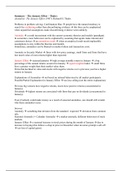
Anomalies: The January Effect (1987). Richard H. Thaler.
Problems in problem solving: Confirmation Bias people have the natural tendency to
search for confirming rather than disconfirming evidence this bias can be emphasised
when unjustified assumptions make disconfirming evidence seem unlikely.
Anomaly a result inconsistent with the current economic theories and models (paradigm).
In economics, most behaviour can be explained by assuming that agents make rational and
consistent choices an anomalous result when an empirical result needs implausible
assumptions to stay within the theories and models.
Sometimes, anomalies can be blamed on market failure and transaction costs.
Anomaly in Security Market firms with low-price earnings, small firms and firms that have
lost much value all earn returns higher than expected.
January Effect seasonal patterns high average monthly return in January a big
percentage of the annual returns occurred in January equal-weighted index small firms
have a greater weight than their market value share.
Firms that declined in value and stocks with negative returns over a previous year have higher
returns in January.
Explanations of Anomalies not based on rational behaviour by all market participants.
Possible/Partial Explanation for January Effect tax-loss selling (not the entire explanation).
Previous big winners have negative returns, losers have positive returns (concentrated in
January).
Dividends highest returns are associated with firms that pay no dividends (concentrated in
January).
Even if nobody could make money as a result of seasonal anomalies, one should still wonder
why these anomalies occur.
Internet:
Anomaly something that deviates from the standard / expected deviation from common
rule.
Seasonal Anomaly (= Calendar Anomaly) a market anomaly, different behaviour of stock
markets.
January Effect a seasonal increase in stock prices during the month of January due to
increase in buying (this follows a drop in price in December when investors prompt a sell-off
tax-loss of capital gains).
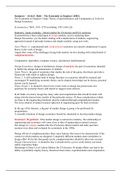
Anomalies: The January Effect (1987). Richard H. Thaler.
Problems in problem solving: Confirmation Bias people have the natural tendency to
search for confirming rather than disconfirming evidence this bias can be emphasised
when unjustified assumptions make disconfirming evidence seem unlikely.
Anomaly a result inconsistent with the current economic theories and models (paradigm).
In economics, most behaviour can be explained by assuming that agents make rational and
consistent choices an anomalous result when an empirical result needs implausible
assumptions to stay within the theories and models.
Sometimes, anomalies can be blamed on market failure and transaction costs.
Anomaly in Security Market firms with low-price earnings, small firms and firms that have
lost much value all earn returns higher than expected.
January Effect seasonal patterns high average monthly return in January a big
percentage of the annual returns occurred in January equal-weighted index small firms
have a greater weight than their market value share.
Firms that declined in value and stocks with negative returns over a previous year have higher
returns in January.
Explanations of Anomalies not based on rational behaviour by all market participants.
Possible/Partial Explanation for January Effect tax-loss selling (not the entire explanation).
Previous big winners have negative returns, losers have positive returns (concentrated in
January).
Dividends highest returns are associated with firms that pay no dividends (concentrated in
January).
Even if nobody could make money as a result of seasonal anomalies, one should still wonder
why these anomalies occur.
Internet:
Anomaly something that deviates from the standard / expected deviation from common
rule.
Seasonal Anomaly (= Calendar Anomaly) a market anomaly, different behaviour of stock
markets.
January Effect a seasonal increase in stock prices during the month of January due to
increase in buying (this follows a drop in price in December when investors prompt a sell-off
tax-loss of capital gains).