CHEM 162 Final
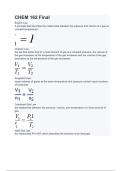
Boyle's Law
A principle that describes the relationship between the pressure and volume of a gas at
constant temperature
Charle's Law
the law that states that for a fixed amount of gas at a constant pressure, the volume of
the gas increases as the temperature of the gas increases and the volume of the gas
decreases as the temperature of the gas decreases
Avogadro's law
equal volumes of gases at the same temperature and pressure contain equal numbers
of molecules
Combined Gas Law
the relationship between the pressure, volume, and temperature of a fixed amount of
gas
Ideal Gas Law
the relationship PV=nRT, which describes the behavior of an ideal gas
,P1V1/n1T1=P2V2/n2T2
P2V2/n2T2
Density Gas Law
d=PM/RT
Dalton's Law
The total pressure of a mixture of gases is the sum of the individual pressures
(Ptotal=P1+P2+P3...)
Dalton"s Partial Pressure
pressure exerted by a single gas in a mixture
Root Mean Square Speed of Gasses
Urms=sqrt(3RT/MM)
,Graham's Law of Diffusion and Effusion
rate1/rate2 = sqrt(molar mass2/molar mass1)
heavier particles diffuse slower
Van der Waals equation
-Attempts to address when gases are not at ideal conditions (real gasses)
a: attractive/repulsive forces
b: actual volume of individual gas molecules
Units of Standard Atmospheric Pressure
The standard atmosphere is a unit of pressure defined as 101325 Pa. It is sometimes
used as a reference pressure or standard pressure. It is approximately equal to Earth's
average atmospheric pressure at sea level.
Main 3 assumptions of the Kinetic Molecular Theory of Gasses
?
heat capacity
the amount of heat needed to increase the temperature of an object exactly 1°C
, Calculating Enthalpy
equation can be used to calculate the heat required to perform a phase change of a
particular substance
Henry's Law
???? (In vocab but not equations) At a given temperature the solubility of a gas in a
liquid is directly proportional to the pressure of the gas above the liquid
Molarity
the number of moles of solute per liter of solution
Molality
moles of solute/kg of solvent
mole fraction
The ratio of the moles of solute in solution to the total number of moles of both solvent
and solute
Boyle's Law
A principle that describes the relationship between the pressure and volume of a gas at
constant temperature
Charle's Law
the law that states that for a fixed amount of gas at a constant pressure, the volume of
the gas increases as the temperature of the gas increases and the volume of the gas
decreases as the temperature of the gas decreases
Avogadro's law
equal volumes of gases at the same temperature and pressure contain equal numbers
of molecules
Combined Gas Law
the relationship between the pressure, volume, and temperature of a fixed amount of
gas
Ideal Gas Law
the relationship PV=nRT, which describes the behavior of an ideal gas
,P1V1/n1T1=P2V2/n2T2
P2V2/n2T2
Density Gas Law
d=PM/RT
Dalton's Law
The total pressure of a mixture of gases is the sum of the individual pressures
(Ptotal=P1+P2+P3...)
Dalton"s Partial Pressure
pressure exerted by a single gas in a mixture
Root Mean Square Speed of Gasses
Urms=sqrt(3RT/MM)
,Graham's Law of Diffusion and Effusion
rate1/rate2 = sqrt(molar mass2/molar mass1)
heavier particles diffuse slower
Van der Waals equation
-Attempts to address when gases are not at ideal conditions (real gasses)
a: attractive/repulsive forces
b: actual volume of individual gas molecules
Units of Standard Atmospheric Pressure
The standard atmosphere is a unit of pressure defined as 101325 Pa. It is sometimes
used as a reference pressure or standard pressure. It is approximately equal to Earth's
average atmospheric pressure at sea level.
Main 3 assumptions of the Kinetic Molecular Theory of Gasses
?
heat capacity
the amount of heat needed to increase the temperature of an object exactly 1°C
, Calculating Enthalpy
equation can be used to calculate the heat required to perform a phase change of a
particular substance
Henry's Law
???? (In vocab but not equations) At a given temperature the solubility of a gas in a
liquid is directly proportional to the pressure of the gas above the liquid
Molarity
the number of moles of solute per liter of solution
Molality
moles of solute/kg of solvent
mole fraction
The ratio of the moles of solute in solution to the total number of moles of both solvent
and solute