2/12/25, 7:13 PM PSY 102 Exam 2
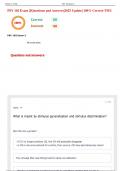
PSY 102 Exam 2|Questions and Answers|2025 Update| 100% Correct-TMU
Correct
Incorrect
PSY 102 Exam 2
59 correct terms
Questions and answers
,2/12/25, 7:13 PM PSY 102 Exam 2
- responses conditioned to particular stimuli often generalizes to similar stimuli
- we can eventually learn to discriminate between them and respond to them
differently
Don't know?
2 of 59
Definition
interpreting these sensations to form meaningful experiences, such as
recognizing a familiar object or sound.
Give this one a go later!
What is meant by the term "subliminal
What is perception?
perception"?
What is meant by stimulus
What is the difference between
generalization and stimulus
sensation and perception
discrimination?
Don't know?
3 of 59
Term
Why was this too radical?
Give this one a go later!
,2/12/25, 7:13 PM PSY 102 Exam 2
1. Novelty detection:
- It allows organisms to quickly notice and respond to new or unexpected stimuli in
their environment.
2. Survival advantage:
- Helps detect potential threats or opportunities, which is crucial for survival in
natural settings.
3. Attention allocation:
- Directs attention to potentially important information, allowing for more efficient
processing of relevant stimuli.
4. Adaptive learning:
- Facilitates learning about new aspects of the environment, which can be beneficial
for future encounters.
5. Cognitive efficiency:
- By automatically orienting to novel stimuli, it helps filter out irrelevant information
and focus on what might be important.
6. Preparedness:
- Primes the organism for potential action, whether it's to investigate further,
approach, or avoid the novel stimulus.
Learning that if you produce a certain behaviour, you will receive a certain outcome
- the outcome depends on your behaviour and so you changed it
- learn an association between own behaviour and an outcome, changing voluntary
behaviour
- learning about whether your behaviour will be rewarded or punished
- Skinner's radical behaviourism was too radical
- we know not all thoughts, feelings, and behaviours are likely to be purely the
result of our history of learning or conditioning
- there do seem to be many built-in genetics predispositions that play a role in
our phobias, personalities, etc
Don't know?
4 of 59
Term
How does the frequency and amplitude of a soundwave relate to the
, 2/12/25, 7:13 PM PSY 102 Exam 2
1. Significance of stimulus:
- Potentially important or dangerous stimuli are more likely to cause sensitization
- The organism's perception of the stimulus's relevance determines the response
2. Context:
- The environment and circumstances in which the stimulus occurs can influence
whether sensitization or habituation occurs
3. Intensity:
- Higher intensity stimuli are more likely to lead to sensitization
- Mild stimuli typically result in habituation
4. Adaptive value:
- Sensitization to potentially threatening stimuli has survival value
- It enhances vigilance and preparedness for important environmental cues
5. Individual differences:
- Genetic factors and past experiences can influence whether an organism
becomes sensitized or habituated to a stimulus
6. Neuroplasticity:
- Repeated exposure can strengthen neural pathways related to the stimulus,
leading to increased sensitivity
1. Initial fear acquisition:
- Classical conditioning: A neutral stimulus becomes associated with a fear-inducing
experience
2. Fear maintenance:
- Instrumental conditioning: Avoidance behaviours are negatively reinforced
3. Process:
- Classical conditioning creates the initial fear responseInstrumental conditioning
reinforces avoidance behaviours
4. Negative reinforcement:
- Avoiding the feared stimulus reduces anxiety
- This reinforces the avoidance behaviour
5. Self-perpetuating cycle:
- Avoidance prevents exposure to the feared stimulus
- Lack of exposure maintains the fear
6. Difficulty in extinction:
- The combination of these factors makes phobias resistant to extinction
1. Bottom-up processing:
- Retinal size: The actual size of the image projected onto the retina
2. Top-down processing:
- Perceived distance: The brain's estimate of how far away an object is, based on
depth cues and prior knowledge
- Size constancy: The brain's scaling of perceived size based on estimated distance
PSY 102 Exam 2|Questions and Answers|2025 Update| 100% Correct-TMU
Correct
Incorrect
PSY 102 Exam 2
59 correct terms
Questions and answers
,2/12/25, 7:13 PM PSY 102 Exam 2
- responses conditioned to particular stimuli often generalizes to similar stimuli
- we can eventually learn to discriminate between them and respond to them
differently
Don't know?
2 of 59
Definition
interpreting these sensations to form meaningful experiences, such as
recognizing a familiar object or sound.
Give this one a go later!
What is meant by the term "subliminal
What is perception?
perception"?
What is meant by stimulus
What is the difference between
generalization and stimulus
sensation and perception
discrimination?
Don't know?
3 of 59
Term
Why was this too radical?
Give this one a go later!
,2/12/25, 7:13 PM PSY 102 Exam 2
1. Novelty detection:
- It allows organisms to quickly notice and respond to new or unexpected stimuli in
their environment.
2. Survival advantage:
- Helps detect potential threats or opportunities, which is crucial for survival in
natural settings.
3. Attention allocation:
- Directs attention to potentially important information, allowing for more efficient
processing of relevant stimuli.
4. Adaptive learning:
- Facilitates learning about new aspects of the environment, which can be beneficial
for future encounters.
5. Cognitive efficiency:
- By automatically orienting to novel stimuli, it helps filter out irrelevant information
and focus on what might be important.
6. Preparedness:
- Primes the organism for potential action, whether it's to investigate further,
approach, or avoid the novel stimulus.
Learning that if you produce a certain behaviour, you will receive a certain outcome
- the outcome depends on your behaviour and so you changed it
- learn an association between own behaviour and an outcome, changing voluntary
behaviour
- learning about whether your behaviour will be rewarded or punished
- Skinner's radical behaviourism was too radical
- we know not all thoughts, feelings, and behaviours are likely to be purely the
result of our history of learning or conditioning
- there do seem to be many built-in genetics predispositions that play a role in
our phobias, personalities, etc
Don't know?
4 of 59
Term
How does the frequency and amplitude of a soundwave relate to the
, 2/12/25, 7:13 PM PSY 102 Exam 2
1. Significance of stimulus:
- Potentially important or dangerous stimuli are more likely to cause sensitization
- The organism's perception of the stimulus's relevance determines the response
2. Context:
- The environment and circumstances in which the stimulus occurs can influence
whether sensitization or habituation occurs
3. Intensity:
- Higher intensity stimuli are more likely to lead to sensitization
- Mild stimuli typically result in habituation
4. Adaptive value:
- Sensitization to potentially threatening stimuli has survival value
- It enhances vigilance and preparedness for important environmental cues
5. Individual differences:
- Genetic factors and past experiences can influence whether an organism
becomes sensitized or habituated to a stimulus
6. Neuroplasticity:
- Repeated exposure can strengthen neural pathways related to the stimulus,
leading to increased sensitivity
1. Initial fear acquisition:
- Classical conditioning: A neutral stimulus becomes associated with a fear-inducing
experience
2. Fear maintenance:
- Instrumental conditioning: Avoidance behaviours are negatively reinforced
3. Process:
- Classical conditioning creates the initial fear responseInstrumental conditioning
reinforces avoidance behaviours
4. Negative reinforcement:
- Avoiding the feared stimulus reduces anxiety
- This reinforces the avoidance behaviour
5. Self-perpetuating cycle:
- Avoidance prevents exposure to the feared stimulus
- Lack of exposure maintains the fear
6. Difficulty in extinction:
- The combination of these factors makes phobias resistant to extinction
1. Bottom-up processing:
- Retinal size: The actual size of the image projected onto the retina
2. Top-down processing:
- Perceived distance: The brain's estimate of how far away an object is, based on
depth cues and prior knowledge
- Size constancy: The brain's scaling of perceived size based on estimated distance