12/02/2025 13:55:08
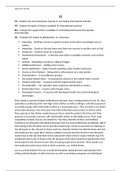
Soils Exam 2
Show how the Al3+ produces acid in soils.
H⁺ is released in the soil causing the soil to become acidic
Identify the two basic types of soil acidity in soils discussed in lab.
Active and Exchangeable
Which of the two types of acidity above generally accounts for the greater
proportion of total acidity?
exchangeable
What is a common material used to raise the pH of soils?
Calcium carbonate
The ions considered acidic in soils are H+ and
Al³⁺
Describe how soils are able to buffer/resist changes in pH.
calcium carbonate is added and carbonate consumes H⁺ which increases
bicarbonate ions in the solution which in creases pH. Calcium ions reaming
in the solution displace the H⁺ ion and decreases the pH again
Identify the 2 fundamental building blocks for aluminosilicate clays.
Silicon Tetrahedron Aluminum octahedron
Describe specifically one way that charge is generated on soil clays. Indicate
ions involved and location of change.
Silcon is replaced by magnesium to create a negative charge also called
isomophic subsitution
. Is the net charge on soil clays generally positive or negative?
Negative
Is it possible for clay minerals to possess no charge?
Yes
Show how the Al3+ produces acid in soils.
H⁺ is released in the soil causing the soil to become acidic
Identify one cation that would be effective at flocculating aluminosilicate clay
minerals. Is the cation a high or low charge density cation?
Ca²⁺
What are the units for expressing cation exchange capacity?
Cmolc/Kg
What cation did we use in lab to displace all the native cations on the soils
tested?
Soils Exam 2
Show how the Al3+ produces acid in soils.
H⁺ is released in the soil causing the soil to become acidic
Identify the two basic types of soil acidity in soils discussed in lab.
Active and Exchangeable
Which of the two types of acidity above generally accounts for the greater
proportion of total acidity?
exchangeable
What is a common material used to raise the pH of soils?
Calcium carbonate
The ions considered acidic in soils are H+ and
Al³⁺
Describe how soils are able to buffer/resist changes in pH.
calcium carbonate is added and carbonate consumes H⁺ which increases
bicarbonate ions in the solution which in creases pH. Calcium ions reaming
in the solution displace the H⁺ ion and decreases the pH again
Identify the 2 fundamental building blocks for aluminosilicate clays.
Silicon Tetrahedron Aluminum octahedron
Describe specifically one way that charge is generated on soil clays. Indicate
ions involved and location of change.
Silcon is replaced by magnesium to create a negative charge also called
isomophic subsitution
. Is the net charge on soil clays generally positive or negative?
Negative
Is it possible for clay minerals to possess no charge?
Yes
Show how the Al3+ produces acid in soils.
H⁺ is released in the soil causing the soil to become acidic
Identify one cation that would be effective at flocculating aluminosilicate clay
minerals. Is the cation a high or low charge density cation?
Ca²⁺
What are the units for expressing cation exchange capacity?
Cmolc/Kg
What cation did we use in lab to displace all the native cations on the soils
tested?