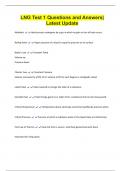
LNG Test 1 Questions and Answers|
Latest Update
Adiabatic ideal process undergone by a gas in which no gain or loss of heat occurs
Boiling Point Vapor pressure of a liquid is equal to pressure on its surface
Boyle's Law Constant Temp
Volume up
Pressure down
Charles' Law Constant Pressure
Volume increases by 1/273 of it's volume at 0C for each degree in centigrade raised
Latent Heat Heat required to change the state of a substance
Sensible Heat Heat Energy given to or taken from a substance that can be mesausered
Critical Temperature Temperature above which gas cannot be liquified by pressure alone
Critical Pressure Pressure at which a substance exists in the liquid state at critical temp
First Law of Thermo Heat lost from a source- total heat gained and work done
Important for reliq plants
, Second Law of Thermo Heat flows from hot to cold
Adiabatic Process NO heat is transferred in or out of system
Gas expands or compressed not time for heat exchange
Isoentropic Process No change in entropy
IGC Code Lastest Code
Built after 1986
Under SOLAS
Updated through 1994
Type 1G Maximum preventive measure to preclude the escape of such cargo
Chlorine, Ethylene Oxide
Type 2G Significant preventative measures
Ethane, Methane
2PG 2G, MAximum allowable relief valve setting of 7 bar gauge at -55C or above
Less than 150m
Type 3G Moderate Preventative Measures
Latest Update
Adiabatic ideal process undergone by a gas in which no gain or loss of heat occurs
Boiling Point Vapor pressure of a liquid is equal to pressure on its surface
Boyle's Law Constant Temp
Volume up
Pressure down
Charles' Law Constant Pressure
Volume increases by 1/273 of it's volume at 0C for each degree in centigrade raised
Latent Heat Heat required to change the state of a substance
Sensible Heat Heat Energy given to or taken from a substance that can be mesausered
Critical Temperature Temperature above which gas cannot be liquified by pressure alone
Critical Pressure Pressure at which a substance exists in the liquid state at critical temp
First Law of Thermo Heat lost from a source- total heat gained and work done
Important for reliq plants
, Second Law of Thermo Heat flows from hot to cold
Adiabatic Process NO heat is transferred in or out of system
Gas expands or compressed not time for heat exchange
Isoentropic Process No change in entropy
IGC Code Lastest Code
Built after 1986
Under SOLAS
Updated through 1994
Type 1G Maximum preventive measure to preclude the escape of such cargo
Chlorine, Ethylene Oxide
Type 2G Significant preventative measures
Ethane, Methane
2PG 2G, MAximum allowable relief valve setting of 7 bar gauge at -55C or above
Less than 150m
Type 3G Moderate Preventative Measures