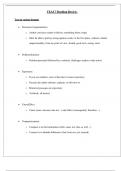
TEAS 7 Reading Review.
Text in various formats
• Persuasive/Argumentative
o Author convinces reader to believe something about a topic
o Must be able to portray strong opinion words: in the first place, without a doubt,
unquestionably, from my point of view, should, good, best, seeing, most
• Problem/Solution
o Problem presented followed by a solution, challenges reader to take action
• Expository
o If you see numbers, most of the time it means expository
o Factual, the author informs, explains, or tells how to
o Historical passages are expository
o Textbook, all factual
• Cause/Effect
o Cause (since, because, due too…) and effect (consequently, therefore…)
• Compare/contrast
o Compare is to find similarities (both, same, too, like, as well…)
o Contrast is to identify differences (but, however, yet, instead)
, • Procedure
o First, next, then, last, in closing…
• Descriptive
o Focuses on particular subject and attempts to depict subject to be clear to readers
• Narrative
o Personal story, passages with pronouns mostly likely narrative
o Fiction, dialogs, people talking, quotation marks, conversation
o Purpose is to entertain, inform, and challenge
• Technical
o Describes complex objects or process
• Denotation
o Nonfiction, literal meaning of word (dictionary def)
Interpret the meaning of words and phrases using context
Distinguish between connotation, denotation, and figurative language
• Denotation
o Nonfiction, literal meaning of word (dictionary def)
Text in various formats
• Persuasive/Argumentative
o Author convinces reader to believe something about a topic
o Must be able to portray strong opinion words: in the first place, without a doubt,
unquestionably, from my point of view, should, good, best, seeing, most
• Problem/Solution
o Problem presented followed by a solution, challenges reader to take action
• Expository
o If you see numbers, most of the time it means expository
o Factual, the author informs, explains, or tells how to
o Historical passages are expository
o Textbook, all factual
• Cause/Effect
o Cause (since, because, due too…) and effect (consequently, therefore…)
• Compare/contrast
o Compare is to find similarities (both, same, too, like, as well…)
o Contrast is to identify differences (but, however, yet, instead)
, • Procedure
o First, next, then, last, in closing…
• Descriptive
o Focuses on particular subject and attempts to depict subject to be clear to readers
• Narrative
o Personal story, passages with pronouns mostly likely narrative
o Fiction, dialogs, people talking, quotation marks, conversation
o Purpose is to entertain, inform, and challenge
• Technical
o Describes complex objects or process
• Denotation
o Nonfiction, literal meaning of word (dictionary def)
Interpret the meaning of words and phrases using context
Distinguish between connotation, denotation, and figurative language
• Denotation
o Nonfiction, literal meaning of word (dictionary def)